Conference highlights first results from the Large Hadron Collider
July 26, 2010
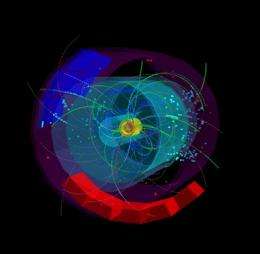
Particle tracks fly out from the heart of the ALICE experiment from one of the first collisions at a total energy of 7 TeV
First results from the LHC at CERN are being revealed at ICHEP, the world's largest international conference on particle physics, which has attracted more than 1000 participants to its venue in Paris. The spokespersons of the four major experiments at the Large Hadron Collider (LHC) - ALICE, ATLAS, CMS and LHCb - are today presenting measurements from the first three months of successful LHC operation at 3.5 TeV per beam, an energy three and a half times higher than previously achieved at a particle accelerator.
With these first measurements the experiments are rediscovering the particles that lie at the heart of the Standard Model - the package that contains current understanding of the particles of matter and the forces that act between them. This is an essential step before moving on to make discoveries. Among the billions of collisions already recorded are some that contain 'candidates' for the top quark, for the first time at a European laboratory.
"Rediscovering our 'old friends' in the particle world shows that the LHC experiments are well prepared to enter new territory" said CERN's Director-General Rolf Heuer. "It seems that the Standard Model is working as expected. Now it is down to nature to show us what is new."
The quality of the results presented at ICHEP bears witness both to the excellent performance of the LHC and to the high quality of the data in the experiments. The Large Hadron Collider, which is still in its early days, is making steady progress towards its ultimate operating conditions. The luminosity - a measure of the collision rate - has already risen by a factor of more than a thousand since the end of March. This rapid progress with commissioning the LHC beam has been matched by the speed with which the data on billions of collisions have been processed by the Worldwide LHC Computing Grid, which allows data from the experiments to be analysed at collaborating centres around the world.
"Within days we were finding Ws, and later Zs - the two carriers of the weak force discovered here at CERN nearly 30 years ago," said Fabiola Gianotti, spokesperson for the 3000-strong ATLAS collaboration. "Thanks to the efforts of the whole collaboration, in particular the young scientists, everything from data-taking at the detector, through calibration, data processing and distribution, to the physics analysis, has worked fast and efficiently."
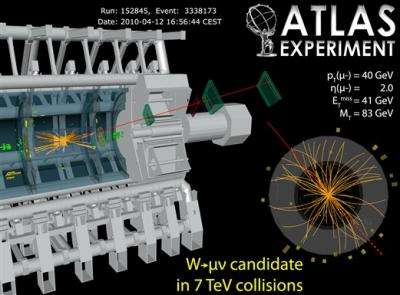
A candidate event at 7 TeV total collision energy with a W boson decaying in ATLAS to a muon (red track) and an invisible neutrino (dotted line).
"It is amazing to see how quickly we have 're-discovered' the known particles: from the lightest resonances up to the massive top quark. What we have shown here in Paris is just the first outcome of an intense campaign of accurate measurements of their properties." said Guido Tonelli, spokesperson for CMS. "This patient and systematic work is needed to establish the known background to any new signal.""The LHCb experiment is tailor-made to study the family of b particles, containing beauty quarks," said the experiment's spokesperson Andrei Golutvin, "So it's extremely gratifying that we are already finding hundreds of examples of these particles, clearly pin-pointed through the analysis of many particle tracks."
"The current running with proton collisions has allowed us to connect with results from other experiments at lower energies, test and improve the extrapolations made for the LHC, and prepare the ground for the heavy-ion runs," said Jurgen Schukraft, spokesperson for the ALICE collaboration. This experiment is optimized to study collisions of lead ions, which will occur in the LHC for the first time later this year.
Two further experiments have also already benefited from the first months of LHC operation at 3.5 TeV per beam. LHCf, which is studying the production of neutral particles in proton-proton collisions to help in understanding cosmic-ray interactions in the Earth's atmosphere, has already collected the data it needs at a beam energy of 3.5 TeV. TOTEM, which has to move close to the beams for its in-depth studies of the proton, is beginning to make its first measurements.
CERN will run the LHC for 18-24 months with the objective of delivering enough data to the experiments to make significant advances across a wide range of physics processes. With the amount of data expected, referred to as one inverse femtobarn, the experiments should be well placed to make inroads in to new territory, with the possibility of significant discoveries.
More information: http://www.ichep2010.fr/
Provided by CERN
-
First atoms reported smashed in Large Hadron Collider (Update)
Nov 23, 2009 |
not rated yet |
0
-
Large Hadron Collider 7 TeV experiment on March 30
Mar 23, 2010 |
not rated yet |
0
-
Large Hadron Collider produces first physics results
Dec 15, 2009 |
not rated yet |
0
-
First physics from the Large Hadron Collider's CMS detector
Feb 17, 2010 |
not rated yet |
0
-
Large Hadron Collider sets new power world record
Nov 30, 2009 |
not rated yet |
0
-
Engineers build first sub-10-nm carbon nanotube transistor
Feb 01, 2012 |
4.9 / 5 (31) |
30
-
Something old, something new: Evolution and the structural divergence of duplicate genes
Jan 31, 2012 |
4.6 / 5 (7) |
1
-
The hidden nanoworld of ice crystals: Revealing the dynamic behavior of quasi-liquid layers
Jan 30, 2012 |
5 / 5 (3) |
1
-
Stock market network reveals investor clustering
Jan 27, 2012 |
3.9 / 5 (23) |
8
-
Of microchemistry and molecules: Electronic microfluidic device synthesizes biocompatible probes
Jan 26, 2012 |
5 / 5 (1) |
0
-
Simple Torque from Gravity Problem
2 hours ago
-
Books To Inspire a Beginnig Physics Student
4 hours ago
-
Pith balls problem
4 hours ago
-
Electrostatics
4 hours ago
-
what is phase constant
4 hours ago
-
Basics In electromagnetic wave
4 hours ago
- More from Physics Forums - General Physics
More news stories
Putting the squeeze on planets outside our solar system
(PhysOrg.com) -- Using high-powered lasers, scientists at Lawrence Livermore National Laboratory and collaborators discovered that molten magnesium silicate undergoes a phase change in the liquid state, abruptly ...
15 hours ago |
4.3 / 5 (7) |
0
|
Hovering not hard if you're top-heavy, researchers find
Top-heavy structures are more likely to maintain their balance while hovering in the air than are those that bear a lower center of gravity, researchers at New York University's Courant Institute of Mathematical Sciences ...
16 hours ago |
5 / 5 (2) |
1
|
SLAC, Stanford team focuses on high-energy electrons to treat cancer
Accelerator physicists at SLAC and cancer specialists from Stanford are working on a new technology that could dramatically reduce the time needed for cancer radiation treatments. The team ran an initial experiment ...
19 hours ago |
5 / 5 (2) |
0
Measurements from high-energy collisions lead to better understanding of why meson particles disappear
For several years, physicists at the Relativistic Heavy Ion Collider (RHIC) at Brookhaven National Laboratory (BNL), USA, have studied an unusual state of matter called the quarkgluon plasma, which they ...
20 hours ago |
4.5 / 5 (4) |
0
Explained: Sigma
It's a question that arises with virtually every major new finding in science or medicine: What makes a result reliable enough to be taken seriously? The answer has to do with statistical significance -- but ...
Feb 09, 2012 |
5 / 5 (16) |
53
Anonymous knocks CIA website offline (Update)
The website of the Central Intelligence Agency was inaccessible on Friday after the hacker group Anonymous claimed to have knocked it offline.
New error-correcting codes guarantee the fastest possible rate of data transmission
Error-correcting codes are one of the triumphs of the digital age. Theyre a way of encoding information so that it can be transmitted across a communication channel such as an optical fiber o ...
Humans may have helped the decline of African rainforests 3000 years ago
(PhysOrg.com) -- Large areas of rainforests in Central Africa mysteriously disappeared over three thousand years ago, to be replaced by savannas. The prevailing theory has been that the cause was a change ...
Small modular reactor design could be a 'SUPERSTAR'
(PhysOrg.com) -- Though most of today's nuclear reactors are cooled by water, we've long known that there are alternatives; in fact, the world's first nuclear-powered electricity in 1951 came from a reactor ...
New power source discovered
(PhysOrg.com) -- Researchers at the Massachusetts Institute of Technology (MIT) and RMIT University have made a breakthrough in energy storage and power generation.
The power of estrogen -- male snakes attract other males
A new study has shown that boosting the estrogen levels of male garter snakes causes them to secrete the same pheromones that females use to attract suitors, and turned the males into just about the sexiest ...

Jul 26, 2010
Rank: 1 / 5 (9)
Jul 26, 2010
Rank: not rated yet
Jul 26, 2010
Rank: 5 / 5 (27)
Jul 27, 2010
Rank: not rated yet
But, It took Fermilab over a decade to achieve 1 fb-1, for what ever that is worth.