Now that's what I call a rat
July 26, 2010
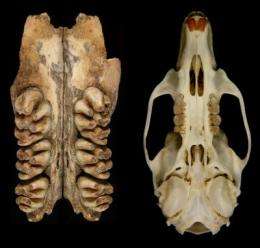
Upper toothrows of Timor's extinct giant rat (left), the biggest rat that ever lived, compared with the skull of a black rat (right). The black rat (Rattus rattus) is one of the world's most common rat species. It is also known as the house, roof or ship rat and is found throughout Africa, Asia, Australia, Europe and the Americas. A typical adult weighs about 150 grams. The skull of the black rat shown here is 35 mm long. Credit: Ken Aplin, CSIRO
Archaeological research in East Timor has unearthed the bones of the biggest rat that ever lived, with a body weight around 6 kg. The cave excavations also yielded a total of 13 species of rodents, 11 of which are new to science. Eight of the rats weighed a kilogram or more.
"East Indonesia is a hot spot for rodent evolution. We want international attention on conservation in the area," CSIRO's Dr Ken Aplin says.
"Rodents make up 40 per cent of mammalian diversity worldwide and are a key element of ecosystems, important for processes like soil maintenance and seed dispersal. Maintaining biodiversity among rats is just as important as protecting whales or birds."
Carbon dating shows that the biggest rat that ever lived survived until around 1000 to 2000 years ago, along with most of the other Timorese rodents found during the excavation. Only one of the smaller species found is known to survive on Timor today.
"People have lived on the island of Timor for over 40,000 years and hunted and ate rats throughout this period, yet extinctions did not occur until quite recently," Dr Aplin says.
"We think this shows people used to live sustainably on Timor until around 1000 to 2000 years ago. This means extinctions aren't inevitable when people arrive on an island. Large scale clearing of forest for agriculture probably caused the extinctions, and this may have only been possible following the introduction of metal tools."
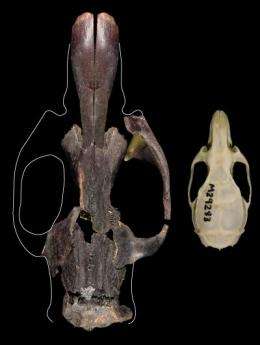
The skull of a black rat (right) compared with a fairly complete skull of one of Timor's other extinct giant rats (left). The giant rat shown here isn't the biggest of the extinct rats, which was around 25 per cent bigger again. The black rat (Rattus rattus) is one of the world's most common rat species. It is also known as the house, roof or ship rat and is found throughout Africa, Asia, Australia, Europe and the Americas. A typical adult weighs about 150 grams. The skull of the black rat shown here is 35 mm long. Credit: Ken Aplin, CSIRO
Each of the islands of eastern Indonesia evolved it own unique collection of rats. Dr Aplin has also found six new rat species in a cave on the island of Flores. Some of these might still be living on Flores but they have evaded detection by modern collectors and further surveys are urgently needed.Timor has few native mammals, with bats and rodents making up the majority of species. Most of Timor today is arid, transformed from the lush rainforests of the past. But there is still room for imagination.
"Although less than 15 per cent of Timor's original forest cover remains, parts of the island are still heavily forested, so who knows what might be out there?" Dr Aplin says.
"During a recent field trip in East Timor, I found the remains of a freshly dead rat which we knew about only from cave deposits."
This video is not supported by your browser at this time.
Podcast: Archaeological research in East Timor has unearthed the bones of the biggest rat that ever lived, with a body weight around 6 kg.
Until Dr Aplin finds a larger one, today's biggest rats weigh around 2kg and live in rainforest in the Philippines and New Guinea.'Quaternary murid rodents of Timor' by Ken Aplin of CSIRO and Kris Helgen of the Smithsonian Institution was published this week in the Bulletin of the American Museum of Natural History.
Provided by CSIRO
-
Globetrotting black rat genes reveal spread of humans and diseases
Feb 01, 2008 |
not rated yet |
0
-
Rediscovering the dragon's paradise lost
Sep 30, 2009 |
not rated yet |
0
-
Smelling a rat to catch a rat
Mar 24, 2008 |
not rated yet |
0
-
Bush rats fight back
Nov 10, 2009 |
not rated yet |
0
-
Scientists find city rats are loyal to their 'hoods'
May 26, 2009 |
not rated yet |
0
-
Engineers build first sub-10-nm carbon nanotube transistor
Feb 01, 2012 |
4.9 / 5 (31) |
30
-
Something old, something new: Evolution and the structural divergence of duplicate genes
Jan 31, 2012 |
4.6 / 5 (7) |
1
-
The hidden nanoworld of ice crystals: Revealing the dynamic behavior of quasi-liquid layers
Jan 30, 2012 |
5 / 5 (3) |
1
-
Stock market network reveals investor clustering
Jan 27, 2012 |
3.9 / 5 (23) |
8
-
Of microchemistry and molecules: Electronic microfluidic device synthesizes biocompatible probes
Jan 26, 2012 |
5 / 5 (1) |
0
-
Mitosis
7 hours ago
-
Stem cell question.
8 hours ago
-
Protease cleavage
14 hours ago
-
Pertubance in a model
21 hours ago
-
Cancer drugs and Alzheimer's, Oh my!
Feb 09, 2012
-
Squishing cells
Feb 09, 2012
- More from Physics Forums - Biology
More news stories
A frank discussion of the power law and linking correlation to causation
(PhysOrg.com) -- Michael Stumpf a mathematics professor at Imperial College in London, and Mason Porter a lecturer at Oxford have teamed together to write and publish a perspective piece in Science regarding the in ...
Employers feel no love for unscrupulous practice of 'service sweethearting'
A new study led by two Florida State University marketing professors finds that some frontline service employees who are rewarded for hikes in customer loyalty and satisfaction also may engage in "service ...
Other Sciences / Economics & Business
15 hours ago |
4 / 5 (1) |
7
The question of life in the ancient world
Theres a general feeling that we dont get the Greeks ancient or modern. Many, including heads of state like Angela Merkel, visibly shake their head in exasperation, rightly or wrongly, at ...
Other Sciences / Archaeology & Fossils
20 hours ago |
1.3 / 5 (3) |
4
Sonic Cradle lands spot in TED exhibition
A Simon Fraser University graduate student project that melds music, meditation and modern technology has landed a rare spot as an exhibit at TEDActive 2012 in Palm Springs, California this month.
17 hours ago |
not rated yet |
0
Do we no longer care about the collective good?
The Transformation of Solidarity, a book co-edited by University of Queensland sociologist Dr Mara Yerkes, tackles the subject of globalisation of national economies and societies where we put a high value ...
Other Sciences / Social Sciences
Feb 06, 2012 |
3.9 / 5 (8) |
39
Anonymous knocks CIA website offline (Update)
The website of the Central Intelligence Agency was inaccessible on Friday after the hacker group Anonymous claimed to have knocked it offline.
New error-correcting codes guarantee the fastest possible rate of data transmission
Error-correcting codes are one of the triumphs of the digital age. Theyre a way of encoding information so that it can be transmitted across a communication channel such as an optical fiber o ...
Humans may have helped the decline of African rainforests 3000 years ago
(PhysOrg.com) -- Large areas of rainforests in Central Africa mysteriously disappeared over three thousand years ago, to be replaced by savannas. The prevailing theory has been that the cause was a change ...
Small modular reactor design could be a 'SUPERSTAR'
(PhysOrg.com) -- Though most of today's nuclear reactors are cooled by water, we've long known that there are alternatives; in fact, the world's first nuclear-powered electricity in 1951 came from a reactor ...
New power source discovered
(PhysOrg.com) -- Researchers at the Massachusetts Institute of Technology (MIT) and RMIT University have made a breakthrough in energy storage and power generation.
The power of estrogen -- male snakes attract other males
A new study has shown that boosting the estrogen levels of male garter snakes causes them to secrete the same pheromones that females use to attract suitors, and turned the males into just about the sexiest ...

Jul 26, 2010
Rank: not rated yet
Jul 26, 2010
Rank: 1 / 5 (4)
http://news.bbc.c...0394.stm