First step toward electronic DNA sequencing: Translocation through graphene nanopores
July 26, 2010
First step toward electronic DNA sequencing: Translocation through graphene nanopores

Enlarge

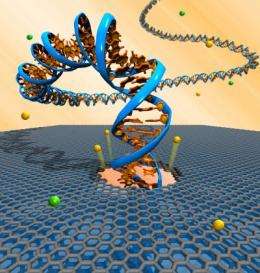
University of Pennsylvania researchers developed a carbon-based, nanoscale platform to electrically detect single DNA molecules. Electric fields push tiny DNA strands through atomically-thin graphene nanopores that ultimately may sequence DNA bases by their unique electrical signature. Credit: Photo: Robert Johnson, Temple University

Researchers at the University of Pennsylvania have developed a new, carbon-based nanoscale platform to electrically detect single DNA molecules.

Using electric fields, the tiny DNA strands are pushed through nanoscale-sized, atomically thin pores in a graphene nanopore platform that ultimately may be important for fast electronic sequencing of the four chemical bases of DNA based on their unique electrical signature.

The pores, burned into graphene membranes using electron beam technology, provide Penn physicists with electronic measurements of the translocation of DNA.

The article, submitted on March 25, is published in the current issue of .

"We were motivated to exploit the unique properties of graphene — a two-dimensional sheet of — in order to develop a new nanopore electrical platform that could exhibit high resolution," said Marija Drndić, associate professor in the Department of Physics and Astronomy in Penn's School of Arts and Sciences and the paper's senior author. "High resolution of graphene nanopore devices is expected because the thickness of the graphene sheet is smaller than the distance between two DNA bases. Graphene has previously been used for other electrical and mechanical devices, but up until now it has not been used for DNA translocation."

The research team had made graphene nanopores in a study completed two years ago and in this study put the pores to work.

To conduct the experiments, Drndić and postdoctoral fellow Christopher A. Merchant, together with Ken Healy, Meni Wanunu, Vishva Ray and other members from the Drndić lab made use of large-area graphene material developed by postdoctoral fellow Zhengtang Luo and Professor A.T. Charlie Johnson, both physicists at Penn. The team used a chemical vapor deposition, or CVD, method to grow large flakes of graphene and suspend them over a single micron-sized hole made in silicon nitride. An even smaller hole, the nanopore in the very center of the suspended graphene, was then drilled with an electron beam of a transmission electron microscope, or TEM.

Solid-state nanopores are proving to be invaluable tools for probing biology at the single-molecule level.

Graphene nanopore devices developed by the Penn team work in a simple manner. The pore divides two chambers of electrolyte solution and researchers apply voltage, which drives ions through the pores. Ion transport is measured as a current flowing from the voltage source. DNA molecules, inserted into the electrolyte, can be driven single file through such nanopores.

As the molecules translocate, they block the flow of ions and are detected as a drop in the measured current. Because the four DNA bases block the current differently, graphene nanopores with sub-nanometer thickness may provide a way to distinguish among bases, realizing a low-cost, high-throughput DNA sequencing technique.

In addition, to increase the robustness of graphene nanopore devices, Penn researchers also deposited an ultrathin layer, only a few atomic layers thick, of titanium oxide on the membrane which further generated a cleaner, more easily wettable surface that allows the DNA to go through it more easily. Although graphene-only nanopores can be used for translocating DNA, coating the graphene membranes with a layer of oxide consistently reduced the noise level and at the same time improved the robustness of the device.

Because of the ultrathin nature of the graphene pores, researchers were able to detect an increase in the magnitude of the translocation signals relative to previous solid state nanopores made in silicon nitride, for similar applied voltages.

The Penn team is now working on improving the overall reliability of these devices and on utilizing the conductivity of the graphene sheet to create devices with transverse electrical control over DNA transport. Specifically, this transverse electrical control may be achievable by carving graphene into nanoelectrodes and utilizing its conducting nature. Towards this goal, Michael Fischbein and Drndic have previously demonstrated nanosculpting of graphene into arbitrary structures, such as nanoribbons, nanopores and other shapes, published in Applied Physics Letters in 2008, creating a firm foundation for future research.

Provided by University of Pennsylvania (news : web)

4.4 /5 (18 votes)  

Filter


Move the slider to adjust rank threshold, so that you can hide some of the comments.


Display comments: newest first

nanotech_republika_pl
Jul 26, 2010

Rank: not rated yet
Neat. And you can stack these sheets and maybe get even more precise reading by combining input from each sheet?
Rank 4.4 /5 (18 votes)
Related Stories
Relevant PhysicsForums posts
  • polymer nanocomposites
    created5 hours ago
  • Corrosion Tests on Magnesium
    created18 hours ago
  • polyethylene copper nanocomposite
    createdFeb 09, 2012
  • Output of xrd analysis
    createdFeb 08, 2012
  • Transport phenomena problem based on problems 18.B11 and 19B.6 from Bird, stewart, lw
    createdFeb 06, 2012
  • Help with material selection - Car Piston
    createdFeb 05, 2012
  • More from Physics Forums - Materials & Chemical Engineering

More news stories

'Dark plasmons' transmit energy

Microscopic channels of gold nanoparticles have the ability to transmit electromagnetic energy that starts as light and propagates via "dark plasmons," according to researchers at Rice University.

Nanotechnology / Nanophysics

created 14 hours ago | popularity 5 / 5 (5) | comments 0 | with audio podcast

Nanotube therapy takes aim at breast cancer stem cells

Wake Forest Baptist Medical Center researchers have again proven that injecting multiwalled carbon nanotubes (MWCNTs) into tumors and heating them with a quick, 30-second laser treatment can kill them.

Nanotechnology / Bio & Medicine

created 19 hours ago | popularity 5 / 5 (1) | comments 0 | with audio podcast

New kind of solar cell could capture significantly more energy than current cells

New solar cells could increase the maximum efficiency of solar panels by over 25%, according to scientists from the University of Cambridge.

Nanotechnology / Nanophysics

created Feb 08, 2012 | popularity 4.5 / 5 (11) | comments 14 | with audio podcast

New technology platform for molecule-based electronics

Researchers at the Nano-Science Center at the University of Copenhagen have developed a new nano-technology platform for the development of molecule-based electronic components using the wonder material graphene. At the same ...

Nanotechnology / Nanomaterials

created 21 hours ago | popularity 5 / 5 (2) | comments 0

Nanoshell whispering galleries improve thin solar panels

Visitors to Statuary Hall in the U.S. Capitol Building may have experienced a curious acoustic feature that allows a person to whisper softly at one side of the cavernous, half-domed room and for another on ...

Nanotechnology / Nanomaterials

created Feb 07, 2012 | popularity 4.3 / 5 (6) | comments 6 | with audio podcast


New error-correcting codes guarantee the fastest possible rate of data transmission

Error-correcting codes are one of the triumphs of the digital age. They’re a way of encoding information so that it can be transmitted across a communication channel — such as an optical fiber o ...

High school students test best with 7 hours' rest

(Medical Xpress) -- Whether or not you know any high school students that actually get nine hours of sleep each night, that’s what federal guidelines currently prescribe.

Soccer -- the link between managers and captains

Soccer managers regard their captains as an extension of themselves, according to new research from Northumbria University, which could explain why Fabio Capello quit as England manager following the FA row ...

Using economic evaluations for drug reimbursement decisions - what have we achieved?

Researchers at the University of York perform evaluations of the clinical and cost-effectiveness of drugs for the National Institute for Health and Clinical Excellence (NICE).

Increasing healthy food options makes economic sense

If there is an obvious truth one can learn from perusing the various dining options on Lehigh’s sprawling Asa Packer campus—from the University Center and Rathbone Hall to the sorority and fraternity houses on “the ...

Humans may have helped the decline of African rainforests 3000 years ago

(PhysOrg.com) -- Large areas of rainforests in Central Africa mysteriously disappeared over three thousand years ago, to be replaced by savannas. The prevailing theory has been that the cause was a change ...