Mars Curiosity Takes First Baby Steps (w/ Video)
July 26, 2010
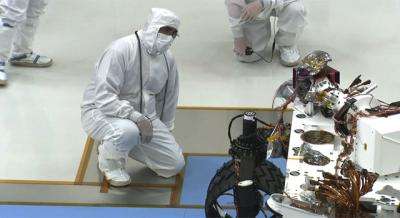
Mars Curiosity team members gather in the clean room at NASA's Jet Propulsion Laboratory to watch the rover roll for the first time. Image credit: NASA/JPL-Caltech
(PhysOrg.com) -- Like proud parents, mission team members gathered in a gallery above a clean room at NASA's Jet Propulsion Laboratory to watch the Mars Curiosity rover roll for the first time.
Engineers and technicians wore "bunny suits" while guiding Curiosity through its first steps, or more precisely, its first roll on the clean room floor. The rover moved forward and backward about 1 meter (3.3 feet).
This video is not supported by your browser at this time.
Mars Science Laboratory (aka Curiosity) is scheduled to launch in fall 2011 and land on the Red Planet in August 2012.Curiosity is the largest rover ever sent to Mars. It will carry 10 instruments that will help search an intriguing region of the Red Planet for two things:
1. Environments where life might have existed
2. The capacity of those environments to preserve evidence of past life
More information: Learn more about Curiosity at http://mars.jpl.nasa.gov/msl/
-
Curiosity Mars Rover Spins Its Wheels (w/ Video)
Jul 13, 2010 |
not rated yet |
0
-
Next Mars Rover Sports a Set of New Wheels
Jul 01, 2010 |
not rated yet |
0
-
Cameron helping build 3-D camera for Mars rover
Apr 29, 2010 |
not rated yet |
0
-
Helicopter Helps Test Radar for 2012 Mars Landing
Apr 13, 2010 |
not rated yet |
0
-
NASA Dryden Hosts Radar Tests for Next Mars Landing
Jun 14, 2010 |
not rated yet |
0
-
Stars containing dark matter should look different from other stars
Feb 20, 2012 |
4.5 / 5 (17) |
11
-
Physicists discover evidence of rare hypernucleus, a component of strange matter
Feb 17, 2012 |
4.7 / 5 (38) |
22
-
Fast photon control brings quantum photonic technologies closer
Feb 13, 2012 |
5 / 5 (8) |
1
-
Engineers build first sub-10-nm carbon nanotube transistor
Feb 01, 2012 |
4.9 / 5 (36) |
32
-
Something old, something new: Evolution and the structural divergence of duplicate genes
Jan 31, 2012 |
4.6 / 5 (7) |
1
-
What is this spectrum I took?
9 hours ago
-
Orientation of Space
9 hours ago
-
Geologically Active Moon Now: NASA
16 hours ago
-
advice on building a science fair telescope
22 hours ago
-
Rise of the Sun
22 hours ago
-
Uncertainty of planetary orbital period
Feb 19, 2012
- More from Physics Forums - General Astronomy
More news stories
Spitzer finds solid buckyballs in space
(PhysOrg.com) -- Astronomers using data from NASA's Spitzer Space Telescope have, for the first time, discovered buckyballs in a solid form in space. Prior to this discovery, the microscopic carbon spheres ...
11 hours ago |
4.7 / 5 (12) |
6
|
Going up: Japan builder eyes space elevator
A Japanese construction firm claimed Wednesday it could execute an out-of-this-world plan to put tourists in space within 40 years by building an elevator that stretches a quarter of the way to the moon.
Space & Earth / Space Exploration
18 hours ago |
3.5 / 5 (13) |
24
ENASA satellite finds Earth's clouds are getting lower
(PhysOrg.com) -- Earth's clouds got a little lower -- about one percent on average -- during the first decade of this century, finds a new NASA-funded university study based on NASA satellite data. The results ...
Space & Earth / Earth Sciences
15 hours ago |
5 / 5 (8) |
9
|
Fresh scandal embroils US climate science debate
A fresh scandal over climate change has erupted in the United States after leaked documents appeared to show a right-wing funded campaign to influence how climate science is taught in schools.
7 hours ago |
4.4 / 5 (7) |
6
World's oceans get an acid bath
Among the repercussions of global climate change, the effect of ocean acidification on marine life is one of the least-understood variables.
14 hours ago |
4.3 / 5 (6) |
4
|
Researchers build first physical 'metatronic' circuit
(PhysOrg.com) -- The technological world of the 21st century owes a tremendous amount to advances in electrical engineering, specifically, the ability to finely control the flow of electrical charges using ...
Faster than light neutrinos? More like faulty wiring
You can shelf your designs for a warp drive engine (for now) and put the DeLorean back in the garage; it turns out neutrinos may not have broken any cosmic speed limits after all.
Physicists surprised by disappearing and reappearing superconductivity in iron selenium chalcogenides
Superconductivity is a rare physical state in which matter is able to conduct electricity -- maintain a flow of electrons -- without any resistance. This phenomenon can only be found in certain materials at low temperatures, ...
Scientists create potent molecules aimed at treating muscular dystrophy
While RNA is an appealing drug target, small molecules that can actually affect its function have rarely been found. But now scientists from the Florida campus of The Scripps Research Institute have for the first time designed ...
Stanford research team cracks animated NuCaptcha
(PhysOrg.com) -- The research team from Stanford University, led by Elie Bursztein, that previously had cracked regular CAPTCHAs and then audio CAPTCHAs, now has also successfully cracked the animated version called NuCapt ...
Less is more: Study of tiny droplets could have big impact on industrial applications
(PhysOrg.com) -- Under a microscope, a tiny droplet slides between two fine hairs like a roller coaster on a set of rails until poof it suddenly spreads along them, a droplet no more.