Without oxygen, 'nothing goes' -- Marine biologists get to the bottom of dead zones
The behaviour of marine bottom dwellers can now, for the first time, be used to predict the development of so-called dead zones in the sea. Animals fight for what little oxygen there is in these zones - but the battle is often in vain: such oxygen crises, now increasingly common, usually end in mass mortalities.
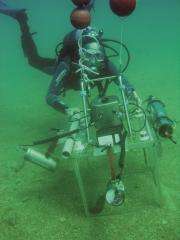
A team of researchers has managed to record the behaviour of organisms in the face of declining oxygen levels. They simulated dead zones on the Adriatic Sea bed with an underwater device they developed themselves. Funded by the Austrian Science Fund FWF, a catalogue of animal behavioural models will be published this August, which can be used to classify the state of such threatened marine environments.
It is no secret that our seas are endangered. What is far less well-known is that a perilous lack of oxygen in our oceans is causing mass mortalities on the sea bed at an ever-increasing rate. Moreover, there has been a recent increase in the prevalence of so-called dead zones - places where there is not enough oxygen in the water. This phenomenon is promoted by polluted rivers and global warming. A total of 400 dead zones have already been recorded across the globe and they cover an area in excess of 250,000 square kilometres - the size of Germany. What exactly happens in such zones has been poorly explored to date. Now, however, scientists from Vienna are the first to have successfully simulated oxygen crises in the sea on a tiny scale. Their project will help detect such situations at an early stage, enabling countermeasures to be taken. The key lies in the threatened animals themselves - in their behaviour.
Behaviour is the yardstick
When the oxygen content in the water drops, marine organisms modify their behaviour. This knowledge forms the basis for the project conducted by a team of researchers at the University of Vienna, as Dr. Michael Stachowitsch from the Department of Marine Biology explains: "We are studying precisely what happens at the bottom of the Adriatic Sea when oxygen levels drop - before, during and after they fall. We observe exactly how the various species react to the lack of oxygen: some try to escape and make their way up to higher water strata, while others curtail their activity or display entirely unnatural behaviour. The goal of our project has been to compile a catalogue to describe these types of behaviour in detail and to match them to specific oxygen concentrations in the water." The catalogue of behaviours will enable experts to determine the status of the water without the need for costly and time-consuming measurements. Dr. Stachowitsch is working together with Dr. Bettina Riedel and Prof. Martin Zuschin to compile the catalogue, the first part of which will be published in August.
In their project, the Vienna-based scientists are following the tradition of the highly-respected "Vienna School of Marine Biology". This approach means is that the research is not performed solely on the computer or in the lab, as is common practice. The work is conducted "in situ", in other words at the site of the action. In the current project, this is 24 metres below sea level at the bottom of the Adriatic, two kilometres off the coast of Piran, Slovenia. However, in order not to miss the poorly predictable oxygen deficiencies, the research team simulates their own little dead zone, which required developing and building an underwater apparatus.
Oxygen crisis under Plexiglas
The EAGU (Experimental Anoxia Generating Unit), developed by the team, is a Plexiglas chamber equipped with high-tech apparatus to supply crucial data, as Dr. Riedel explains: "First, we move a 50 x 50 x 50 centimetre open frame into position. This allows us to observe the events at normal oxygen concentrations for a period of 24 hours. Then we close the cube. Within a few days the entire oxygen inside the EAGU is used up. As the oxygen level declines, the behaviour of the mussels, sponges, snails, brittle stars, anemones and sea squirts enclosed in the cube changes too. A time-lapse camera takes images at six-minute intervals and sensors measure the concentration of oxygen and hydrogen sulphide in the water, along with the pH value and the temperature." The scientists are thereby able to ascribe the behaviour of the animals as recorded in the images to the individual oxygen categories.
The resulting catalogue of behaviours, which is being supported by the Austrian Science Fund FWF, can serve as a guide for the early recognition of dead zones. As such, it could also help to ensure that the correct political action is taken without delay in the event of an emergency - for instance, a ban on fishing in the affected area to give the ecosystem a chance to regenerate.
Provided by Austrian Science Fund


