Biologists find that red-blooded vertebrates evolved twice, independently
July 27, 2010
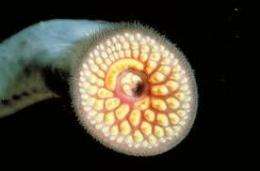
Sea lamprey.
(PhysOrg.com) -- Nature, in all its glory, is nothing if not thrifty.
Through the process of natural selection, it finds new uses for existing features, often resulting in what is known as convergent evolution -- the development of similar biological traits in different orders of animals, such as powered flight in birds and bats.
Now, research by University of Nebraska-Lincoln biologists has found convergent evolution of a key physiological innovation that traces back through the two deepest branches of the vertebrate family tree.
A team led by Jay Storz (prounounced storts), assistant professor of biological sciences, analyzed the complete genome sequences of multiple vertebrate species and found that jawless fishes (e.g., lampreys and hagfish) and jawed vertebrates (pretty much everything else, including humans) independently invented different mechanisms of blood-oxygen transport to sustain aerobic metabolism.
Specifically, comparative analysis of their gene repertoires revealed that the ancestors of jawed and jawless vertebrates co-opted completely different precursor proteins to serve as oxygen-transport hemoglobins, the respiratory proteins that give blood its red color. The jawed and jawless vertebrates separated about 500 million years ago, late in the Cambrian Period and about 30 million years after the first vertebrate precursors (the chordates) show up in the fossil record.
"What we've discovered is that similar physiological problems called forth similar solutions in different branches of the vertebrate family tree," Storz said. "For example, jawed vertebrates invented one type of hemoglobin as an oxygen transport protein, whereas the other main vertebrate lineage, the jawless fishes, represented today by lampreys and hagfish, came up with their own independent solution for the same physiological problem."
This video is not supported by your browser at this time.
That problem was size, which can matter greatly in natural selection when it comes to staying alive to find and keep a mate and to produce and protect offspring. Many animals, such as insects, get by without any type of oxygen transport protein in their circulation because they're small enough that they can rely exclusively on the passive diffusion of oxygen through what's called the tracheal system. But that process puts an upper limit on body size, which is why insects don't grow to much more than 3 inches long.The evolution of hemoglobins as oxygen transport proteins a half billion years ago opened up new opportunities for the evolution of aerobic metabolism, and thereby facilitated the evolution of increased body size and internal complexity in animal evolution. The UNL study showed that nature found more than one way to cross that evolutionary threshold.
"The oxygen transport hemoglobins that were independently invented by the jawed and jawless vertebrates are functionally quite similar, but there are numerous structural details that belie their independent origins," Storz said. "These small but telling differences reflect the fact that the proteins evolved their oxygen-transport function from different ancestral starting points.
"The discovery that the hemoglobins of jawed and jawless vertebrates were invented independently provides powerful testimony to the ability of natural selection to cobble together similar design solutions using different starting materials."
The findings were reported in the July 26-30 online edition of the Proceedings of the National Academy of Sciences.
-
Ancient Jawless Vertebrates Used Novel Immune Responses
Dec 22, 2005 |
not rated yet |
0
-
Fresh fossil evidence of eye forerunner uncovered
Dec 12, 2007 |
not rated yet |
0
-
New piece in the jigsaw puzzle of human origins
Jan 15, 2009 |
not rated yet |
0
-
Biologists identify the molecular basis of high-altitude adaptation in mice
Aug 10, 2009 |
not rated yet |
0
-
Ancient Chinese lampreys are studied
Jun 21, 2006 |
not rated yet |
0
-
Engineers build first sub-10-nm carbon nanotube transistor
Feb 01, 2012 |
4.9 / 5 (29) |
30
-
Something old, something new: Evolution and the structural divergence of duplicate genes
Jan 31, 2012 |
4.6 / 5 (7) |
1
-
The hidden nanoworld of ice crystals: Revealing the dynamic behavior of quasi-liquid layers
Jan 30, 2012 |
5 / 5 (3) |
1
-
Stock market network reveals investor clustering
Jan 27, 2012 |
3.9 / 5 (23) |
8
-
Of microchemistry and molecules: Electronic microfluidic device synthesizes biocompatible probes
Jan 26, 2012 |
5 / 5 (1) |
0
-
Science behind the bore feeling?
6 hours ago
-
Homo Sapien vs. Chimpanzee - Divergence Timeline
10 hours ago
-
a single mRNA strand is attached to sevaral ribosomes?
Feb 08, 2012
-
Oestrogen and FSH
Feb 07, 2012
-
Linear Blood Vessel Network Examples in Animals or Plants
Feb 07, 2012
-
Neuroscientists: What is a Principal Cell Layer?
Feb 06, 2012
- More from Physics Forums - Biology
More news stories
Ocean warming causes elephant seals to dive deeper
Global warming is having an effect on the dive behaviour and search for food of southern elephant seals. Researchers from the Alfred Wegener Institute for Polar and Marine Research in the Helmholtz Association cooperating ...
11 minutes ago |
not rated yet |
0
Fresh city tomatoes, any time
Why not produce lettuce, beans and tomatoes where most of the consumers are to be found: in the city? The flat roofs of many buildings are well-suited for growing vegetables. Rooftop greenhouses can also make ...
19 minutes ago |
not rated yet |
0
Deciding to go left or right: Researchers use device to determine that lower animals can navigate too
For decades, scientists have associated binary decision making opting to go left or right with higher-ranking animals, including humans. A team of Harvard researchers, however, is rewriting that ...
2 hours ago |
not rated yet |
2
|
Life in Antarctic lake? It's everywhere else
If scientists find microbes in a frigid lake two miles beneath the thick ice of Antarctica, it will illustrate once again that somehow life finds a way to survive in the strangest and harshest places.
6 hours ago |
3 / 5 (4) |
0
Can indigenous insects be used against the light brown apple moth?
The light brown apple moth (LBAM), Epiphyas postvittana (Walker), an invasive insect from Australia, was found in California in 2006. The LBAM feeds on apples, pears, stonefruits, citrus, grapes, berries and many other plants ...
1 hour ago |
not rated yet |
0
Apple to debut 'iPad 3' in March: report
Apple will unveil a new version of its market-ruling iPad table computer in March, according to a report in Dow Jones-owned technology blog All Things D.
Model analyzes shape-memory alloys for use in earthquake-resistant structures
Recent earthquake damage has exposed the vulnerability of existing structures to strong ground movement. At the Georgia Institute of Technology, researchers are analyzing shape-memory alloys for their potential ...
Facebook sees slowing growth
Few experts were surprised when Facebook disclosed in its recent IPO filing that its user growth had slowed in the U.S. and Canada. But a deeper look at Facebook's user numbers shows its growth is also slowing ...
New Kindle Touch is an impressive e-reader
When it comes to reading digital books, tablets are all the rage. But there's a lot to like about simple e-readers, which over the past year have become both a lot cheaper and a lot less clunky.
Digital photos could put kids at risk
A study published in the International Journal of Electronic Security and Digital Forensics this month suggests that parents and carers could be putting children at risk if they upload digital photos that are automatically "geota ...
New battery could lead to cheaper, more efficient solar energy
A joint research project between the University of Southampton and lithium battery technology company REAPsystems has found that a new type of battery has the potential to improve the efficiency and reduce the cost of solar ...
Jul 27, 2010
Rank: 4.2 / 5 (9)
Jul 28, 2010
Rank: 5 / 5 (3)
A front and back and a top and bottom seem to be the basis for all the life that has much control of how it goes about doing things. A mouth at one end and an exit at the other. A preferred side to the bottom and now you have bi-lateral symmetry.
I expect that there will be a lot of convergence. Just not as much as on Star Trek where the budget constrains life and not natural selection.
Ethelred
Jul 28, 2010
Rank: 5 / 5 (8)
According to wikipedia, it's 19 times more efficient to release energy with oxygen than without (aerobic versus anaerobic metabolism). In a crazy oversimplification that would give an organism with a oxygen-transporting molecule 19 times better chances against the other organism without the molecule: faster growth, stronger.
These co-evolution examples are something like the most awesome demonstrations of evolution at work. You can build a molecule with a certain function in a huge number of ways, it is only likely that two species will find a different solution, although it takes time. And I guess our hemoglobin today is not the same as 500 million years ago; it's been evolving and improving ever since, but maybe a molecular biologist can elaborate on that, instead? :)
Simon
Jul 28, 2010
Rank: 5 / 5 (4)
It's NOT the same structure...that's what the article is saying. Its DIFFERENT hemoglobin. See also Horseshoe crabs [wikipedia]:horseshoe crabs do not have hemoglobin in their blood, but instead use hemocyanin to carry oxygen. Because of the copper present in hemocyanin, their blood is blue.
The point is that there are all of these DIFFERENT ways that are used by life to transport oxygen. It's only "convergent" that horseshoe crabs, jawless and jawed vertibrates all use "blood" but that blood is different.
Like a car and Semi...both 'converged' to use internal combustion piston engines...but use gasoline or diesel either of which won't really run in the other.
Jul 28, 2010
Rank: 5 / 5 (5)
This isn't hand-waving, and it's no less miraculous. I think most scientists are blown away that under whatever rock we turn over there is a novel solution to some problem...that evolved out of some previous solution and problem.
Jul 28, 2010
Rank: 4.8 / 5 (6)
Science does not address whether there is no god, one god or many gods. If a god exists, then what science is doing is studying god's work - surely you can respect that.
And studies of life, such as this one, show that if a god is in charge of creating life, that god's favorite tool is evolution.
Now who exactly put you in charge of deciding which tools god is allowed to use?
Jul 28, 2010
Rank: 4.6 / 5 (10)
Would you just keep your stupid ideas to yourself. We don't come to your bible study and start spreading logic and reason during story time. We come to this site to escape the humans like you we are forced to co-habitat with until we can migrate off this rock and away from its religious waste products.
Please, if you or your family are ever afflicted with a terminal disease that can be cured with any medical treatment that stemmed from genetic analysis, please decline, pray, and move on, if you catch my lingo.
Aug 01, 2010
Rank: 5 / 5 (3)
And some like you will remain actively ignorant since you refuse to learn anything despite the many times your errors have been pointed out. With evidence. You have NO evidence to support you. Just an ancient written long ago by men that wrote done stuff told by men that mostly couldn't read. And those that could read had no eduction outside of their religion. They had no choice about being ignorant.
What is your excuse for remaining as ignorant as them on biology?
More reality to come
Aug 01, 2010
Rank: 5 / 5 (2)
Evolution is a process that cannot NOT happen. Mutations happen, even some Creationists are aware of this. The environment selects which mutations survive and which die out. Similar environment will kill off similar mutations and the mutations that survive MAY be similar as well. For instance in most of the world canines are enlarged in many species and very few species have enlarged teeth in the lower jaw. In Australia most of the species went the other way with enlarged teeth in the lower jaw to do the work of canines. Similar but not identical.
Continuing reality for an unreceptive non-reader
Aug 01, 2010
Rank: 5 / 5 (3)
Reality will return In a Quantum of Scientific Thinking as we are limited to quantum posts
Aug 01, 2010
Rank: 5 / 5 (1)
I am tempted to just save a copy of this and fill in the quotes from Kevins next post. It won't make a bit of difference to the reply as Kevin never says anything I haven't already seen. The same ignorant remarks every bloody post.
And nearly every single time he scarpers off. Doesn't even have the courage to stay and support his claims.
Ethelred
Aug 01, 2010
Rank: 5 / 5 (1)
Life will always find a way .
Before the present Oxygen rich environment which we now enjoy , billions of years back , life survived with Sulphur as the basis instead of Oxygen. There are still some extremeophiles which use sulphur to get energy instead of Oxygen.
That ability to "breathe" Sulphut wasn't god given. In fact life always evolves to adapt itself to the environment. You could argue that God is not a singularity, rather god is everywhere , perhaps god is life itself ?