Potentially hazardous asteroid might collide with the Earth in 2182
July 27, 2010
Potentially hazardous asteroid might collide with the Earth in 2182

Enlarge

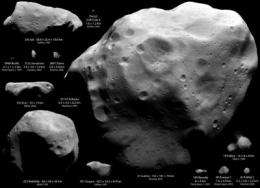
These are asteroids and comets visited by spacecraft. Credit: ESA, NASA, JAXA, RAS, JHUAPL, UMD, OSIRIS

The potentially hazardous asteroid, (101955) 1999 RQ36, has a one-in-a-thousand chance of impacting the Earth, and more than half of this probability indicates that this could happen in the year 2182, based on a global study in which Spanish researchers have been involved. Knowing this fact may help design in advance mechanisms aimed at deviating the asteroid's path.

"The total impact probability of asteroid '(101955) 1999 RQ36' can be estimated in 0.00092 -approximately one-in-a-thousand chance-, but what is most surprising is that over half of this chance (0.00054) corresponds to 2182," explains to SINC María Eugenia Sansaturio, co-author of the study and researcher of Universidad de Valladolid (UVA). The research also involved scientists from the University of Pisa (Italy), the Jet Propulsion Laboratory (USA) and INAF-IASF-Rome (Italy).

Scientists have estimated and monitored the potential impacts for this asteroid through 2200 by means of two mathematical models (Monte Carlo Method and line of variations sampling). Thus, the so called Virtual Impactors (VIs) have been searched. VIs are sets of statistical uncertainty leading to collisions with the on different dates of the XXII century. Two VIs appear in 2182 with more than half the chance of impact.

Asteroid '(101955) 1999 RQ36' is part of the Potentially Hazardous Asteroids (PHA), which have the possibility of hitting the Earth due to the closeness of their orbits, and they may cause damages. This PHA was discovered in 1999 and has around 560 meters in diameter.

The Yarkovsky effect

In practice, its orbit is well determined thanks to 290 optical observations and 13 radar measurements, but there is a significant "orbital uncertainty" because, besides gravity, its path is influenced by the Yarkovsky effect. Such disturbance slightly modifies the orbits of the Solar System's small objects because, when rotating, they radiate from one side the radiation they take from the sun through the other side.

The research, which has been published in Icarus journal, predicts what could happen in the upcoming years considering this effect. Up to 2060, divergence of the impacting orbits is moderate; between 2060 and 2080 it increases 4 orders of magnitude because the will approach the Earth in those years; then, it increases again on a slight basis until another approach in 2162, it then decreases, and 2182 is the most likely year for the collision.

"The consequence of this complex dynamic is not just the likelihood of a comparatively large impact, but also that a realistic deflection procedure (path deviation) could only be made before the impact in 2080, and more easily, before 2060," stands out Sansaturio.

The scientist concludes: "If this object had been discovered after 2080, the deflection would require a technology that is not currently available. Therefore, this example suggests that impact monitoring, which up to date does not cover more than 80 or 100 years, may need to encompass more than one century. Thus, the efforts to deviate this type of objects could be conducted with moderate resources, from a technological and financial point of view."

Provided by FECYT - Spanish Foundation for Science and Technology

4.6 /5 (25 votes)  

Filter


Move the slider to adjust rank threshold, so that you can hide some of the comments.


Display comments: newest first

otto1923
Jul 27, 2010

Rank: 4.3 / 5 (4)
We will have made a good meal of it by then-
Gerben_Mulder
Jul 27, 2010

Rank: 2 / 5 (4)
I imagine we have a turret ring around the earth by that time, which will target asteroids like in starship troopers.
GSwift7
Jul 27, 2010

Rank: 4.3 / 5 (4)
How strange. Think about this: In the example above, let's pretend that the likelyhood of impact were much higher, like 1/10. We would have to do something at that point, so we spend billions of dollars and we successfully deflect this rock in 20 years. Our theoretical impact isn't 100% sure, just one in ten, but we moved it enough that it's no longer a danger. The people we saved aren't alive yet, and most of them won't even be born until long after we are all dead. That's 172 years from now. Would anyone even remember it except a historian, physicist or astronomer? When that year eventually comes, would they celebrate our efforts with a holiday or a TV mini-series?

Just an idle thought to ponder.
yyz
Jul 27, 2010

Rank: 5 / 5 (1)
GSwift:

Good point that detecting/averting possible Earth-crossing asteroids is not only in our (short term) best interest but may save future generations yet unborn.

"When that year eventually comes, would they celebrate our efforts with a holiday or a TV mini-series?"

Reruns of 'Meteor', 'Armageddon', 'Deep Impact' with no commercial interruptions!
DaveGee
Jul 27, 2010

Rank: not rated yet
Can't wait for the Hollywood Elite to hold a half-hour live fundraiser and raise a mind boggling $4.2M to prevent the impending disaster and then get 5 days of face time with all the major networks.
Astro_Pipe
Jul 27, 2010

Rank: not rated yet
This article is not new... This article is based in a paper of january 2009. The new is that they have estimated 'exactly' the possibility of impact.
DaveGee
Jul 27, 2010

Rank: 4 / 5 (6)
How strange.... When that year eventually comes, would they celebrate our efforts with a holiday or a TV mini-series? Just an idle thought to ponder.


While I can sorta see what you're saying, here's something to put things into perspective. When was the last time you went out of your way to thank a WWII or Korea or Vietnam etc vet and that was way less than 150 years ago? Or to go back to a similar time span, how about those who died in the Revolutionary or Civil wars?

It's very sad but humans have a very short attention span and are SO bad at honoring those who came before us and gave their lives for us.
nanotech_republika_pl
Jul 27, 2010

Rank: not rated yet
Why bother having an option for enlarging the photo/picture? It's all the same: unreadable!
bottomlesssoul
Jul 27, 2010

Rank: not rated yet
A back of the envelope calculation if it's density is 2g/cc and it hits at 5km/s the impact will equal 1 gigatonne which is about 10% of annual human energy needs in one year.

It seems we're already giving ourselves slow impact damage 10 times worse each year though it happens continuously instead of in 10 short bursts.

Weird!
Kedas
Jul 28, 2010

Rank: 5 / 5 (2)
Even if it was a sure impact we still have until 2060 to decide how to change the orbit without penalty.
And by that time we probably have found some much better way's of changing the orbit.
(think about how much is changed in the last 50 years then you realise it is pointless to invest in it now)
Hunnter
Jul 28, 2010

Rank: 3 / 5 (2)
Completely agreed DaveGee.
Despite all the atrocities that happened, if it weren't for those happening, the world would be in one hell of a state.
Sadly, those wars and the nuclear bombs led to stability for the most part.

Whether or not this stability will last till that date is beyond me, but i would think not simply due to increasing numbers, dwindling space and resources.
yyz
Jul 28, 2010

Rank: not rated yet
nanotech_republika_pl:

A larger version of the image: http://www.planet...2010.png

For a description of the picture and other images: http://www.planet...0002585/
DaveGee
Jul 28, 2010

Rank: not rated yet
Completely agreed DaveGee.
Despite all the atrocities that happened, if it weren't for those happening, the world would be in one hell of a state. Sadly, those wars and the nuclear bombs led to stability for the most part. Whether or not this stability will last till that date is beyond me,


I'm very much afraid the collective WE that call this earth our home haven't learned enough and over the decades will continue to flirt with peace and war as if they were toys. It's about time today's world needs to be graphically reintroduced to how badly people are capable of behaving.

The slaughter of untold numbers of people with a nuclear weapon,

The wholesale elimination of Jews & others whose only crime was their heritage.

Entire tribes and villages full of people who didn't agree with a madman dictator being found in mass graves covered in lie.

The systematic elimination of people with glasses or clean hands since they were assumed educated.

Char limit reached but I lots mo
trekgeek1
Jul 28, 2010

Rank: not rated yet
172 years from now? School children will probably visit it to study near Earth objects first hand. We'll probably mine it and use it for our own benefit. If we haven't figured out how to stop it by then, we deserve the destruction it brings.
Rank 4.6 /5 (25 votes)
Tags

Related Stories
Relevant PhysicsForums posts
  • Titan's lack of impact craters
    created1 hour ago
  • Real pictures of black hole eating a star?
    created19 hours ago
  • Hypothetical way to travel faster than light, but not technically exceed lightspeed
    createdFeb 06, 2012
  • How do scientists monitor the Sun's activity?
    createdFeb 05, 2012
  • Search patterns in observational studies
    createdFeb 05, 2012
  • Derivation of Pogson's law
    createdFeb 03, 2012
  • More from Physics Forums - General Astronomy

More news stories

2C warming goal now 'optimistic' - French scientists

French scientists unveiling new estimates for global warming said on Thursday the 2 C (3.6 F) goal enshrined by the United Nations was "the most optimistic" scenario left for greenhouse-gas emissions.

Space & Earth / Environment

created 25 minutes ago | popularity not rated yet | comments 0

Tidal forces could squeeze out planetary water

Alien planets might experience tidal forces powerful enough to remove all their water, leaving behind hot, dry worlds like Venus, researchers said.

Space & Earth / Space Exploration

created 3 hours ago | popularity 5 / 5 (1) | comments 0 | with audio podcast

New views show old NASA Mars landers

(PhysOrg.com) -- The High Resolution Imaging Science Experiment (HiRISE) camera on NASA's Mars Reconnaissance Orbiter recorded a scene on Jan. 29, 2012, that includes the first color image from orbit showing ...

Space & Earth / Space Exploration

created 5 hours ago | popularity 4.8 / 5 (4) | comments 2 | with audio podcast

Black holes and star formation

(PhysOrg.com) -- It has long been recognized that galaxy mergers or even close interactions can play a vital role in shaping the morphology of galaxies. One way they can do so, it is thought, is by triggering ...

Space & Earth / Astronomy

created 4 hours ago | popularity 5 / 5 (2) | comments 1 | with audio podcast

NASA sees Tropical Cyclone Jasmine over Vanuatu and New Caledonia

NASA's Aqua satellite passed over Tropical Cyclone Jasmine on Feb. 8, 2012 as it was passing between Vanuatu and New Caledonia. NASA imagery showed Jasmine had a 20 nautical mile-wide eye.

Space & Earth / Earth Sciences

created 3 hours ago | popularity not rated yet | comments 0


Secrets of immune response illuminated in new study

When disease-causing invaders like bacteria infect a human host, cells of various types swing into action, coordinating their activities to address the threat.

Nanotube therapy takes aim at breast cancer stem cells

Wake Forest Baptist Medical Center researchers have again proven that injecting multiwalled carbon nanotubes (MWCNTs) into tumors and heating them with a quick, 30-second laser treatment can kill them.

Potentially important new mechanisms found anti-aging effects of resveratrol

A well-conducted experimental study in mice has provided potentially important new insights into the association of the intake of resveratrol and like compounds with health benefits. Resveratrol is a constituent of red wine ...

Touch screens create online shopping experiences at stores

Imagine browsing knife sets in an airport and then ordering one before you board your plane, or going to a department store to look at makeup without having to bounce from counter to counter to check out each brand's selection.

Doctors telling more adults: Get out and exercise

(AP) -- More and more U.S. adults are being told by their doctor to get out and exercise, according to government survey released Thursday.

Study shows fainting factor in cardiac arrests

A new study by Dr. Andrew Krahn shows that over a quarter of unexplained cardiac arrests occurred after the patient had an event of fainting, known as syncope. According to Dr. Krahn, a Cardiologist at London Health Sciences ...