Engineered coral pigment helps scientists to observe protein movement
July 27, 2010
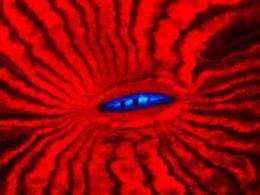
The image shows fluorescence of the mouth region of the reef coral Lobophyllia hemprichii. The red fluorescent protein isolated from this coral was rendered in an advanced tool for super-resolution microscopy. Credit: Jörg Wiedenmann
Scientists in Southampton, UK, and Ulm and Karlsruhe in Germany have shown that a variant form of a fluorescent protein (FP) originally isolated from a reef coral has excellent properties as a marker protein for super-resolution microscopy in live cells. Their findings have been published online by Nature Methods and will appear in print in the upcoming August issue of that journal.
Fluorescent proteins produced by a range of marine animals glow with a rainbow of colours, adding to the visual spectacle of coral reefs. Over recent years, molecular biologists have isolated a number of FPs and their genes, and used them to create genetically engineered variant FPs with particular light-emission characteristics.
"Fluorescent pigments from corals and related animals have proved to be invaluable lead structures to produce advanced markers for biomedical research," said Dr Jörg Wiedenmann of the University of Southampton's School of Ocean and Earth Science (SOES) based at the National Oceanography Centre, Southampton: "They enable a plethora of exciting experiments, including non-invasive study of dynamical processes within live cells,"
Photoactivatable FPs (PA-FPs)can, as their name suggests, be switched on by light. When light of a particular wavelength is shone upon them they start to glow, emitting light of characteristic hue.
Wiedenmann and his collaborators previously described EosFP, a PA-FP from the reef-building coral Lobophyllia. Genetic engineering yielded the variant IrisFP with dual photoactivation capacity. In one mode it is irreversibly 'photo-converted' from a green- to a red-emitting form under violet light. In a second mode, these two light-emitting forms can be switched on and off more or less at will using light of different wavelengths ('photo-switching').
For use in cell biology experiments, PA-FPs are genetically fused to proteins of interest, and expressed in live cells. Small regions of the cell are then illuminated with laser light of specific wavelength, causing the marker proteins to emit light at another wavelength. This allows dynamical cell processes to be visualised and studied under the microscope.
In the native state, four molecules of IrisFP join together to form a tetramer, creating problems for fusion-protein applications. To get round this, the researchers have now modified the protein by introducing four mutations. This makes individual IrisFP molecules (monomers) more stable, reducing their tendency for form tetramers.
"The monomeric variant, mIrisFP, maintains dual photoactivation capacity and has excellent properties as a genetically encoded fluorescent marker protein," explained Wiedenmann.
To test the usefulness of mIrisFP, the researchers genetically fused it with a number of other proteins within cultured cells. These included transcription factors, which regulate the expression of genes within the cell nucleus, and constituent proteins of the cell skeleton ('cytoskeleton'). In all cases, the fusion proteins functioned normally.
Further experiments demonstrated that mIrisFP fusion proteins could, as hoped, be used to study dynamical processes within live cells with a spatial resolution beyond the limits of conventional light microscopy. Specifically, the researchers successfully combined so-called pulse-chase experiments with photoactivation localisation microscopy (PALM) imaging to follow the movement of fluorescently marked fusion proteins over time and at very high spatial resolution.
"The dual photoactivation capability and the monomeric nature of mIrisFP should allow cell biologists to perform a wider range of experiments than possible using only conventional PA-FPs," said Wiedenmann.
"Marine animals such as corals and anemones are not only beautiful and important for ecosystem functioning, but also as source of fluorescent proteins of enormous value to biomedical research," he added.
More information: Publication: Fuchs, J., Boehme, S., Oswald, F., Hedde, P. N., Krause, M., Wiedenmann, J. & Nienhaus, G. U. A photoactivatable marker protein for pulse-chase imaging with superresolution. Nature Methods (Published online: 4 July 2010). doi:10.1038/nmeth.147
Provided by National Oceanography Centre, Southampton
-
Biomedical research profits from the exploration of the deep sea
Nov 19, 2008 |
not rated yet |
0
-
Fluorescent proteins illuminating biomedical research
Jan 25, 2009 |
not rated yet |
0
-
Fluorescent protein basis for bluish coral
Aug 27, 2005 |
not rated yet |
0
-
Researchers find molecular structure of key fluorescent proteins
Apr 22, 2010 |
not rated yet |
0
-
Sea coral's trick helps scientists tag proteins
Mar 19, 2006 |
not rated yet |
0
-
Engineers build first sub-10-nm carbon nanotube transistor
Feb 01, 2012 |
4.9 / 5 (30) |
30
-
Something old, something new: Evolution and the structural divergence of duplicate genes
Jan 31, 2012 |
4.6 / 5 (7) |
1
-
The hidden nanoworld of ice crystals: Revealing the dynamic behavior of quasi-liquid layers
Jan 30, 2012 |
5 / 5 (3) |
1
-
Stock market network reveals investor clustering
Jan 27, 2012 |
3.9 / 5 (23) |
8
-
Of microchemistry and molecules: Electronic microfluidic device synthesizes biocompatible probes
Jan 26, 2012 |
5 / 5 (1) |
0
-
Cancer drugs and Alzheimer's, Oh my!
6 hours ago
-
Squishing cells
7 hours ago
-
Any books/articles for evolutionary stable strategy models in humans?
18 hours ago
-
Science behind the bore feeling?
Feb 09, 2012
-
Homo Sapien vs. Chimpanzee - Divergence Timeline
Feb 09, 2012
-
a single mRNA strand is attached to sevaral ribosomes?
Feb 08, 2012
- More from Physics Forums - Biology
More news stories
Miami battling invasion of giant African snails
No one knows how they got there. But an invasion of African giant snails has southern Florida in a panic over potential crop damage, disease and general yuckiness surrounding the slimy gastropods.
23 minutes ago |
not rated yet |
0
Fighting crimes against biodiversity: How to catch a killer weed
Invasive species which have the potential to destroy biodiversity and influence global change could be tracked and controlled in the same way as wanted criminals, according to new research from Queen Mary, University of London.
1 hour ago |
not rated yet |
0
Ultraviolet protection molecule in plants yields its secrets
Lying around in the sun all day is hazardous not just for humans but also for plants, which have no means of escape. Ultraviolet (UV) radiation from the sun can damage proteins and DNA inside cells, leading ...
14 hours ago |
5 / 5 (5) |
0
|
Deadly bird parasite evolves at exceptionally fast rate
A new study of a devastating bird disease that spread from poultry to house finches in the mid-1990s reveals that the bacteria responsible for the disease evolves at an exceptionally fast rate. What's more, ...
13 hours ago |
5 / 5 (2) |
0
|
Decoding the molecular machine behind E. coli and cholera
Scientists from Queen Mary, University of London have discovered the workings behind some of the bacteria that kill hundreds of thousands every year, possibly paving the way for new antibiotics that could treat infections ...
13 hours ago |
not rated yet |
0
|
Humans may have helped the decline of African rainforests 3000 years ago
(PhysOrg.com) -- Large areas of rainforests in Central Africa mysteriously disappeared over three thousand years ago, to be replaced by savannas. The prevailing theory has been that the cause was a change ...
Japan scientist makes 'Avatar' robot
A Japanese-developed robot that mimics the movements of its human controller is bringing the Hollywood blockbuster "Avatar" one step closer to reality.
Metastatic breast cancer hitches a free ride from the immune system
Inflammatory breast cancer (IBC) is the most lethal form of breast cancer . It spreads easily through the lymphatic and blood vessels, forming metastasis which can lead to multi-organ failure. New research published in BioMed ...
Sleep breathing machine shows clear benefits in children with sleep apnea
Children and adolescents with obstructive sleep apnea had substantial improvements in attention, anxiety and quality of life after treatment with positive airway pressure (PAP)a nighttime therapy in which a machine ...
Neurologic improvement detected in rats receiving stem cell transplant
In a study to be presented today at the Society for Maternal-Fetal Medicine's annual meeting, The Pregnancy Meeting, in Dallas, Texas, researchers will report that early transplantation of human placenta-derived mesenchymal ...
India's global pharmacy role threatened by EU pact
(AP) -- Efforts by India and the European Union to strengthen trade are threatening India's ability to deliver lifesaving medicines to the world's poorest, analysts say as the two sides push through protracted ...