Latest 'green' packing material? Mushrooms
July 27, 2010
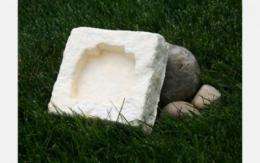
EcoCradle packaging material is composed of agricultural byproducts (cotton gin trash) bound together by fungal mycelium. With an appearance and functionality of polymer foams, EcoCradle can be manufactured with just one eighth the energy and one tenth the carbon dioxide of traditional foam packing material. Credit: Edward Browka, Ecovative Design
A new packing material that grows itself is now appearing in shipped products across the country.
The composite of inedible agricultural waste and mushroom roots is called Mycobond, and its manufacture requires just one eighth the energy and one tenth the carbon dioxide of traditional foam packing material.
And unlike most foam substitutes, when no longer useful, it makes great compost in the garden.
The technology was the brainchild of two former Rensselaer Polytechnic Institute undergraduates, Gavin McIntyre and Eben Bayer, who founded Ecovative Design of Green Island, N.Y., to bring their idea into production.
"We don't manufacture materials, we grow them," says McIntyre. "We're converting agricultural byproducts into a higher-value product."
Because the feedstock is based on renewable resources, he adds, the material has an economic benefit as well: it is not prone to the price fluctuations common to synthetic materials derived from such sources as petroleum. "All of our raw materials are inherently renewable and they are literally waste streams," says McIntyre. "It's an open system based on biological materials."
With support from NSF, McIntyre and Bayer are developing a new, less energy-intensive method to sterilize their agricultural-waste starter material--a necessary step for enabling the mushroom fibers, called mycelia, to grow. McIntyre and Bayer are replacing a steam-heat process with a treatment made from cinnamon-bark oil, thyme oil, oregano oil and lemongrass oil.
The sterilization process, which kills any spores that could compete with Ecovative's mushrooms, is almost as effective as the autoclaving process used to disinfect medical instruments and will allow the Mycobond™ products to grow in the open air, instead of their current clean-room environment.
"The biological disinfection process simply emulates nature," says McIntyre, "in that it uses compounds that plants have evolved over centuries to inhibit microbial growth. The unintended result is that our production floor smells like a pizza shop."
Much of the manufacturing process is nearly energy-free, with the mycelia growing around and digesting agricultural starter material--such as cotton seed or wood fiber--in an environment that is both room-temperature and dark. Because the growth occurs within a molded plastic structure (which the producers customize for each application), no energy is required for shaping the products.
Once fully formed, each piece is heat-treated to stop the growth process and delivered to the customer--though with the new, easier, disinfection treatment, Bayer and McIntyre are hoping the entire process can be packaged as a kit, allowing shipping facilities, and even homeowners, to grow their own Mycobond™ materials.
Based on a preliminary assessment McIntyre and Bayer conducted under their Phase I NSF SBIR award, the improvements to the sterilization phase will reduce the energy of the entire manufacturing process to one fortieth of that required to create polymer foam.
"This project is compelling because it uses innovative technology to further improve Ecovative's value, while also providing the environmental benefits that NSF is looking for," said Ben Schrag, the NSF program officer who oversees Ecovative's Small Business Innovation Research (SBIR) award. "The traction that they have gotten with their early customers demonstrates how companies can build strong businesses around products whose primary competitive advantage lies in their sustainability."
In addition to the packaging product, called EcoCradle, Ecovative has developed a home insulation product dubbed greensulate™. Comparable in effectiveness to foam insulation, it has the added benefit of being flame retardant.
Ecovative is already producing custom protective packaging products for several Fortune 500 companies, though they are leveraging the new disinfection process to produce turnkey systems that they plan to deploy to off-site customers and do-it-yourself homeowners by 2013.
-
DVDs and CD-ROMs that thwart global warming
Apr 08, 2008 |
not rated yet |
0
-
Compostable plastics have a sweet ending
Feb 17, 2010 |
not rated yet |
0
-
Nature's own chemical plant
Nov 10, 2008 |
not rated yet |
0
-
PhD researcher develops inexpensive, sustainable production method
Dec 06, 2006 |
not rated yet |
0
-
Researchers Discover Use for Carbon Dioxide in Conversion of Biomass Into Biofuel
Nov 11, 2009 |
not rated yet |
0
-
Engineers build first sub-10-nm carbon nanotube transistor
Feb 01, 2012 |
4.9 / 5 (30) |
30
-
Something old, something new: Evolution and the structural divergence of duplicate genes
Jan 31, 2012 |
4.6 / 5 (7) |
1
-
The hidden nanoworld of ice crystals: Revealing the dynamic behavior of quasi-liquid layers
Jan 30, 2012 |
5 / 5 (3) |
1
-
Stock market network reveals investor clustering
Jan 27, 2012 |
3.9 / 5 (23) |
8
-
Of microchemistry and molecules: Electronic microfluidic device synthesizes biocompatible probes
Jan 26, 2012 |
5 / 5 (1) |
0
-
Stoichiometry
12 hours ago
-
Boiling and melting point of impure substances
13 hours ago
-
Safe nitrogen compound to decompose a 500 deg C in a furnace?
20 hours ago
-
[ask]electron inside drinking water
Feb 08, 2012
-
How to avoid formation of Lithium Chromate ???
Feb 08, 2012
-
how to choose a reduced or oxidated form in a redox
Feb 08, 2012
- More from Physics Forums - Chemistry
More news stories
Fool's gold may prove an unlikely alternative to overexploited catalytic materials
Catalytic materials, which lower the energy barriers for chemical reactions, are used in everything from the commercial production of chemicals to catalytic converters in car engines. However, with current catalytic materials ...
3 hours ago |
5 / 5 (2) |
1
|
Unpicking HIV’s invisibility cloak
Drug researchers hunting for alternative ways to treat human immunodeficiency virus (HIV) infections may soon have a novel targetits camouflage coat. HIV hides inside a cloak unusually rich in a sugar ...
3 hours ago |
5 / 5 (2) |
0
Hydrogen from acidic water: Researchers develop potential low cost alternative to platinum for splitting water
A technique for creating a new molecule that structurally and chemically replicates the active part of the widely used industrial catalyst molybdenite has been developed by researchers with the Lawrence Berkeley ...
23 hours ago |
5 / 5 (12) |
11
|
No entry without protein recycling: Researchers discover new coherence in enzyme transport
The group of Prof. Dr. Ralf Erdmann at the Ruhr-Universität Bochum, Germany, discovered a connection of peroxisomal protein import and receptor export. In the Journal of Biological Chemistry, they disclo ...
3 hours ago |
not rated yet |
0
Flexible paper robots
(PhysOrg.com) -- These inexpensive robots can stretch, bend and twist under control, and lift objects up to 120 times their own weight. Being soft, they can apply gentle and even pressure, and adapt to varied ...
21 hours ago |
5 / 5 (5) |
4
|
Hovering not hard if you're top-heavy, researchers find
Top-heavy structures are more likely to maintain their balance while hovering in the air than are those that bear a lower center of gravity, researchers at New York University's Courant Institute of Mathematical Sciences ...
Grass to gas: Researchers' genome map speeds biofuel development
Researchers at the University of Georgia have taken a major step in the ongoing effort to find sources of cleaner, renewable energy by mapping the genomes of two originator cells of Miscanthus x giganteus, a large perenn ...
Putting the squeeze on planets outside our solar system
(PhysOrg.com) -- Using high-powered lasers, scientists at Lawrence Livermore National Laboratory and collaborators discovered that molten magnesium silicate undergoes a phase change in the liquid state, abruptly ...
Researchers develop new method for creating tissue engineering scaffolds
Researchers at Northwestern University have developed a new method for creating scaffolds for tissue engineering applications, providing an alternative that is more flexible and less time-intensive than current technology.
Molecular profiling reveals differences between primary and recurrent ovarian cancers
There is a need to analyze tumor specimens at the time of ovarian cancer recurrence, according to a new study published in Molecular Cancer Therapeutics. Researchers used a diagnostic technology called molecular profiling to examine ...
C-sections linked to breathing problems in preterm infants
Research conducted at Yale School of Medicine shows that a cesarean (C-section) delivery, which was thought to be harmless, is associated with breathing problems in preterm babies who are small for gestational age.
Jul 27, 2010
Rank: not rated yet
Jul 27, 2010
Rank: not rated yet
Aug 01, 2010
Rank: not rated yet