Findings show promise for nuclear fusion test reactors
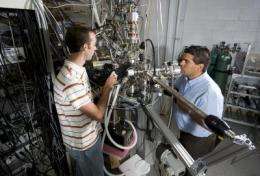
Researchers have discovered mechanisms critical to interactions between hot plasma and surfaces facing the plasma inside a thermonuclear fusion reactor, part of work aimed at developing coatings capable of withstanding the grueling conditions inside the reactors.
Fusion powers the stars and could lead to a limitless supply of clean energy. A fusion power plant would produce 10 times more energy than a conventional nuclear fission reactor, and because the deuterium fuel is contained in seawater, a fusion reactor's fuel supply would be virtually inexhaustible.
Research at Purdue University focuses on the "plasma-material interface," a crucial region where the inner lining of a fusion reactor comes into contact with the extreme heat of the plasma. Nuclear and materials engineers are harnessing nanotechnology to define tiny features in the coating in work aimed at creating new "plasma-facing" materials tolerant to radiation damage, said Jean Paul Allain, an assistant professor of nuclear engineering.
One lining being considered uses lithium, which is applied to the inner graphite wall of the reactor and diffuses into the graphite, creating an entirely new material called lithiated graphite. The lithiated graphite binds to deuterium atoms in fuel inside fusion reactors known as tokamaks. The machines house a magnetic field to confine a donut-shaped plasma of deuterium, an isotope of hydrogen.
During a fusion reaction, some of the deuterium atoms strike the inner walls of the reactor and are either "pumped," causing them to bind with the lithiated graphite, or returned to the core and recycled back to the plasma. This process can be "tuned" by these liners to control how much deuterium fuel is retained.
"We now have an understanding of how the lithiated graphite controls the recycling of hydrogen," Allain said. "This is the first time that anyone has looked systematically at the chemistry and physics of pumping by the lithiated graphite. We are learning, at the atomic level, exactly how it is pumped and what dictates the binding of deuterium in this lithiated graphite. So we now have improved insight on how to recondition the surfaces of the tokamak."
Findings have been detailed in two research papers presented during the 19th International Conference on Plasma-Surface Interactions in May, and another paper will be presented during the Fusion Nuclear Science and Technology/Plasma Facing Components meeting on Aug. 2-6 at the University of California at Los Angeles.
Purdue is working with researches at Princeton University in the Princeton Plasma Physics Laboratory, which operates the nation's only spherical tokamak reactor, known as the National Spherical Torus Experiment. The machines are ideal for materials testing.
A major challenge in finding the right coatings to line fusion reactors is that the material changes due to extreme conditions inside the reactors, where temperatures reach millions of degrees. The energy causes tiny micro- and nano-scale features to "self-organize" on the surface of the lithiated graphite under normal plasma-surface interaction conditions. But the surface only continues this pumping action for a few seconds before being compromised by damage induced by the extreme internal conditions, so researchers are trying to improve the material durability, Allain said.
"The key is to understand how to exploit these self-organizing structures and patterns to provide the recycling and also to self-heal, or replenish the pumping conditions we started with," he said.
Allain's group is working Purdue's Birck Nanotechnology Center to analyze tiles used in the Princeton Plasma Physics Laboratory tokamak.
The Purdue team also will study materials inserted into the tokamak using a special "plasma-materials interface probe." The materials will then be studied at the Princeton laboratory using a specialized "in situ surface analysis facility laboratory" that will be assembled at Purdue and transported to Princeton later this summer.
"We will bring the samples in and study them right there, and we will be able to do the characterization in real time to see what happens to the surfaces," Allain said. "We're also going to use computational modeling to connect the fundamental physics learned in our experiments and what we observe inside the tokamak."
Data from the analyses will be used to validate the models.
The research involves doctoral student Chase Taylor and graduate student Bryan Heim. The project is funded by the U.S. Department of Energy through the DOE's Office of Fusion Energy Sciences.
Future work will include research to study the role played by specific textures, the nanometer-scale structures formed in the tokamak linings.
One of the research papers presented during the 19th International Conference on Plasma-Surface Interactions was written by Taylor; Heim; Osman El-Atwani, a Purdue doctoral student in the School of Materials Engineering; Allain; and colleagues from the Princeton Plasma Physics Laboratory: Charles H. Skinner, Lane Roquemore and Henry W. Kugel. In addition, atomistic modeling is conducted in collaboration with Predrag Krstic, a physicist from the Oak Ridge National Laboratory.
The other paper was written by Martin Nieto-Perez, a scientist at CICATA-IPN in Queretaro, Mexico, along with Taylor, Heim and Allain. Taylor, Heim and El-Atwani are Allain's students in his Radiation Surface Science and Engineering Laboratory.
The paper to be presented during the Fusion Nuclear Science and Technology/Plasma Facing Components meeting in August will be presented by Allain and Taylor.
Provided by Purdue University


