Microbes on the menu
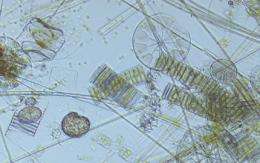
The functioning of marine ecosystems depends on the size and flavor of microbes at the base of the food chain. Changes to the Earth's atmosphere might rearrange that microscopic menu. Microbes that currently are the main course for other organisms might get harder to find in the future, and microbes that are now inconspicuous as members of a "rare biosphere" might become more common.
Four biologists at USC College have started work on a project funded by the National Science Foundation to examine the changes that might occur within communities of marine microbes as seawater becomes more acidic, a change that is happening as the rising levels of carbon dioxide in the atmosphere are absorbed by the ocean.
The principal investigator on the project is Astrid Schnetzer, a research assistant professor in the USC marine environmental biology program who said the study will examine the response of microbial communities to ocean acidification and increases in temperature.
"The change that is happening is very complex — it won't be just an increase in carbon dioxide in the water or an increase in temperature," Schnetzer said. "Global climate change will affect a whole suite of ocean properties, directly or indirectly, in the coming decades."
Schnetzer is working on the project with three other faculty members in marine environmental biology: professors David Caron and David Hutchins, and research assistant professor Feixue Fu. All are affiliated with the USC Wrigley Institute for Environmental Studies.
During the three-year study, Schnetzer and her colleagues will look within natural communities of microbes for specific species that can beat their competitors because they acclimate better to the altered temperature and chemistry of seawater in a "greenhouse world." The researchers will isolate microbes that pass the "acclimation test," cultivate them for several generations and then recombine them to examine the structure of their communities under conditions that are predicted for the future.
"The species that can acclimate better to changes in CO2 levels will have a competitive advantage," Schnetzer said.
The new study at USC will do more than evaluate the individual species that might survive the marine conditions that are predicted for the future. It will monitor the growth rates and elemental composition of phytoplankton under new conditions and the "functional groups" of organisms that might emerge in the future.
The "primary producers" are one of the most critical of these functional groups. These are the algae capable of photosynthesis that create plant material out of sunlight, carbon dioxide and ambient nutrients. Schnetzer said these algae might change as the chemistry and temperature of seawater change. The algae might grow more quickly or slowly, or bigger or smaller. They might become more or less palatable and more or less nutritious.
The other microbes and crustaceans that feed on these algae, in turn, will react to any changes in the plant material that is fundamental to their diets.
"The reason the primary producers are so important is because, ultimately, they're the base of food chain," Schnetzer said. "Whatever affects them will affect anything else that's higher up. That means the protozoa that graze on them, the zooplankton that graze on them, small crustaceans, fish — and somewhere up that food chain we find ourselves."
In addition to providing food for other marine organisms, the primary producers influence the chemistry of seawater because they remove carbon dioxide from it.
Seawater absorbs carbon dioxide from the atmosphere, and the primary producers convert dissolved CO2 into plant matter. Schnetzer said the microbes are on the front lines of "carbon sequestration" on a global scale, but changes to the temperature and chemistry of seawater in a "greenhouse world" might change the growth rates of the primary producers. That would change the rate at which they remove carbon dioxide from the water and their capacity to assist in the sequestration of CO2 from the atmosphere.
Schnetzer said changes in water chemistry also might open a window of opportunity for species of microbes that typically exist at very low numbers. Organisms that are now part of this "rare biosphere" might thrive under new conditions, and in some cases they might become very conspicuous members of a new order.
"Harmful algal blooms could be considered a 'real world' example of the rare biosphere," Schnetzer said. "You know that these species of algae are around, but they're not really abundant; they're somewhere in the very background of what's present at any given time. Then, something in the environment changes, a window of opportunity opens and they suddenly take over and dominate."
The ocean naturally absorbs carbon dioxide from the air. Over the course of millions of years, the balance of CO2 in the air and in seawater reached equilibrium, and so did the chemistry of the seawater. But the burning of fossil fuels for energy adds billions of tons of carbon dioxide to the atmosphere every year, and as the atmosphere becomes more saturated with carbon dioxide, so does the seawater. The marine life we know today is suited for the equilibrium as it exists now, but rising levels of carbon dioxide in the environment are pushing ocean chemistry out of this age-old balance.
Source USC College News


