Spacequakes Rumble Near Earth (w/ Video)
July 28, 2010 by Dr. Tony Phillips
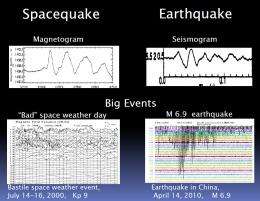
During a spacequake, Earth's magnetic field shakes in a way that is analogous to the shaking of the ground during an earthquake. Image credit: Evgeny Panov, Space Research Institute of Austria.
Researchers using NASA's fleet of five THEMIS spacecraft have discovered a form of space weather that packs the punch of an earthquake and plays a key role in sparking bright Northern Lights. They call it "the spacequake."
A spacequake is a temblor in Earth's magnetic field. It is felt most strongly in Earth orbit, but is not exclusive to space. The effects can reach all the way down to the surface of Earth itself.
"Magnetic reverberations have been detected at ground stations all around the globe, much like seismic detectors measure a large earthquake," says THEMIS principal investigator Vassilis Angelopoulos of UCLA.
It's an apt analogy because "the total energy in a spacequake can rival that of a magnitude 5 or 6 earthquake," according to Evgeny Panov of the Space Research Institute in Austria. Panov is first author of a paper reporting the results in the April 2010 issue of Geophysical Research Letters (GRL).
This video is not supported by your browser at this time.
A spacequake in action. Click to launch a computer-simulated movie created by Walt Feimer of Goddard's Scientific Visualization Lab.
In 2007, THEMIS discovered the precursors of spacequakes. The action begins in Earth's magnetic tail, which is stretched out like a windsock by the million mph solar wind. Sometimes the tail can become so stretched and tension-filled, it snaps back like an over-torqued rubber band. Solar wind plasma trapped in the tail hurtles toward Earth. On more than one occasion, the five THEMIS spacecraft were in the line of fire when these "plasma jets" swept by. Clearly, the jets were going to hit Earth. But what would happen then? The fleet moved closer to the planet to find out."Now we know," says THEMIS project scientist David Sibeck of the Goddard Space Flight Center. "Plasma jets trigger spacequakes."
According to THEMIS, the jets crash into the geomagnetic field some 30,000 km above Earth's equator. The impact sets off a rebounding process, in which the incoming plasma actually bounces up and down on the reverberating magnetic field. Researchers call it "repetitive flow rebuffing." It's akin to a tennis ball bouncing up and down on a carpeted floor. The first bounce is a big one, followed by bounces of decreasing amplitude as energy is dissipated in the carpet.
"We've long suspected that something like this was happening," says Sibeck. "By observing the process in situ, however, THEMIS has discovered something new and surprising."
The surprise is plasma vortices, huge whirls of magnetized gas as wide as Earth itself, spinning on the verge of the quaking magnetic field.
"When plasma jets hit the inner magnetosphere, vortices with opposite sense of rotation appear and reappear on either side of the plasma jet," explains Rumi Nakamura of the Space Research Institute in Austria, a co-author of the study. "We believe the vortices can generate substantial electrical currents in the near-Earth environment."

A THEMIS map of plasma flows during a spacequake. The axes are labeled in Earth radii, so each swirl is about the size of Earth.
Acting together, vortices and spacequakes could have a noticeable effect on Earth. The tails of vortices may funnel particles into Earth's atmosphere, sparking auroras and making waves of ionization that disturb radio communications and GPS. By tugging on surface magnetic fields, spacequakes generate currents in the very ground we walk on. Ground current surges can have profound consequences, in extreme cases bringing down power grids over a wide area.After THEMIS discovered the jets and quakes, Joachim Birn of the Los Alamos National Lab in New Mexico conducted a computer simulation of the rebounding process. Lo and behold, vortices appeared in good accord with THEMIS measurements. Moreover, the simulations suggest that the rebounding process can be seen from Earth's surface in the form of ripples and whirls in auroral displays. Ground stations report just such a phenomenon.
"It's a complicated process, but it all fits together," says Sibeck.
The work isn't finished. "We still have a lot to learn," he adds. "How big can spacequakes become? How many vortices can swirl around Earth at once--and how do they interact with one another?"
Stay tuned for answers from THEMIS.
More information: http://www.nasa.go … n/index.html
Provided by Science@NASA
-
NASA Satellites Discover What Powers Northern Lights
Jul 24, 2008 |
not rated yet |
0
-
THEMIS satellite tracks electrical tornadoes in space
Apr 23, 2009 |
not rated yet |
0
-
Colliding auroras produce an explosion of light
Dec 17, 2009 |
not rated yet |
0
-
University of Alberta space research to solve aurora mystery
Jan 10, 2007 |
not rated yet |
0
-
Researchers set alarm for incoming space storms
May 27, 2009 |
not rated yet |
0
-
Engineers build first sub-10-nm carbon nanotube transistor
Feb 01, 2012 |
4.9 / 5 (30) |
30
-
Something old, something new: Evolution and the structural divergence of duplicate genes
Jan 31, 2012 |
4.6 / 5 (7) |
1
-
The hidden nanoworld of ice crystals: Revealing the dynamic behavior of quasi-liquid layers
Jan 30, 2012 |
5 / 5 (3) |
1
-
Stock market network reveals investor clustering
Jan 27, 2012 |
3.9 / 5 (23) |
8
-
Of microchemistry and molecules: Electronic microfluidic device synthesizes biocompatible probes
Jan 26, 2012 |
5 / 5 (1) |
0
-
Titan's lack of impact craters
4 hours ago
-
Real pictures of black hole eating a star?
21 hours ago
-
Hypothetical way to travel faster than light, but not technically exceed lightspeed
Feb 06, 2012
-
How do scientists monitor the Sun's activity?
Feb 05, 2012
-
Search patterns in observational studies
Feb 05, 2012
-
Derivation of Pogson's law
Feb 03, 2012
- More from Physics Forums - General Astronomy
More news stories
NASA sees Tropical Storm 12S - a possible threat to Madagascar
The twelfth tropical depression formed in the Southern Indian Ocean today and quickly became a tropical storm, dubbed Tropical Storm 12S. NASA's Aqua satellite passed over the storm and captured infrared data that revealed ...
Space & Earth / Earth Sciences
2 minutes ago |
not rated yet |
0
Ocean microbe communities changing, but long-term environmental impact is unclear
As oceans warm due to climate change, water layers will mix less and affect the microbes and plankton that pump carbon out of the atmosphere but researchers say it's still unclear whether these processes ...
Space & Earth / Earth Sciences
1 hour ago |
not rated yet |
0
|
Researchers create 3-D laser maps that show how earthquake changes landscape
Geologists have a new tool to study how earthquakes change the landscape down to a few inches, and it's giving them insight into how earthquake faults behave. In the Feb. 10 issue of the journal Science, a team ...
Space & Earth / Earth Sciences
1 hour ago |
5 / 5 (1) |
0
|
Tidal forces could squeeze out planetary water
Alien planets might experience tidal forces powerful enough to remove all their water, leaving behind hot, dry worlds like Venus, researchers said.
Space & Earth / Space Exploration
5 hours ago |
5 / 5 (1) |
1
|
New views show old NASA Mars landers
(PhysOrg.com) -- The High Resolution Imaging Science Experiment (HiRISE) camera on NASA's Mars Reconnaissance Orbiter recorded a scene on Jan. 29, 2012, that includes the first color image from orbit showing ...
Space & Earth / Space Exploration
7 hours ago |
4.9 / 5 (7) |
3
|
Hydrogen from acidic water: Researchers develop potential low cost alternative to platinum for splitting water
A technique for creating a new molecule that structurally and chemically replicates the active part of the widely used industrial catalyst molybdenite has been developed by researchers with the Lawrence Berkeley ...
Ultraviolet protection molecule in plants yields its secrets
Lying around in the sun all day is hazardous not just for humans but also for plants, which have no means of escape. Ultraviolet (UV) radiation from the sun can damage proteins and DNA inside cells, leading ...
To perform with less effort, practice beyond perfection
Whether you are an athlete, a musician or a stroke patient learning to walk again, practice can make perfect, but more practice may make you more efficient, according to a surprising new University of Colorado Boulder study.
Scientists identify most lethal known species of prion protein
Scientists from the Florida campus of The Scripps Research Institute have identified a single prion protein that causes neuronal death similar to that seen in "mad cow" disease, but is at least 10 times more ...
Researchers weigh in on ethics of H5N1 research
(Medical Xpress) -- In a commentary on the biosecurity controversy surrounding publication of bird flu research details, a bioethicist and a vaccine expert at Johns Hopkins reaffirm that "all scientists have an affirmativ ...
US workers are 'giving away the store,' costing firms billions
Nearly 70 percent of the nation's service employees give away free goods and services from hamburgers to cable TV costing companies billions of dollars a year, according to a groundbreaking study.
