Signs of reversal of Arctic cooling in some areas
Parts of the Arctic have cooled clearly over the past century, but temperatures have been rising steeply since 1990 also there. This is the finding of a summer temperature reconstruction for the past 400 years produced on the base of tree rings from regions beyond the Arctic Circle. German and Russian researchers analysed tree growth using ring width of pine from Russia's Kola Peninsula and compared their findings with similar studies from other parts of the Arctic.
For the past 400 years since AD 1600, the reconstructed summer temperature on Kola in the months of July and August has varied between 10.4°C (1709) and 14.7°C (1957), with a mean of 12.2°C. Afterwards, after a cooling phase, a ongoing warming can be observed from 1990 onwards. Researchers from the Institute of Geography in Moscow, Hohenheim University and the Helmholtz Centre for Environmental Research (UFZ) report in journal Arctic, Antarctic and Alpine Research: "The data indicate that solar activity may have been one of the major driving factors of summer temperatures, but this has been overlaid by other factors since 1990".
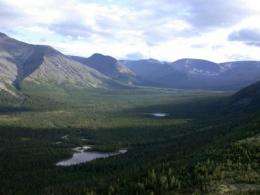
The researchers used for this study wood samples from a total of 69 Scots pines (Pinus sylvestris) from the Khibiny Mountains on the Kola Peninsula, situated between the Arctic Circle and the ocean port of Murmansk, not far from the Finnish border. The investigated region is a transition zone between Scandinavia, which is strongly affected by the gulf stream resp. North Atlantic Current, and the continental regions Eurasia. This makes the region particularly interesting for climatological studies.
Kola has a cold-temperate climate with long, moderately cold winters and cool, humid summers. In this part of the Arctic, the mean temperature fluctuates between -12°C in January and +13°C in July, with a growing season of just 60 to 80 days. The northern taiga vegetation is dominated by spruce, pine and birch. The samples came from three locations in the Khibiny Mountains close to recent altitudinal timberline at altitudes of between 250 and 450 m above sea level. The geographical northern timberline lies approximately 100 km further north. In earlier studies, researchers led by Tatjana Böttger from the UFZ were able to show that pine forests on the Kola Peninsula expanded between 7000 and 3500 years ago to about 50 km north of their present-day limit. However, for this study, they used trees from the altitudinal timberline, since they respond very sensitively to temperature fluctuations and provide particularly useful information, as demonstrated by US researchers in November 2009 in the journal PNAS when they used a long-lived species of pine in California and Nevada to show that these trees had grown particularly fast over the last 50 of the past 3500 years because of higher temperatures.
In the Tree-Ring-Laboratory at the University of Hohenheim in Stuttgart the German researchers measured the width of the individual tree rings. The calibration of these data with the help of meteorological records for the last 127 years and the interpretation of results occurred together with Russian Academy of Sciences in Moscow and the Helmholtz Centre for Environmental Research in Halle. "Besides of temperature, growth is also strongly influenced by non-climatic factors like light, nutrients, water supply and competition from other trees. So it is vital to isolate these trends to obtain a climate signal as pure as possible," explains Yury M. Kononov from the Russian Academy of Sciences in Moscow.
Following the summer temperature reconstruction on the Kola Peninsula, the researchers compared their results with similar tree-ring studies from Swedish Lapland and from the Yamal and Taimyr Peninsulas in Russian Siberia, which had been published in Holocene in 2002. The reconstructed summer temperatures of the last four centuries from Lapland and the Kola and Taimyr Peninsulas are similar in that all three data series display a temperature peak in the middle of the twentieth century, followed by a cooling of one or two degrees. Only the data series from the Yamal Peninsula differed, reaching its peak later, around 1990. What stands out in the data from the Kola Peninsula is that the highest temperatures were found in the period around 1935 and 1955, and that by 1990 the curve had fallen to the 1870 level, which corresponds to the start of the Industrial Age. Since 1990, however, temperatures have increased again evidently. What is conspicuous about the new data is that the reconstructed minimum temperatures coincide exactly with times of low solar activity. The researchers therefore assume that in the past, solar activity was a significant factor contributing to summer temperature fluctuations in the Arctic. However, this correlation is only visible until 1970, after which time other - possibly regional - factors gain the upper hand. "One thing is certain: this part of the Arctic warmed up after the end of the Little Ice Age around 250 years ago, cooled down from the middle of the last century and has been warming up again since 1990," says Dr Tatjana Böttger, a paleoclimatologist at the UFZ.
In September 2009, another international team presented model calculations showing that the Arctic had gradually cooled down by around 0.2 °C per thousand years over the last two millennia to the start of the Industrial Age. They attributed this to a gradual decline in solar radiation in the summer. However, the last decade was the warmest of the Common Era and was 1.4 °C above the forecasts, report Darrell S. Kaufman and his colleagues in Science. The new data produced by Kononov, Friedrich and Böttger support the thesis that solar activity seems to be a significant factor influencing summer temperatures in the Arctic, but that its influence has weakened considerably over the past few decades.
More information: Yu. M. Kononov, M. Friedrich and T. Boettger (2009): Regional Summer Temperature Reconstruction in the Khibiny Low Mountains (Kola Peninsula, NW Russia) by Means of Tree-ring Width during the Last Four Centuries. Arctic, Antarctic, and Alpine Research, Vol. 41, No. 4, 2009, pp. 460. DOI: 10.1657/1938-4246-41.4.460
Provided by Helmholtz Association of German Research Centres


