Ear bones reveal spawning secrets of Lake Erie walleye
Ecologists have long believed that fish tend to return to the same river where they hatched in order to spawn. But researchers at Ohio State University have determined that the old rule doesn't always apply -- not for Lake Erie walleye, at least.
Using a statistical analysis of chemicals found in walleye ear bones, the researchers were able to calculate the percentage of walleye hatched in the Sandusky and Maumee rivers that returned home to spawn, and the percentage that strayed elsewhere.
They discovered that almost all the walleye that spawned in the Maumee were hatched in the Maumee, but only two thirds of the walleye that spawned in the Sandusky were hatched in the Sandusky. Most of the remaining third had hatched in the Maumee.
The findings, which will be presented at the Joint Statistical Meeting in Vancouver, British Columbia on Thursday, August 5, will help wildlife officials determine which rivers may be at risk of overfishing and which may not.
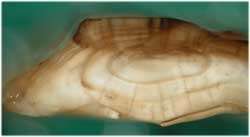
Otoliths, commonly called "ear stones," are actually inner ear bones that help fish sense their balance and movement in the water. Similar structures perform the same function in the human ear.
"As fish grow, the otoliths grow, too," said Bethann Mangel Pflugeisen, who just earned her master's degree in statistics at Ohio State. "Every day, new layers are deposited on the outside of the otolith. Trace elements from the water become embedded in the layers, and ecologists can read these chemical 'signatures' to reconstruct the life history of a fish."
Otoliths contain rings -- similar to tree rings -- that mark the passage of the seasons. Scientists can sample the material between the rings to tell where a fish was living during that particular season.
The walleye is the Ohio state fish, and it is prized by commercial fisheries, recreational anglers, and seafood lovers. It can be found all over the Great Lakes, but those that live in Lake Erie tend to spawn in either the Sandusky or Maumee -- two tributaries some 35 miles apart on the southwest lake shore. Wildlife officials regularly sample the populations to set size and number limits on how many fish can be caught each season.
Walleye appearance varies from Great Lake to Great Lake, but within any one lake, the fish look very similar, regardless of where they hatched. So ecologists have to use other means to identify a fish's river of origin.
Analyzing otoliths is a technique that has gained acceptance over the last decade. Mangel Pflugeisen used a statistical method that will help ecologists make the most of the limited information they can get.
She explained how her results could apply to fishery management.
"Almost no walleye stray from other sites to spawn at the Maumee," she said. "So if the Maumee is ever overfished, it is unlikely to recover, since fish won't be coming in from other sites to replenish the population. However, since so many fish from other sites stray to the Sandusky to spawn, the Sandusky is less vulnerable to overfishing. Officials would have a little more flexibility in the management of that river."
Her advisor, Catherine Calder, associate professor of statistics, explained the larger significance.
"While this research was motivated by the need to better understand particular Lake Erie walleye populations, the statistical techniques in Bethann's thesis are general enough to be directly applicable in studies of other fish species in different regions of the world," Calder said.
Mangel Pflugeisen decided to pursue the project after taking an aquatic ecology course from Elizabeth Marschall, associate professor of evolution, ecology, and organismal biology at Ohio State.
Marschall provided Lake Erie walleye data collected by one of her former graduate students, Jennell Bigrigg, who just earned her doctorate in veterinary medicine.
Bigrigg harvested nearly 250 walleye from the Sandusky and Maumee over three spawning seasons during the spring of 2003, 2004, and 2005. She removed a tiny ear bone, known as an otolith, from each fish, and measured the chemical elements contained in it.
Mangel Pflugeisen compared the amounts two key elements, strontium and calcium, at the core of each otolith -- the part of the bone that grew just after the fish hatched.
Bedrock beneath the Sandusky contains more strontium than bedrock beneath the Maumee. Yet both sites contain roughly equal amounts of calcium. So, she reasoned, fish hatched in the Sandusky should have absorbed much more strontium from the water during their early life, and stored much higher concentrations of strontium in their otoliths from that time.
Once she isolated a unique chemical signature for the two rivers, she used a statistical technique known as Bayesian hierarchical mixture modeling to analyze the data. The task was difficult, because the model had to account for the ratio of elements in the otoliths and in the water of both rivers at the same time.
The analysis showed that about 92 percent of the fish that were caught at the Maumee had also hatched in the Maumee, with a very small percentage having originated at the Sandusky.
At the Sandusky, however, only about 66 percent of the fish that were caught were returners -- that is, had been hatched in the Sandusky -- and about 30 percent originated at the Maumee.
The results confirmed what Marschall already suspected: the Maumee fish were straying to the Sandusky to spawn, but not vice versa.
"Dr. Marschall already had strong reason to believe that's what was happening, so I was not surprised by the results," Mangel Pflugeisen said. "But it was really neat to be able to back up her strong, ecologically-based sense of what was going on with a statistical analysis that yielded the same general trend, while also giving numerical estimates."
Provided by The Ohio State University


