Behind the secrets of silk lie high-tech opportunities
July 29, 2010
Behind the secrets of silk lie high-tech opportunities

Enlarge

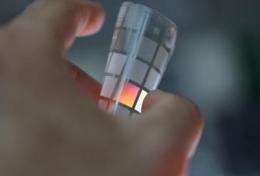
Tougher than a bullet-proof vest yet synonymous with beauty and luxury, silks spun by worms and spiders are a masterpiece of nature whose properties have yet to be fully replicated in the laboratory. But Tufts University biomedical engineers report that success in unraveling the secrets of silk is taking silk from the world of textiles to technology. This silk card shows diffractive optics entirely constituted by pure silk obtained by pouring silk solution on nanopatterned molds and letting the solution dry and crystallize. The resulting film retains the pattern and is a free-standing optical component so flexible it can be rolled up. Credit: Fiorenzo Omenetto/Tufts University

Tougher than a bullet-proof vest yet synonymous with beauty and luxury, silk fibers are a masterpiece of nature whose remarkable properties have yet to be fully replicated in the laboratory.

Thanks to their amazing mechanical properties as well as their looks, silk fibers have been important materials in textiles, medical sutures, and even armor for 5,000 years.

Silk spun by spiders and silk worms combines high strength and extensibility. This one-two punch is unmatched by synthetics, even though silk is made from a relatively simple protein processed from water.

But in recent years scientists have begun to unravel the secrets of silk.

In the July 30, 2010, issue of the journal Science, Tufts biomedical engineering researchers Fiorenzo Omenetto, Ph.D., and David Kaplan, Ph.D., report that "Silk-based materials have been transformed in just the past decade from the commodity textile world to a growing web of applications in more high technology directions."

Fundamental discoveries into how silk fibers are made have shown that chemistry, molecular biology and biophysics all play a role in the process. These discoveries have provided the basis for a new generation of applications for silk materials, from medical devices and drug delivery to electronics.

Edible Optics, Implantable Electronics

The Science paper notes that the development of silk hydrogels, films, fibers and sponges is making possible advances in photonics and optics, nanotechnology, electronics, adhesives and , as well as engineering of bone and ligaments. Because silk fiber formation does not rely on complex or toxic chemistries, such materials are biologically and environmentally friendly, even able to integrate with living systems.

Down the silk road of the future, Kaplan and Omenetto believe applications could include degradable and flexible electronic displays for sensors that are biologically and environmentally compatible and implantable for diagnosis and treatment. Progress in "edible optics" and implantable electronics has already been demonstrated by Kaplan and Omenetto, John Rogers at the University of Illinois at Urbana-Champaign, and others.

Many challenges remain. Kaplan and Omenetto say that key questions include how to fully replicate native silk assembly in the lab, how best to mimic silk protein sequences via genetic engineering to scale-up materials production, and how to use silk as a model polymer to spur new synthetic polymer designs that mimic natural silk's green chemistry.

Techniques for reprocessing natural silk protein in the lab continue to advance. Silks are also being cloned and expressed in a variety of hosts, including E. coli bacteria, fungi, plants and mammals, and through transgenic silkworms.

One day, efficient transgenic plants could be used to crop silk in much the same way that cotton is harvested today, the Tufts researchers note in their paper. In some regions, silk production might create a new microeconomy, as demand grows and production techniques improve.

"Based on the recent and rapid progression of materials from the ancient textile use into a host of new high-technology applications, we anticipate growth in the use of silks in a wide platform of applications will continue as answers to these remaining questions are obtained," say Omenetto and Kaplan.

Provided by Tufts University

4.5 /5 (10 votes)  

Filter


Move the slider to adjust rank threshold, so that you can hide some of the comments.


Display comments: newest first

Ravenrant
Jul 30, 2010

Rank: not rated yet
Tougher than a bulletproof vest? If we can make silk shirts why aren't we using it in a vest? So if I put on all 20 of mine it will stop a bullet?
RealScience
Jul 31, 2010

Rank: not rated yet
Yes, Ravenrant, if you put on 20 silk shirts it probably would stop a small or medium-caliber bullet.
You might find that the bullet had pushed the silk a few centimeters into your flesh, but if you pulled on the silk you would likely find that the bullet had not punctured the silk and that you could pull the bullet out.
Unpleasant, but a lot less unpleasant than being shot without the silk shirts.

('Tougher' is typically measured by weight.)
Rank 4.5 /5 (10 votes)
Related Stories
Relevant PhysicsForums posts
  • Stoichiometry
    createdFeb 10, 2012
  • Boiling and melting point of impure substances
    createdFeb 10, 2012
  • Safe nitrogen compound to decompose a 500 deg C in a furnace?
    createdFeb 09, 2012
  • [ask]electron inside drinking water
    createdFeb 08, 2012
  • How to avoid formation of Lithium Chromate ???
    createdFeb 08, 2012
  • how to choose a reduced or oxidated form in a redox
    createdFeb 08, 2012
  • More from Physics Forums - Chemistry

More news stories

Fool's gold may prove an unlikely alternative to overexploited catalytic materials

Catalytic materials, which lower the energy barriers for chemical reactions, are used in everything from the commercial production of chemicals to catalytic converters in car engines. However, with current catalytic materials ...

Chemistry / Materials Science

created 16 hours ago | popularity 4.4 / 5 (8) | comments 5 | with audio podcast

Unpicking HIV’s invisibility cloak

Drug researchers hunting for alternative ways to treat human immunodeficiency virus (HIV) infections may soon have a novel target—its camouflage coat. HIV hides inside a cloak unusually rich in a sugar ...

Chemistry / Biochemistry

created 16 hours ago | popularity 5 / 5 (5) | comments 0

Hydrogen from acidic water: Researchers develop potential low cost alternative to platinum for splitting water

A technique for creating a new molecule that structurally and chemically replicates the active part of the widely used industrial catalyst molybdenite has been developed by researchers with the Lawrence Berkeley ...

Chemistry / Materials Science

created Feb 09, 2012 | popularity 4.8 / 5 (14) | comments 15 | with audio podcast

No entry without protein recycling: Researchers discover new coherence in enzyme transport

The group of Prof. Dr. Ralf Erdmann at the Ruhr-Universität Bochum, Germany, discovered a connection of peroxisomal protein import and receptor export. In the Journal of Biological Chemistry, they disclo ...

Chemistry / Biochemistry

created 16 hours ago | popularity not rated yet | comments 0

Under the microscope #7

In this video Dr Ingrid Graz shows us a thin layer of gold on top of rubber. Cracks in the gold allow it to stretch and we can use this for stretchable electronics.

Chemistry / Other

created 18 hours ago | popularity not rated yet | comments 0


Anonymous knocks CIA website offline (Update)

The website of the Central Intelligence Agency was inaccessible on Friday after the hacker group Anonymous claimed to have knocked it offline.

New error-correcting codes guarantee the fastest possible rate of data transmission

Error-correcting codes are one of the triumphs of the digital age. They’re a way of encoding information so that it can be transmitted across a communication channel — such as an optical fiber o ...

Google users warned of threat to smartphone wallets

Users of Google smartphone wallets were being warned on Friday that there is a way to crack pass codes intended to thwart thieves from going on illicit shopping sprees.

Humans may have helped the decline of African rainforests 3000 years ago

(PhysOrg.com) -- Large areas of rainforests in Central Africa mysteriously disappeared over three thousand years ago, to be replaced by savannas. The prevailing theory has been that the cause was a change ...

New power source discovered

(PhysOrg.com) -- Researchers at the Massachusetts Institute of Technology (MIT) and RMIT University have made a breakthrough in energy storage and power generation.

Small modular reactor design could be a 'SUPERSTAR'

(PhysOrg.com) -- Though most of today's nuclear reactors are cooled by water, we've long known that there are alternatives; in fact, the world's first nuclear-powered electricity in 1951 came from a reactor ...