An Alchemist's Dream: Superatoms Mimic Elements
July 29, 2010
An Alchemist's Dream: Superatoms Mimic Elements

Enlarge

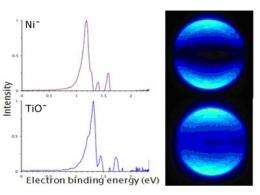
The team used photoelectron imaging spectroscopy to examine similarities between a nickel atom and a titanium-monoxide molecule. Left: Graphical displays of energy peaks were similar between a nickel atom and a titanium-monoxide molecule. Right: Bright spots in the images, which correspond to the energy of the electrons emitted during their removal from the atoms' outer shells, appeared to be similar between a nickel atom (right, top) and a titanium-monoxide molecule (right, bottom). Credit: Castleman lab, Penn State

(PhysOrg.com) -- Dr. Will Castleman and his team have discovered clusters of atoms that mimic some of the properties of other elements. Called "superatoms," these clusters of atoms behave like a single "superatom" of a different species, and they may have implications as significant as the alchemists' search for gold.

Castleman's search was part of Pacific Northwest National Laboratory's Frontiers in & Analysis Seminar Series. The series features academic, government, and industrial leaders who discuss novel ideas and advances in research and development.

Superatom clusters could serve as building blocks for new materials that are cheaper and more effective than materials currently being used as catalysts in chemical processing, and in the catalytic converters of automobiles. They may even have potential as new sources of energy.

The superatom concept was observed in studies involving aluminum clusters where, depending on the number of aluminum constituting the cluster, reactivity patterns would emerge mimicking the chemistry associated with isolated elements. Identifying potential cluster species in the gas-phase as novel catalysts that could be used to assemble new materials with specific properties has been an ongoing research pursuit in the Castleman labs at Pennsylvania State University. Instrumental in these studies were Patrick Roach and Samuel Peppernick, both former members of Dr. Castleman's group and now postdoctoral researchers at PNNL.

Electron configurations key to mimicking phenomenon: Castleman and his team have shown that certain combinations of elemental atoms have electron configurations that mimic those of other elements. The researchers also showed that the atoms that have been identified so far in these mimicry events can be predicted simply by looking at the .

Initially, Dr. Castleman and his team observed chemical behavior in superatom clusters that reflected the behavior of a given element. To provide quantitative evidence, they examined the photoelectron behavior in the superatoms, detaching and analyzing the electrons of a given cluster of atoms to see what orbital the electrons were coming from.

"We started working with titanium monoxide (TiO) and much to our surprise we saw the TiO was isoelectronic (having very similar electronic configurations) with nickel," Castleman said. "This amazed us because we started seeing behaviors where TiO looked like nickel. We thought this must just be a chance happening."

But the team looked at other species, including zirconium oxide, which is isoelectronic with palladium, and tungsten carbide which is isoelectronic with palladium. "When we analyzed the behavior for each of these species, we saw a behavior that was amazingly similar. It looked as though TiO was a superatom of nickel."

Using the periodic table to predict behavior: With this discovery, the team returned to the periodic table to look at species with similar valence electrons. They found that superatoms mimicking other elements could be predicted by simple arithmetic. Titanium, for example, has four outer-shell electrons, atomic oxygen has six. So move six to the right of titanium and you're at nickel, whose 10 outer-shell electrons make it isoelectronic with titanium oxide. Assuming this finding must be a coincidence, Castleman and his team tried it with other atoms and found a definite pattern. Castleman said he doesn't know if the pattern will be repeated across the entire periodic table. Right now, he and his team are working through the transition-metal atoms.

So why use a different element if the actual element is available? First, the element mimic might be less expensive, as in the case of palladium, which, at $100 a gram, is used as a catalyst in jet engines. At two cents a gram, zirconium oxide would be a worthy substitute. Dr. Castleman and his team are pursing this through a U.S Air Force grant.

Another reason is that you might want some cluster that has different functionalities than the actual element. "It might behave like one particular element, but would do something else, like detect something or destroy something," Castleman said.

Provided by Pacific Northwest National Laboratory (news : web)

4.9 /5 (8 votes)  

Filter


Move the slider to adjust rank threshold, so that you can hide some of the comments.


Display comments: newest first

Caliban
Jul 29, 2010

Rank: 1 / 5 (1)
Applications for superconductors, batteries, and a host of other technologies that are, or supposedly will be, limited by reliance on rare earth elemnts for their manufacture.
This is breakthrough science.
Jigga
Jul 29, 2010

Rank: 1 / 5 (5)
Actually we cannot mimic all properties so easily. For example nickel atoms dispersed at TiO2 are prone to oxidation with compare to platinum metal - so you cannot use them as an automobile exhaust catalyst.
Nik_2213
Aug 01, 2010

Rank: 5 / 5 (1)
This may be a way to explore the chemistry of the transuranics, especially those around the hypothesized 'island of stability' ~120.
Rank 4.9 /5 (8 votes)
Related Stories
Relevant PhysicsForums posts
  • Stoichiometry
    created7 hours ago
  • Boiling and melting point of impure substances
    created8 hours ago
  • Safe nitrogen compound to decompose a 500 deg C in a furnace?
    created15 hours ago
  • [ask]electron inside drinking water
    createdFeb 08, 2012
  • How to avoid formation of Lithium Chromate ???
    createdFeb 08, 2012
  • how to choose a reduced or oxidated form in a redox
    createdFeb 08, 2012
  • More from Physics Forums - Chemistry

More news stories

Under the microscope #7

In this video Dr Ingrid Graz shows us a thin layer of gold on top of rubber. Cracks in the gold allow it to stretch and we can use this for stretchable electronics.

Chemistry / Other

created 33 minutes ago | popularity not rated yet | comments 0

Hydrogen from acidic water: Researchers develop potential low cost alternative to platinum for splitting water

A technique for creating a new molecule that structurally and chemically replicates the active part of the widely used industrial catalyst molybdenite has been developed by researchers with the Lawrence Berkeley ...

Chemistry / Materials Science

created 18 hours ago | popularity 5 / 5 (11) | comments 11 | with audio podcast

Flexible paper robots

(PhysOrg.com) -- These inexpensive robots can stretch, bend and twist under control, and lift objects up to 120 times their own weight. Being soft, they can apply gentle and even pressure, and adapt to varied ...

Chemistry / Materials Science

created 16 hours ago | popularity 5 / 5 (5) | comments 3 | with audio podcast

New method makes culture of complex tissue possible in any lab

Scientists at the University of California, San Diego have developed a new method for making scaffolds for culturing tissue in three-dimensional arrangements that mimic those in the body. This advance, published online in ...

Chemistry / Biochemistry

created 15 hours ago | popularity 5 / 5 (4) | comments 0 | with audio podcast

Materials that shrink when heated

One common reason that people with fillings experience toothache is that their fillings expand at a different rate to the original tooth when, for example, drinking a hot drink. Contrary to intuition, however, ...

Chemistry / Materials Science

created 17 hours ago | popularity 5 / 5 (2) | comments 1


New error-correcting codes guarantee the fastest possible rate of data transmission

Error-correcting codes are one of the triumphs of the digital age. They’re a way of encoding information so that it can be transmitted across a communication channel — such as an optical fiber o ...

A frank discussion of the power law and linking correlation to causation

(PhysOrg.com) -- Michael Stumpf a mathematics professor at Imperial College in London, and Mason Porter a lecturer at Oxford have teamed together to write and publish a perspective piece in Science regarding the in ...

Mars Science Laboratory computer issue resolved

(PhysOrg.com) -- Engineers have found the root cause of a computer reset that occurred two months ago on NASA's Mars Science Laboratory and have determined how to correct it.

Advanced power-grid model finds low-cost, low-carbon future in West

(PhysOrg.com) -- The least expensive way for the Western U.S. to reduce greenhouse gas emissions enough to help prevent the worst consequences of global warming is to replace coal with renewable and other ...

Small modular reactor design could be a 'SUPERSTAR'

(PhysOrg.com) -- Though most of today's nuclear reactors are cooled by water, we've long known that there are alternatives; in fact, the world's first nuclear-powered electricity in 1951 came from a reactor ...

Clam fields found at deep, low-temperature Mariana vents

(PhysOrg.com) -- Scientists have marveled at the unusual life forms thriving at high temperature hydrothermal vents of the deep ocean.