Brown Dwarf Found Orbiting a Young Sun-Like Star
July 29, 2010
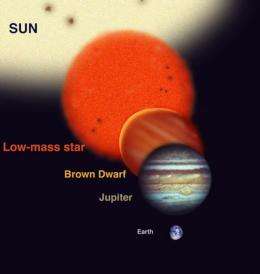
The range of sizes of a brown dwarf compared to Jupiter and the Sun and the Earth (to scale). Brown Dwarfs are more massive than planets but less massive than stars. But they have similar diameters to planets such as Jupiter. (Image by Jon Lomberg, provided by Gemini Observatory)
(PhysOrg.com) -- Astronomers have imaged a very young brown dwarf, or failed star, in a tight orbit around a young nearby sun-like star. The discovery is expected to shed light on the early stages of solar system formation.
Astronomers have imaged a very young brown dwarf, or failed star, in a tight orbit around a young nearby sun-like star.
An international team led by University of Hawaii astronomers Beth Biller and Michael Liu with help from University of Arizona astronomer Laird Close and UA graduate students Eric Nielsen, Jared Males and Andy Skemer made the rare find using the Near-Infrared Coronagraphic Imager, or NICI, on the international 8-meter Gemini-South Telescope in Chile.
What makes this discovery special is the proximity between the 36 Jupiter-mass brown dwarf companion, dubbed PZ Tel B, and its primary star, named PZ Tel A. They are separated by only 18 Astronomical Units, or AUs, similar to the distance between Uranus and the sun.
Most young brown dwarf and planetary companions found by direct imaging are at orbital separations greater than 50 AUs - larger than the orbit of Pluto, at 40 AUs.
In addition to its small separation, in just the past year the researchers observed PZ Tel B moving quickly outward from its parent star.
An older image, taken seven years ago and reanalyzed by Laird Close, a professor at UA's Steward Observatory and the department of astronomy, showed PZ Tel B was obscured by the glare from its parent star as recently as 2003, indicating its orbit is more elliptical than circular.
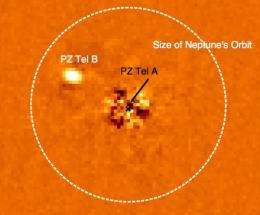
The sun-like star, PZ Tel A and its brown dwarf companion, PZ Tel B. The vast majority of light from PZ Tel A has been removed from this image using specialized image analysis techniques. For size comparison, the size of Neptune's orbit is shown; PZ Tel B is one of few brown dwarfs imaged at a distance closer than 30 Astronomical Units from its parent star. It travels around its star at a closer distance than Uranus revolves around our Sun. (Image provided by Beth Biller and the Gemini NICI Planet-Finding Campaign)
"Because PZ Tel A is a rare star being both close and very young, it had been imaged several times in the past," said Close. "So we were quite surprised to see a new companion around what was thought to be a single star."Lead author and UA graduate Beth Biller said, "PZ Tel B travels on a particularly eccentric orbit - in the last 10 years, we have literally watched it careen through its inner solar system. This can best be explained by a highly eccentric, or oval-shaped, orbit."
The host star, PZ Tel A, is a younger version of the sun, having a similar mass but a very young age of only 12 million years (about 400 times younger than the sun). In fact, the PZ Tel system is young enough to still possess significant amounts of cold circumstellar dust, which may have been sculpted by the gravitational interaction with the young brown dwarf companion.
This makes the PZ Tel system an important laboratory for studying the early stages of solar system formation. With an estimated mass of 36 times that of Jupiter, PZ Tel B's orbital motion has significant implications for what type of planets can form (and whether planets can form at all) in the PZ Tel system.
Because PZ Tel B is so close to its parent star, special techniques are necessary to distinguish the faint light of the companion from the light of the primary star. PZ Tel B is separated by 0.33 arcseconds from PZ Tel A, equivalent to a dime seen at a distance of 7 miles (11 km).
In order to take pictures so close to the star, the team used an adaptive optics system coupled to a coronagraph in order to block out excess starlight, and then applied specialized analysis techniques to the images to detect PZ Tel B and measure its orbital motion.
PZ Tel B was discovered using the Near-Infrared Coronagraphic Imager, or NICI, the most powerful high-contrast instrument designed for imaging brown dwarfs and extrasolar planets around other stars. NICI can detect companions 1 million times fainter than the host star at just 1 arcsecond separations.
An international team of researchers drawn from across the Gemini Telescope community is currently carrying out a 300-star survey with NICI, the largest high-contrast imaging survey conducted to date.
NICI campaign leader Michael Liu said: "We are just beginning to glean the many configurations of solar systems around stars like the sun. The unique capabilities of NICI provide us with a powerful tool for studying their constituents using direct imaging."
The discovery of PZ Tel B is described in a paper being published by Astrophysical Journal Letters.
-
The star, the dwarf and the planet
Oct 19, 2006 |
not rated yet |
0
-
Benchmark survey shows that giant outer extrasolar planets are rare
Jul 11, 2007 |
not rated yet |
0
-
A sub-stellar Jonah: Brown dwarf survives being swallowed
Aug 02, 2006 |
not rated yet |
0
-
First Detection of a Planet-Forming Disk Near Environment of a Dying Star
Jan 09, 2007 |
not rated yet |
0
-
Brown dwarf pair mystifies astronomers
Dec 21, 2009 |
not rated yet |
0
-
Engineers build first sub-10-nm carbon nanotube transistor
Feb 01, 2012 |
4.9 / 5 (30) |
30
-
Something old, something new: Evolution and the structural divergence of duplicate genes
Jan 31, 2012 |
4.6 / 5 (7) |
1
-
The hidden nanoworld of ice crystals: Revealing the dynamic behavior of quasi-liquid layers
Jan 30, 2012 |
5 / 5 (3) |
1
-
Stock market network reveals investor clustering
Jan 27, 2012 |
3.9 / 5 (23) |
8
-
Of microchemistry and molecules: Electronic microfluidic device synthesizes biocompatible probes
Jan 26, 2012 |
5 / 5 (1) |
0
-
Titan's lack of impact craters
19 hours ago
-
Real pictures of black hole eating a star?
Feb 08, 2012
-
Hypothetical way to travel faster than light, but not technically exceed lightspeed
Feb 06, 2012
-
How do scientists monitor the Sun's activity?
Feb 05, 2012
-
Search patterns in observational studies
Feb 05, 2012
-
Derivation of Pogson's law
Feb 03, 2012
- More from Physics Forums - General Astronomy
More news stories
Humans may have helped the decline of African rainforests 3000 years ago
(PhysOrg.com) -- Large areas of rainforests in Central Africa mysteriously disappeared over three thousand years ago, to be replaced by savannas. The prevailing theory has been that the cause was a change ...
NASA budget will axe Mars deal with Europe: scientists
US President Barack Obama's budget proposal to be submitted next week for 2013 will cut NASA's budget by 20 percent and eliminate a major partnership with Europe on Mars exploration, scientists said Thursday.
Space & Earth / Space Exploration
27 minutes ago |
not rated yet |
0
New views show old NASA Mars landers
(PhysOrg.com) -- The High Resolution Imaging Science Experiment (HiRISE) camera on NASA's Mars Reconnaissance Orbiter recorded a scene on Jan. 29, 2012, that includes the first color image from orbit showing ...
Space & Earth / Space Exploration
22 hours ago |
4.9 / 5 (7) |
9
|
Black holes and star formation
(PhysOrg.com) -- It has long been recognized that galaxy mergers or even close interactions can play a vital role in shaping the morphology of galaxies. One way they can do so, it is thought, is by triggering ...
21 hours ago |
4.1 / 5 (7) |
5
|
Deconstructing a mystery: What caused Snowmaggedon?
In the quiet after the storms, streets and cars had all but disappeared under piles of snow. The U.S. Postal Service suspended service for the first time in 30 years. Snow plows struggled to push the evidence ...
Space & Earth / Earth Sciences
14 hours ago |
4.7 / 5 (3) |
1
|
Protein libraries in a snap
(PhysOrg.com) -- A Rice University undergraduate will depart with not only a degree but also a possible patent for his invention of an efficient way to create protein libraries, an important component of biomolecular ...
Sleep breathing machine shows clear benefits in children with sleep apnea
Children and adolescents with obstructive sleep apnea had substantial improvements in attention, anxiety and quality of life after treatment with positive airway pressure (PAP)a nighttime therapy in which a machine ...
Neurologic improvement detected in rats receiving stem cell transplant
In a study to be presented today at the Society for Maternal-Fetal Medicine's annual meeting, The Pregnancy Meeting, in Dallas, Texas, researchers will report that early transplantation of human placenta-derived mesenchymal ...
Miami battling invasion of giant African snails
No one knows how they got there. But an invasion of African giant snails has southern Florida in a panic over potential crop damage, disease and general yuckiness surrounding the slimy gastropods.
Researchers show benefits of local anesthesia after knee replacement surgery
Researchers at the Rothman Institute at Jefferson have shown that local anesthesia delivered through a catheter in the joint, intraarticularly, may be more beneficial than traditional opioids such as morphine and Oxycontin ...
Study finds massively parallel sequencing can detect fetal aneuploidies, including Down syndrome
In a study to be presented today at the Society for Maternal-Fetal Medicine's annual meeting, The Pregnancy Meeting, in Dallas, Texas, researchers will report findings that indicate that massively parallel sequencing can ...

Jul 29, 2010
Rank: 4.3 / 5 (3)
This is an important step in the right direction toward understanding the origin of stars and planetary systems!
With kind regards,
Oliver K. Manuel
Former NASA Principal
Investigator for Apollo
Jul 29, 2010
Rank: not rated yet
Is there enough data to yet say what a "normal" stellar system might look like?
Jul 30, 2010
Rank: not rated yet
Fine-tuning the understanding of the relative abundance of different kinds of planetary systems is what this research is about.
Jul 30, 2010
Rank: 3 / 5 (2)
Run for the Hills. Oh... that's right. The hills are full of Reptiles and Greys -who inhabit them. darn. Can't go there! Anal probing AND being served up as dinner! (Not necessarily in that order)(apparently, I mean, I wouldn't know...never met the guy before in my life. Really! Would I lie?)
Run for the neighbor's pool, then. At least it's only got pee and bacteria in it.