Ancient reptiles 'make tracks'
July 29, 2010
Ancient reptiles 'make tracks'

Enlarge

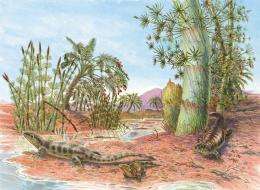
Ancient reptiles conquer continental interiors. Credit: © James Robins

A new discovery of fossilized footprints reveals when reptiles first conquered dry land.

The 318-million-year-old reptile footprints were found in sea-cliffs on the Bay of Fundy, New Brunswick, Canada. They show that were the first vertebrates (animals with a backbone) to conquer dry continental interiors. These pioneers paved the way for the diverse ecosystems that exist on land today.

The footprints were discovered by Dr Howard Falcon-Lang of Royal Holloway, University of London. The results of his study, undertaken with Professor Mike Benton of the University of Bristol and Canadian colleagues, are published today in the journal Palaeogeography, Palaeoclimatology, Palaeoecology.

It has long been suspected that reptiles were the first to make the continental interiors their home. This is because reptiles do not need to return to water to breed unlike their amphibian cousins. The new discovery of footprints proves this theory. The rocks in which they occur show that the reptiles lived on dry river plains hundreds of miles from the sea.

Professor Benton said: "The footprints date from the when a single supercontinent (Pangaea) dominated the world. At first life was restricted to coastal swamps where lush rainforest existed, full of giant ferns and dragonflies. However, when reptiles came on the scene they pushed back the frontiers, conquering the dry continental interiors."
Ancient reptiles 'make tracks'
Enlarge

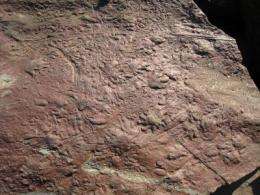
These are tetrapod trackways discovered in Nova Scotia by Dr. Howard Falcon-Lang, Royal Holloway, University of London. The trackways are the subject of research by Dr. Falcon-Lang and colleagues at the University of Bristol, UK, published this week in Palaeo-3. Credit: courtesy of Dr Howard Falcon-Lang

The same team reported the oldest known reptile from a different site in New Brunswick in 2007. The new discovery is of similar age, and may be even older.

Dr Falcon-Lang added: "The Bay of Fundy is such an amazing place to hunt for fossils. The sea-cliffs are rapidly eroding and each rock-fall reveals exciting new fossils. You just never know what will turn up next."

Provided by University of Bristol (news : web)


Rank 5 /5 (9 votes)
Related Stories
Relevant PhysicsForums posts
  • Pertubance in a model
    created6 hours ago
  • Cancer drugs and Alzheimer's, Oh my!
    created14 hours ago
  • Squishing cells
    created14 hours ago
  • Any books/articles for evolutionary stable strategy models in humans?
    createdFeb 09, 2012
  • Science behind the bore feeling?
    createdFeb 09, 2012
  • Homo Sapien vs. Chimpanzee - Divergence Timeline
    createdFeb 09, 2012
  • More from Physics Forums - Biology

More news stories

Employers feel no love for unscrupulous practice of 'service sweethearting'

A new study led by two Florida State University marketing professors finds that some frontline service employees who are rewarded for hikes in customer loyalty and satisfaction also may engage in "service ...

Other Sciences / Economics & Business

created 21 minutes ago | popularity not rated yet | comments 0

A frank discussion of the power law and linking correlation to causation

(PhysOrg.com) -- Michael Stumpf a mathematics professor at Imperial College in London, and Mason Porter a lecturer at Oxford have teamed together to write and publish a perspective piece in Science regarding the in ...

Other Sciences / Mathematics

created 6 hours ago | popularity 5 / 5 (1) | comments 2 | with audio podcast report

Sonic Cradle lands spot in TED exhibition

A Simon Fraser University graduate student project that melds music, meditation and modern technology has landed a rare spot as an exhibit at TEDActive 2012 in Palm Springs, California this month.

Other Sciences / Other

created 2 hours ago | popularity not rated yet | comments 0

The question of life in the ancient world

There’s a general feeling that we don’t get the Greeks – ancient or modern. Many, including heads of state like Angela Merkel, visibly shake their head in exasperation, rightly or wrongly, at ...

Other Sciences / Archaeology & Fossils

created 5 hours ago | popularity 1 / 5 (1) | comments 2

US workers are 'giving away the store,' costing firms billions

Nearly 70 percent of the nation's service employees give away free goods and services – from hamburgers to cable TV – costing companies billions of dollars a year, according to a groundbreaking study.

Other Sciences / Economics & Business

created 23 hours ago | popularity 4.5 / 5 (2) | comments 10


Putting the squeeze on planets outside our solar system

(PhysOrg.com) -- Using high-powered lasers, scientists at Lawrence Livermore National Laboratory and collaborators discovered that molten magnesium silicate undergoes a phase change in the liquid state, abruptly ...

India probes Google over 'forex transactions'

Indian authorities are probing whether online giant Google broke domestic foreign-exchange transactions rules while shifting funds abroad, the Press Trust of India reported on Friday.

Germany freezes signing of disputed Internet pact

Germany on Friday halted the signing of a controversial international accord billed as a way to beat online piracy that has sparked angry protests, saying it needed more time to consider it.

Health experts, scientists to discuss bird flu studies

The World Health Organization said Friday it will meet next week to determine whether scientists can publish research on a bird flu virus that may be easily passed among humans.

Obama forges compromise birth control plan

US President Barack Obama Friday announced a compromise to defuse a row over access to birth control which prompted election-year Republican critics to claim he was waging a war on religion.

US issues guidelines to avoid heparin contamination

Four years after US drug-maker Baxter International's blood thinner heparin was contaminated in China, causing dozens of deaths, US regulators on Friday issued draft guidelines for safe production.