Scientists post lower speed limit for cell-signaling protein assembly
July 29, 2010
Scientists post lower speed limit for cell-signaling protein assembly

Enlarge

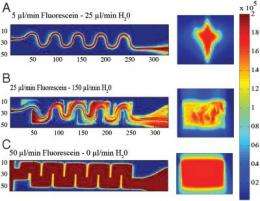
These are microscopic images of the serpentine-form mixing process for the Waldauer-Lapidus team's protein folding study. The different views show the effects of different flow rates. Panels at right show cross-section views. Credit: Waldauer/Lapidus/MSU

The apparently random self-assembly of molecular threads into the proteins that make the body work is far less frantic than previously thought, Michigan State University scientists say. That discovery could be a key to help unlock the nature of some diseases.

How proteins spontaneously "fold" from wiggling chains of into a wide variety of functional - or malfunctioning - three-dimensional molecules is one of the biggest mysteries in biochemistry.

"People thought they understood how protein diffusion worked, but now our data suggests they're wrong by a factor of 1,000," MSU physics and astronomy assistant professor Lisa Lapidus said. "Now we can start changing the models - we've been trying to solve protein folding for 50 years, and now we're advancing our fundamental understanding of what unfolded proteins do before they fold."

The findings were published online by the science journal . Lapidus was joined in the research by University of Zurich Institute of Physical Chemistry researcher Steven Waldauer, whose recent MSU doctoral dissertation formed the basis of the study, and University of California, Davis, scientist Olgica Bakajin.

Proteins, which do most of the work in the body's cells, are chain molecules composed of amino acids. The order in which the amino acids are assembled was charted by the , but the function of the protein depends on its shape, and how a protein folds is not yet understood. Much of the process is random and diffusive, like sugar moving through an unstirred cup of coffee.

Most proteins can fold in milliseconds, although there are so many possible combinations that left to chance it's physically impossible, scientists agree. So they speculate that there must be built-in folding pathways - but those remain unproved. Now physics is helping make sense of biology, posting a lower speed limit for proteins as they spontaneously assemble into their lowest-energy, so-called natural state - like a relaxed spring.

"In order to measure how quickly this random, unfolded state changes confirmations, we had to design an entirely new apparatus as well as design and fabricate a microfluidic chip capable of observing proteins within a fraction of a millisecond after being allowed to refold," Waldauer explained. Two lasers were employed to observe the formation of the immunoglobulin proteins.

"We found that the nature of the unfolded state is far from intuitive and that a protein will change from one random conformation to another much more slowly than previously thought," he said.

Scientists know that errors can occur in folding, and these are associated with a variety of diseases including Alzheimer's, ALS, cystic fibrosis and diabetes. Lapidus and colleagues speculate that the rate of the process could influence the outcome. Proteins that wiggle more rapidly, for example, may be more prone to sticking together and causing plaques such as those in Alzheimer's. The team's discovery may lead to new therapeutic strategies for this class of diseases.

"I believe this measurement of intramolecular diffusion is something that will be crucial for any subsequent studies of folding or mis-folding," Lapidus said.

Provided by Michigan State University (news : web)


Rank 5 /5 (4 votes)
Related Stories
Relevant PhysicsForums posts
  • Stoichiometry
    created13 hours ago
  • Boiling and melting point of impure substances
    created14 hours ago
  • Safe nitrogen compound to decompose a 500 deg C in a furnace?
    created21 hours ago
  • [ask]electron inside drinking water
    createdFeb 08, 2012
  • How to avoid formation of Lithium Chromate ???
    createdFeb 08, 2012
  • how to choose a reduced or oxidated form in a redox
    createdFeb 08, 2012
  • More from Physics Forums - Chemistry

More news stories

Fool's gold may prove an unlikely alternative to overexploited catalytic materials

Catalytic materials, which lower the energy barriers for chemical reactions, are used in everything from the commercial production of chemicals to catalytic converters in car engines. However, with current catalytic materials ...

Chemistry / Materials Science

created 4 hours ago | popularity 5 / 5 (2) | comments 1 | with audio podcast

Unpicking HIV’s invisibility cloak

Drug researchers hunting for alternative ways to treat human immunodeficiency virus (HIV) infections may soon have a novel target—its camouflage coat. HIV hides inside a cloak unusually rich in a sugar ...

Chemistry / Biochemistry

created 4 hours ago | popularity 5 / 5 (2) | comments 0

Flexible paper robots

(PhysOrg.com) -- These inexpensive robots can stretch, bend and twist under control, and lift objects up to 120 times their own weight. Being soft, they can apply gentle and even pressure, and adapt to varied ...

Chemistry / Materials Science

created 22 hours ago | popularity 5 / 5 (5) | comments 4 | with audio podcast

No entry without protein recycling: Researchers discover new coherence in enzyme transport

The group of Prof. Dr. Ralf Erdmann at the Ruhr-Universität Bochum, Germany, discovered a connection of peroxisomal protein import and receptor export. In the Journal of Biological Chemistry, they disclo ...

Chemistry / Biochemistry

created 4 hours ago | popularity not rated yet | comments 0

New method makes culture of complex tissue possible in any lab

Scientists at the University of California, San Diego have developed a new method for making scaffolds for culturing tissue in three-dimensional arrangements that mimic those in the body. This advance, published online in ...

Chemistry / Biochemistry

created 21 hours ago | popularity 5 / 5 (4) | comments 0 | with audio podcast


Putting the squeeze on planets outside our solar system

(PhysOrg.com) -- Using high-powered lasers, scientists at Lawrence Livermore National Laboratory and collaborators discovered that molten magnesium silicate undergoes a phase change in the liquid state, abruptly ...

Employers feel no love for unscrupulous practice of 'service sweethearting'

A new study led by two Florida State University marketing professors finds that some frontline service employees who are rewarded for hikes in customer loyalty and satisfaction also may engage in "service ...

Expat French get Internet vote for first time

French citizens will for the first time this year be able to vote in a parliamentary election over the Internet, an experiment that could be extended to other elections if successful.

"Twisted Metal" gamers get shot at real gunplay

Fans of "Twisted Metal" will get to welcome a long-awaited sequel of the car-battle videogame with a real-world bang by blasting an ice cream truck to bits with a machine gun.

The power of estrogen -- male snakes attract other males

A new study has shown that boosting the estrogen levels of male garter snakes causes them to secrete the same pheromones that females use to attract suitors, and turned the males into just about the sexiest ...

New error-correcting codes guarantee the fastest possible rate of data transmission

Error-correcting codes are one of the triumphs of the digital age. They’re a way of encoding information so that it can be transmitted across a communication channel — such as an optical fiber o ...