James Webb Space Telescope Completes Cryogenic Mirror Test
July 30, 2010
James Webb Space Telescope Completes Cryogenic Mirror Test

Enlarge

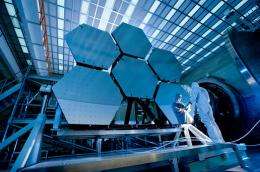
During cryogenic testing, the mirrors will be subjected to temperatures dipping to -415 degrees Fahrenheit, permitting engineers to measure in extreme detail how the shape of each mirror changes as it cools. (NASA/MSFC/David Higginbotham/Emmett Given)

Recently, six James Webb Space Telescope beryllium mirror segments completed a series of cryogenic tests at the X-ray & Cryogenic Facility at NASA's Marshall Space Flight Center in Huntsville, Ala.

During testing, the mirrors were subjected to extreme temperatures dipping to -415 degrees Fahrenheit, permitting NASA contractor engineers to measure in extreme detail how the shape of the mirror changes as it cools.

With those measurements, the mirrors will be shipped to Tinsley Corp. in Redmond, Calif., for final surface polishing at room temperature. Using those "surface error" measurements, each mirror will then be polished in the opposite of the surface error values observed, so when the mirror goes through the next round of cryogenic testing, at Marshall, it should "distort" into a perfect shape.

The facility at Marshall is the world’s largest X-ray telescope test facility and a unique site for cryogenic, clean-room optical testing.

The next set of mirrors are due to arrive at NASA Marshall in August.

The Webb telescope has a total of 18 mirrors. Each of the 18 mirror segments will be cryogenically tested twice in the Marshall Center's X-ray & Cryogenic Facility to ensure that the mirror will maintain its shape in a space environment -- once with bare polished and then again after a thin coating of gold is applied.

The cryogenic test gauges how each mirror changes temperature and shape over a range of operational temperatures in space. This helps predict how well the telescope will image infrared sources.

The mirrors are designed to stay cold to allow scientists to observe the infrared light they reflect using a telescope and instruments optimized to detect this light. Warm objects give off infrared light, or heat. If the Webb telescope mirror is too warm, the faint from distant galaxies may be lost in the infrared glow of the itself. Thus, the Webb telescope's mirrors need to operate in a deep cold or cryogenic state, at around -379 degree Fahrenheit.

Northrop Grumman is the prime contractor for the Webb telescope, leading a design and development team under contract to NASA's Goddard Space Flight Center in Greenbelt, Md.

The is NASA's next-generation premier space observatory, exploring deep space phenomena from the formation of distant galaxies to the behavior and interrelationships of nearby planets and stars. The Webb will give scientists clues about the formation of the universe and the evolution of our own solar system, from the first light after the Big Bang to the formation of star systems capable of supporting life on planets like Earth.

Provided by JPL/NASA (news : web)


Rank 5 /5 (7 votes)
Relevant PhysicsForums posts

More news stories

Bonding out: Making companies pay up front for potential environmental disasters

Whether it’s building an oil pipeline, drilling for fuel in the ocean or “fracking” to flush natural gas out of the Earth, we’re often asked to believe the process is safe, when companies want to do something ...

Space & Earth / Environment

created 2 minutes ago | popularity not rated yet | comments 0

Amasia: As next supercontinent forms, Arctic Ocean, Caribbean will vanish first

(PhysOrg.com) -- Geologists at Yale University have proposed a new theory to describe the formation of supercontinents, the epic process by which Earth’s major continental blocks combine into a single ...

Space & Earth / Earth Sciences

created 14 hours ago | popularity 4.1 / 5 (11) | comments 4 | with audio podcast

Astronomy team discovers nearby dwarf galaxy

(PhysOrg.com) -- A team led by UCLA research astronomer Michael Rich has used a unique telescope to discover a previously unknown companion to the nearby galaxy NGC 4449, which is some 12.5 million light years ...

Space & Earth / Astronomy

created 13 hours ago | popularity 4.3 / 5 (4) | comments 5 | with audio podcast

New images capture 'stealth merger' of dwarf galaxies

New images of a nearby dwarf galaxy have revealed a dense stream of stars in its outer regions, the remains of an even smaller companion galaxy in the process of merging with its host. The host galaxy, known ...

Space & Earth / Astronomy

created 14 hours ago | popularity 4 / 5 (2) | comments 0 | with audio podcast

Chandra finds Milky Way's black hole grazing on asteroids

(PhysOrg.com) -- The giant black hole at the center of the Milky Way may be vaporizing and devouring asteroids, which could explain the frequent flares observed, according to astronomers using data from NASA's ...

Space & Earth / Astronomy

created 14 hours ago | popularity 5 / 5 (5) | comments 6 | with audio podcast


Soraa LED light may dim 50-watt halogen rivals

(PhysOrg.com) -- Soraa, a Fremont, California company founded in 2008, this week launched its first product, a light that uses LEDS (light emitting diodes). The "Soraa LED MR16 lamp" is the "perfect" replacement for traditional ...

China's Alibaba raising $3bn for Yahoo! stake: report

Chinese online commerce giant Alibaba plans to borrow $3 billion to buy back the stake Yahoo! owns in the company, a report said Thursday, as the struggling US Internet firm overhauls its Asia holdings.

Study finds some medications may interact with common anti-recurrent preterm birth medication

In a study to be presented today at the Society for Maternal-Fetal Medicine's annual meeting, The Pregnancy Meeting, in Dallas, Texas, researchers will report findings that indicate that prescription medications may affect ...

Lenovo 3Q profit up by half, warns of disk supply

(AP) -- Lenovo Group Ltd., the world's second biggest personal computer maker, said Thursday that quarterly profit grew by more than half but warned hard drive costs would remain high amid a global shortage.

Life in Antarctic lake? It's everywhere else

If scientists find microbes in a frigid lake two miles beneath the thick ice of Antarctica, it will illustrate once again that somehow life finds a way to survive in the strangest and harshest places.

Researchers probe 200-year-old shipwreck off RI

(AP) -- For two centuries it rested a mile from shore, shrouded by a treacherous reef from the pleasure boaters and beachgoers who haunt New England's southern coast.