Nanomaterial in novel home-air treatment counters hazards from toxic drywall
July 30, 2010
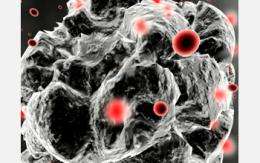
Artist's interpretation of FAST-ACT absorbing and destroying toxins. Credit: Trent Schindler, NSF
A nanomaterial originally developed to fight toxic waste is now helping reduce debilitating fumes in homes with corrosive drywall.
Developed by Kenneth Klabunde of Kansas State University, and improved over three decades with support from the National Science Foundation, the FAST-ACT material has been a tool of first responders since 2003.
Now, NanoScale Corporation of Manhattan, Kansas--the company Klabunde co-founded to market the technology--has incorporated FAST-ACT into a cartridge that breaks down the corrosive drywall chemicals.
Homeowners have reported that the chemicals--particularly sulfur compounds such as hydrogen sulfide and sulfur dioxide--have caused respiratory illnesses, wiring corrosion and pipe damage in thousands of U.S. homes with sulfur-rich, imported drywall.
"It is devastating to see what has happened to so many homeowners because of the corrosive drywall problem, but I am glad the technology is available to help," said Klabunde. "We've now adapted the technology we developed through years of research for FAST-ACT for new uses by homeowners, contractors and remediators."
The new cartridge, called OdorKlenz®, takes the place of the existing air filter in a home. The technology is similar to one that NanoScale adapted in 2008 for use by a major national disaster restoration service company for odors caused by fire and water damage.
In homes with corrosive drywall, the cartridge is used in combination with related FAST-ACT-based, OdorKlenz® surface treatments (and even laundry additives) to remove the sulfur-bearing compounds causing the corrosion issues.
Developers at NanoScale tested their new air cartridge in affected homes that were awaiting drywall removal, and in every case, odor dropped to nearly imperceptible levels within 10 days or less and corrosion was reduced.
The FAST-ACT material is a non-toxic mineral powder composed of the common elements magnesium, titanium and oxygen. While metal oxides similar to FAST-ACT have an established history tackling dangerous compounds, none have been as effective.
NanoScale's breakthrough was a new method to manufacture the compound as a nanocrystalline powder with extremely high surface area--only a few tablespoons have as much surface area as a football field.
The surface area allows more interactions between the metal oxides and the toxic molecules, enabling the powder to capture and destroy a large quantity of hazardous chemicals ranging from sulfuric acid to VX gas--and their hazardous byproducts--in minutes.
"The concept of nano-sized adsorbents as both a cost-efficient, useful product for first responders and an effective product for in-home use illustrates the wide spectrum of possibilities for this technology," said NSF program director Rosemarie Wesson, who oversaw NanoScale's NSF Small Business Innovation Resarch grants. "It is great to see the original work we supported to help reduce the toxic effects of hazardous spills now expand into other applications."
In coming months, the company is proposing its technology for use in Gulf Coast residences affected by the recent oil spill and other hazardous situations where airborne toxins are causing harm.
-
Nano-engineered Powders Tackle Toxic Chemicals
Apr 28, 2005 |
not rated yet |
0
-
Student Proving Walls (Even Sofas) Can Talk
Mar 04, 2009 |
not rated yet |
0
-
Glass sensors measure weathering effects
Sep 26, 2004 |
not rated yet |
0
-
Brookhaven Lab Patents New Method for Mercury Remediation
Sep 15, 2009 |
not rated yet |
0
-
Scrubbing sulfur: New process removes sulfur components, CO2 from power plant emissions (w/ Video)
Aug 18, 2009 |
not rated yet |
0
-
Engineers build first sub-10-nm carbon nanotube transistor
Feb 01, 2012 |
4.9 / 5 (31) |
30
-
Something old, something new: Evolution and the structural divergence of duplicate genes
Jan 31, 2012 |
4.6 / 5 (7) |
1
-
The hidden nanoworld of ice crystals: Revealing the dynamic behavior of quasi-liquid layers
Jan 30, 2012 |
5 / 5 (3) |
1
-
Stock market network reveals investor clustering
Jan 27, 2012 |
3.9 / 5 (23) |
8
-
Of microchemistry and molecules: Electronic microfluidic device synthesizes biocompatible probes
Jan 26, 2012 |
5 / 5 (1) |
0
-
polymer nanocomposites
12 hours ago
-
Corrosion Tests on Magnesium
Feb 09, 2012
-
polyethylene copper nanocomposite
Feb 09, 2012
-
Output of xrd analysis
Feb 08, 2012
-
Transport phenomena problem based on problems 18.B11 and 19B.6 from Bird, stewart, lw
Feb 06, 2012
-
Help with material selection - Car Piston
Feb 05, 2012
- More from Physics Forums - Materials & Chemical Engineering
More news stories
What lies beneath: Mapping hidden nanostructures
The ability to diagnose and predict the properties of materials is vital, particularly in the expanding field of nanotechnology. Electron and atom-probe microscopy can categorize atoms in thin sheets of material, ...
5 hours ago |
5 / 5 (1) |
1
'Dark plasmons' transmit energy
Microscopic channels of gold nanoparticles have the ability to transmit electromagnetic energy that starts as light and propagates via "dark plasmons," according to researchers at Rice University.
21 hours ago |
5 / 5 (6) |
1
|
New kind of solar cell could capture significantly more energy than current cells
New solar cells could increase the maximum efficiency of solar panels by over 25%, according to scientists from the University of Cambridge.
Feb 08, 2012 |
4.5 / 5 (12) |
14
|
Nanoshell whispering galleries improve thin solar panels
Visitors to Statuary Hall in the U.S. Capitol Building may have experienced a curious acoustic feature that allows a person to whisper softly at one side of the cavernous, half-domed room and for another on ...
Nanotechnology / Nanomaterials
Feb 07, 2012 |
4.3 / 5 (6) |
6
|
Nanotube therapy takes aim at breast cancer stem cells
Wake Forest Baptist Medical Center researchers have again proven that injecting multiwalled carbon nanotubes (MWCNTs) into tumors and heating them with a quick, 30-second laser treatment can kill them.
Nanotechnology / Bio & Medicine
Feb 09, 2012 |
5 / 5 (1) |
0
|
Human cognitive performance suffers following natural disasters, researchers find
Not surprisingly, victims of a natural disaster can experience stress and anxiety, but a new study indicates that it might also cause them to make more errors - some serious - in their daily lives. In their upcoming Human Fa ...
"Twisted Metal" gamers get shot at real gunplay
Fans of "Twisted Metal" will get to welcome a long-awaited sequel of the car-battle videogame with a real-world bang by blasting an ice cream truck to bits with a machine gun.
Putting the squeeze on planets outside our solar system
(PhysOrg.com) -- Using high-powered lasers, scientists at Lawrence Livermore National Laboratory and collaborators discovered that molten magnesium silicate undergoes a phase change in the liquid state, abruptly ...
The power of estrogen -- male snakes attract other males
A new study has shown that boosting the estrogen levels of male garter snakes causes them to secrete the same pheromones that females use to attract suitors, and turned the males into just about the sexiest ...
Both maternal and paternal age linked to autism
Older maternal and paternal age are jointly associated with having a child with autism, according to a recently published study led by researchers at The University of Texas Health Science Center at Houston (UTHealth).
New error-correcting codes guarantee the fastest possible rate of data transmission
Error-correcting codes are one of the triumphs of the digital age. Theyre a way of encoding information so that it can be transmitted across a communication channel such as an optical fiber o ...