On the path to quantum computers: Ultra-strong interaction between light and matter realized
July 30, 2010
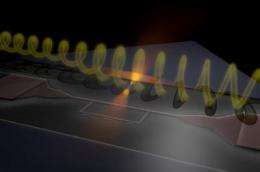
This is an impression of the interaction between a superconducting electrical circuit and a microwave photon. Credit: Dr. A. Marx, Technische Universitaet Muenchen
Researchers around the world are working on the development of quantum computers that will be vastly superior to present-day computers. Here, the strong coupling of quantum bits with light quanta plays a pivotal role. Professor Rudolf Gross, a physicist at the Technische Universitaet Muenchen, Germany, and his team of researchers have now realized an extremely strong interaction between light and matter that may represent a first step in this direction.
The interaction between matter and light represents one of the most fundamental processes in physics. Whether a car that heats up like an oven in the summer due to the absorption of light quanta or solar cells that extract electricity from light or light-emitting diodes that convert electricity into light, we encounter the effects of these processes throughout our daily lives. Understanding the interactions between individual light particles - photons - and atoms is crucial for the development of a quantum computer.
Physicists from the Technische Universitaet Muenchen (TUM), the Walther-Meissner-Institute for Low Temperature Research of the Bavarian Academy of Sciences (WMI) and the Augsburg University have now, in collaboration with partners from Spain, realized an ultrastrong interaction between microwave photons and the atoms of a nano-structured circuit. The realized interaction is ten times stronger than levels previously achieved for such systems.
The simplest system for investigating the interactions between light and matter is a so-called cavity resonator with exactly one light particle and one atom captured inside (cavity quantum electrodynamics, cavity QED). Yet since the interaction is very weak, these experiments are very elaborate. A much stronger interaction can be obtained with nano-structured circuits in which metals like aluminum become superconducting at temperatures just above absolute zero (circuit QED). Properly configured, the billions of atoms in the merely nanometer thick conductors behave like a single artificial atom and obey the laws of quantum mechanics. In the simplest case, one obtains a system with two energy states, a so-called quantum bit or qubit.
Coupling these kinds of systems with microwave resonators has opened a rapidly growing new research domain in which the TUM Physics, the WMI and the cluster of excellence Nanosystems Initiative Munich (NIM) are leading the field. In contrast to cavity QED systems, the researchers can custom tailor the circuitry in many areas.
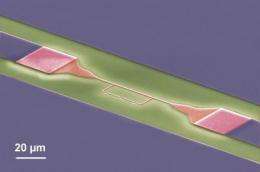
This is an electron microscopical picture of the superconducting circuit (red: Aluminum-Qubit, grey: Niob-Resonator, green: Silicon substrate). Credit: Thomasz Niemczyk, Technische Universitaet Muenchen
To facilitate the measurements, Professor Gross and his team captured the photon in a special box, a resonator. This consists of a superconducting niobium conducting path that is configured with strongly reflective "mirrors" for microwaves at both ends. In this resonator, the artificial atom made of an aluminum circuit is positioned so that it can optimally interact with the photon. The researchers achieved the ultrastrong interactions by adding another superconducting component into their circuit, a so-called Josephson junction.The measured interaction strength was up to twelve percent of the resonator frequency. This makes it ten times stronger than the effects previously measureable in circuit QED systems and thousands of times stronger than in a true cavity resonator. However, along with their success the researchers also created a new problem: Up to now, the Jaynes-Cummings theory developed in 1963 was able to describe all observed effects very well. Yet, it does not seem to apply to the domain of ultrastrong interactions. "The spectra look like those of a completely new kind of object," says Professor Gross. "The coupling is so strong that the atom-photon pairs must be viewed as a new unit, a kind of molecule comprising one atom and one photon.
Experimental and theoretical physicists will need some time to examine this more closely. However, the new experimental inroads into this domain are already providing researchers with a whole array of new experimental options. The targeted manipulation of such atom-photon pairs could hold the key to quanta-based information processing, the so-called quantum computers that would be vastly superior to today's computers.
More information: Circuit quantum electrodynamics in the ultrastrong-coupling regime, T. Niemczyk, F. Deppe, H. Huebl, E. P. Menzel, F. Hocke, M. J. Schwarz, J. J. Garcia-Ripoll, D. Zueco, T. Hümmer, E. Solano, A. Marx and R. Gross, Nature Physics, published online July 25, 2010 - DOI:10.1038/NPHYS1730
Provided by Technische Universitaet Muenchen
-
Yale scientists bring quantum optics to a microchip
Sep 08, 2004 |
not rated yet |
0
-
From a classical laser to a 'quantum laser'
Mar 31, 2010 |
not rated yet |
0
-
NIST Develops 'Dimmer Switch' for Superconducting Quantum Computing
Apr 27, 2010 |
not rated yet |
0
-
Entangled Light in Bose-Einstein Condensates
Apr 08, 2009 |
not rated yet |
0
-
Effects of 'strong coupling' observed for the first time between light and a micromechanical object
Aug 06, 2009 |
not rated yet |
0
-
Engineers build first sub-10-nm carbon nanotube transistor
Feb 01, 2012 |
4.9 / 5 (30) |
30
-
Something old, something new: Evolution and the structural divergence of duplicate genes
Jan 31, 2012 |
4.6 / 5 (7) |
1
-
The hidden nanoworld of ice crystals: Revealing the dynamic behavior of quasi-liquid layers
Jan 30, 2012 |
5 / 5 (3) |
1
-
Stock market network reveals investor clustering
Jan 27, 2012 |
3.9 / 5 (23) |
8
-
Of microchemistry and molecules: Electronic microfluidic device synthesizes biocompatible probes
Jan 26, 2012 |
5 / 5 (1) |
0
-
Acousto optical modulators
1 hour ago
-
Jerk during Gravitation
2 hours ago
-
2 springs attached by a rigid massless bar
3 hours ago
-
Thermal conductivity value of (.17-.20)W/m.K
3 hours ago
-
Which energy is easier to catch? LED or laser
8 hours ago
-
two boxes with same initial velocity on a 2d track but one is at top of a hill
8 hours ago
- More from Physics Forums - Classical Physics
More news stories
Borexino Collaboration succeeds in spotting pep neutrinos emitted from the sun
(PhysOrg.com) -- To learn more about how the sun works, scientists study particles that are emitted from it into space due to thermonuclear reactions that occur inside; by applying known physics principles, ...
Explained: Sigma
It's a question that arises with virtually every major new finding in science or medicine: What makes a result reliable enough to be taken seriously? The answer has to do with statistical significance -- but ...
10 hours ago |
5 / 5 (6) |
13
Physics research suggests new pathways for cancer progression
Observing that certain cancer cells may exhibit greater flexibility than normal cells, some scientists believe that this capability promotes rapid tumor growth. Now computer simulations developed by Boston University Biomedical ...
7 hours ago |
5 / 5 (1) |
0
Quantum physicist explains $100K offer for proof scaled-up quantum computing is impossible
(PhysOrg.com) -- MIT researcher Scott Aaronson has certainly riled the physics community with his offer this past Friday, of $100,000 to anyone who can prove that scaled-up quantum computing is impossible. ...
Physicists build highly efficient 'no-waste' laser
A team of University of California, San Diego researchers has built the smallest room-temperature nanolaser to date, as well as an even more startling device: a highly efficient, "thresholdless" laser that ...
Feb 08, 2012 |
5 / 5 (18) |
5
|
'Dark plasmons' transmit energy
Microscopic channels of gold nanoparticles have the ability to transmit electromagnetic energy that starts as light and propagates via "dark plasmons," according to researchers at Rice University.
Decoding the molecular machine behind E. coli and cholera
Scientists from Queen Mary, University of London have discovered the workings behind some of the bacteria that kill hundreds of thousands every year, possibly paving the way for new antibiotics that could treat infections ...
Deadly bird parasite evolves at exceptionally fast rate
A new study of a devastating bird disease that spread from poultry to house finches in the mid-1990s reveals that the bacteria responsible for the disease evolves at an exceptionally fast rate. What's more, ...
Flexible paper robots
(PhysOrg.com) -- These inexpensive robots can stretch, bend and twist under control, and lift objects up to 120 times their own weight. Being soft, they can apply gentle and even pressure, and adapt to varied ...
Cell biologists describes mechanism by which some people may be more susceptible to colon cancer
An international research team led by cell biologists at the University of California, Riverside has uncovered a new insight into colon cancer, the third leading cause of cancer-related deaths in the United ...
New method makes culture of complex tissue possible in any lab
Scientists at the University of California, San Diego have developed a new method for making scaffolds for culturing tissue in three-dimensional arrangements that mimic those in the body. This advance, published online in ...

Aug 01, 2010
Rank: 5 / 5 (1)
Aug 02, 2010
Rank: not rated yet
Aug 02, 2010
Rank: not rated yet
Aug 04, 2010
Rank: not rated yet
Also, how does another party know that it has been measured? This is where I really need a better understanding because it appears to me that a qubit is nothing more than a bit whose value is unknown( or in quantum terms - superposition ). For example schrodinger's cat does not appear to me as having both states of alive and dead. To me it is simply unknown. Now if I observe the cat as in fact being dead and then close the box( and told no one of my observation), how would anyone else know what the state of the cat is? More importantly would it not still retain its quantum state to everyone else with the exception of myself?