Blowing in the Wind: Cassini Helps with Dune Whodunit
July 30, 2010
Blowing in the Wind: Cassini Helps with Dune Whodunit

Enlarge

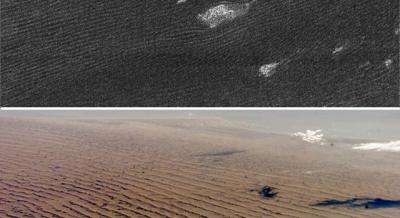
Cassini radar sees sand dunes on Saturn's giant moon Titan (upper photo) that are sculpted like Namibian sand dunes on Earth (lower photo). The bright features in the upper radar photo are not clouds but topographic features among the dunes. Image credit: NASA/JPL (upper photo); NASA/JSC (lower photo)

(PhysOrg.com) -- The answer to the mystery of dune patterns on Saturn's moon Titan did turn out to be blowing in the wind. It just wasn't from the direction many scientists expected.

Basic principles describing the rotation of planetary atmospheres and data from the European Space Agency's Huygens probe led to circulation models that showed surface winds streaming generally east-to-west around Titan's equatorial belt. But when NASA's obtained the first images of dunes on Titan in 2005, the dunes' orientation suggested the sands - and therefore the winds - were moving from the opposite direction, or west to east.

A new paper by Tetsuya Tokano in press with the journal Aeolian Research seeks to explain the paradox. It explains that seasonal changes appear to reverse patterns on Titan for a short period. These gusts, which occur intermittently for perhaps two years, sweep west to east and are so strong they do a better job of transporting sand than the usual east-to-west surface winds. Those east-to-west winds do not appear to gather enough strength to move significant amounts of sand.

A related perspective article about Tokano's work by Cassini radar scientist Ralph Lorenz, the lead author on a 2009 paper mapping the dunes, appears in this week's issue of the journal Science.

"It was hard to believe that there would be permanent west-to-east winds, as suggested by the dune appearance," said Tokano, of the University of Cologne, Germany. "The dramatic, monsoon-type wind reversal around equinox turns out to be the key."

The dunes track across the vast sand seas of Titan only in latitudes within 30 degrees of the equator. They are about a kilometer (half a mile) wide and tens to hundreds of kilometers (miles) long. They can rise more than 100 meters (300 feet) high. The sands that make up the dunes appear to be made of organic, hydrocarbon particles. The dunes' ridges generally run west-to-east, as wind here generally sheds sand along lines parallel to the equator.

Scientists predicted winds in the low latitudes around Titan's equator would blow east-to-west because at higher latitudes the average wind blows west-to-east. The wind forces should balance out, based on basic principles of rotating atmospheres.
Blowing in the Wind: Cassini Helps with Dune Whodunit
Enlarge

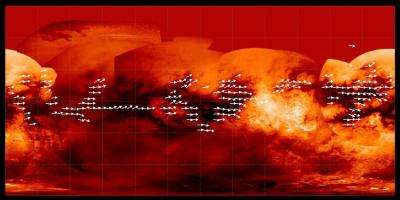
Scientists have used data from the Cassini radar mapper to map the global wind pattern on Saturn's moon Titan using data collected over a four-year period, as depicted in this image. Image credit: NASA/JPL/Space Science Institute

Tokano re-analyzed a computer-based global circulation model for Titan he put together in 2008. That model, like others for Titan, was adapted from ones developed for Earth and Mars. Tokano added in new data on Titan topography and shape based on Cassini radar and gravity data. In his new analysis, Tokano also looked more closely at variations in the wind at different points in time rather than the averages. Equinox periods jumped out.

Equinoxes occur twice a Titan year, which is about 29 Earth years. During equinox, the sun shines directly over the equator, and heat from the sun creates upwelling in the atmosphere. The turbulent mixing causes the winds to reverse and accelerate. On Earth, this rare kind of wind reversal happens over the Indian Ocean in transitional seasons between monsoons.

The episodic reverse winds on Titan appear to blow around 1 to 1.8 meters per second (2 to 4 mph). The threshold for sand movement appears to be about 1 meter per second (2 mph), a speed that the typical east-to-west winds never appear to surpass. Dune patterns sculpted by strong, short episodes of wind can be found on Earth in the northern Namib sand seas in Namibia, Africa.

"This is a subtle discovery -- only by delving into the statistics of the winds in the model could this rather distressing paradox be resolved," said Ralph Lorenz, a Cassini scientist based at the Johns Hopkins University Applied Physics Laboratory in Laurel, Md. "This work is also reassuring for preparations for proposed future missions to Titan, in that we can become more confident in predicting the winds which can affect the delivery accuracy of landers, or the drift of balloons."

Provided by JPL/NASA (news : web)

4.8 /5 (5 votes)  

Rank 4.8 /5 (5 votes)
Related Stories
Relevant PhysicsForums posts
  • Titan's lack of impact craters
    createdFeb 09, 2012
  • Real pictures of black hole eating a star?
    createdFeb 08, 2012
  • Hypothetical way to travel faster than light, but not technically exceed lightspeed
    createdFeb 06, 2012
  • How do scientists monitor the Sun's activity?
    createdFeb 05, 2012
  • Search patterns in observational studies
    createdFeb 05, 2012
  • Derivation of Pogson's law
    createdFeb 03, 2012
  • More from Physics Forums - General Astronomy

More news stories

Humans may have helped the decline of African rainforests 3000 years ago

(PhysOrg.com) -- Large areas of rainforests in Central Africa mysteriously disappeared over three thousand years ago, to be replaced by savannas. The prevailing theory has been that the cause was a change ...

Space & Earth / Environment

created 10 hours ago | popularity 5 / 5 (3) | comments 9 | with audio podcast report

Could Venus be shifting gear?

(PhysOrg.com) -- ESA’s Venus Express spacecraft has discovered that our cloud-covered neighbour spins a little slower than previously measured. Peering through the dense atmosphere in the infrared, the ...

Space & Earth / Space Exploration

created 6 hours ago | popularity 5 / 5 (5) | comments 7 | with audio podcast

Mars Science Laboratory computer issue resolved

(PhysOrg.com) -- Engineers have found the root cause of a computer reset that occurred two months ago on NASA's Mars Science Laboratory and have determined how to correct it.

Space & Earth / Space Exploration

created 7 hours ago | popularity 5 / 5 (5) | comments 3 | with audio podcast

Clam fields found at deep, low-temperature Mariana vents

(PhysOrg.com) -- Scientists have marveled at the unusual life forms thriving at high temperature hydrothermal vents of the deep ocean.

Space & Earth / Earth Sciences

created 6 hours ago | popularity not rated yet | comments 0 | with audio podcast

Two new moons for Jupiter

Advances in technology have lead to the discovery of new planets outside of our Solar System, and now even new moons in our own backyard.

Space & Earth / Space Exploration

created 6 hours ago | popularity not rated yet | comments 3


Human cognitive performance suffers following natural disasters, researchers find

Not surprisingly, victims of a natural disaster can experience stress and anxiety, but a new study indicates that it might also cause them to make more errors - some serious - in their daily lives. In their upcoming Human Fa ...

The power of estrogen -- male snakes attract other males

A new study has shown that boosting the estrogen levels of male garter snakes causes them to secrete the same pheromones that females use to attract suitors, and turned the males into just about the sexiest ...

New error-correcting codes guarantee the fastest possible rate of data transmission

Error-correcting codes are one of the triumphs of the digital age. They’re a way of encoding information so that it can be transmitted across a communication channel — such as an optical fiber o ...

Putting the squeeze on planets outside our solar system

(PhysOrg.com) -- Using high-powered lasers, scientists at Lawrence Livermore National Laboratory and collaborators discovered that molten magnesium silicate undergoes a phase change in the liquid state, abruptly ...

Both maternal and paternal age linked to autism

Older maternal and paternal age are jointly associated with having a child with autism, according to a recently published study led by researchers at The University of Texas Health Science Center at Houston (UTHealth).

Curry spice component may help slow prostate tumor growth

Curcumin, an active component of the Indian curry spice turmeric, may help slow down tumor growth in castration-resistant prostate cancer patients on androgen deprivation therapy (ADT), a study from researchers ...