Great Barrier Reef corals unveil sea level and climate changes
July 30, 2010
Great Barrier Reef corals unveil sea level and climate changes

Enlarge

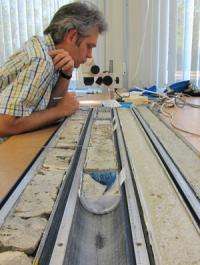
Researchers examining the fossil coral reef cores have found climate change has not been smooth and continuous.

(PhysOrg.com) -- Groundbreaking preliminary findings from the Great Barrier Reef show climate change has not been smooth and continuous but may have been characterised by several rapid changes.

A team of international scientists, including Dr Jody Webster from the University of Sydney, have taken part in a groundbreaking voyage to the Great Barrier Reef between February to April this year to acquire fossil coral reef cores from the edge of the continental shelf.

The team has discovered the fossil reef that grew from the last Ice Age when and climate were very different from today. The team, led by co-chief scientists Dr Webster, and Dr Yusuke Yokoyama from the University of Tokyo, have now begun investigating these cores and their unique archive of past sea-level and climate change and how the Great Barrier Reef responded to these major environmental changes.

The Great Barrier Reef Environmental Changes Expedition (GBREC) is the only expedition in Australian waters that forms part of the Integrated (IODP), which is a multi-million dollar international collaboration with US, Europe, Japan , Australia, New Zealand, China, and India, that explores Earth's history and structure as it is recorded in seafloor sediments and rocks, and sub-seafloor environments.

The preliminary findings from the IODP Onshore Science Party held in Bremen, Germany in July unveiled fossil coral reefs up to 30,000 years old and showed how the responded to rapid rises of sea level and changes in climate.

The investigation team recovered more than 225 metres of material from 34 holes at three key geographical locations on the outer edge of the Great Barrier Reef.

The Great Barrier Reef is a significant site for the expedition because it is a tectonically inactive area situated a long way from glaciated regions that might bias global sea level reconstructions.

"The Great Barrier Reef is on a tectonically stable portion of the Earth's crust and is a prime location to investigate sea level changes over the last 20,000 years including the final phase of the last ice age," Dr Webster said.

" are excellent sea-level indicators, and their accurate dating by mass spectrometry is critical for constraining the timing, rate and amplitude of deglaciation events."

Although the investigations deal with past events in Earth history they can be very important to our understanding of how the modern Great Barrier Reef, a World Heritage Site since 1980, will respond to future changes.

Analysis of the cores will provide important insights into how robust the reef is over different timescales and under different environmental conditions and stresses such as changing sea level and sea-surface temperatures, changing sediment input and ocean chemistry.

"The expedition has provided us with a truly unique opportunity to test ecologic theories about coral reef resilience and the vulnerability of the to future climate change," Dr Webster said.

A preliminary report of the GBREC Expedition is due to be released in the next six to eight weeks. A more detailed report of the expedition and scientific papers concerning the findings will be released later next year.

Provided by University of Sydney

4.7 /5 (6 votes)  

Filter


Move the slider to adjust rank threshold, so that you can hide some of the comments.


Display comments: newest first

TegiriNenashi
Jul 30, 2010

Rank: 1 / 5 (1)
Jules from Pulp Fiction: Say "robust" again. SAY "ROBUST AGAIN". I dare you, I double dare you. Say Robust one more time.
Rank 4.7 /5 (6 votes)
Related Stories
Relevant PhysicsForums posts
  • Wind Waves in Reservoir ~ Wind run-up and Wind set-up
    createdFeb 08, 2012
  • Balance of oxygen in the atmosphere
    createdFeb 01, 2012
  • The case for a methanol-based economy
    createdJan 30, 2012
  • Weather in a rotating cylinder
    createdJan 25, 2012
  • Importance of difference between SVP over ice and water?
    createdJan 19, 2012
  • Ozone and atmosphere sampling
    createdJan 16, 2012
  • More from Physics Forums - Earth

More news stories

Astronomy team discovers nearby dwarf galaxy

(PhysOrg.com) -- A team led by UCLA research astronomer Michael Rich has used a unique telescope to discover a previously unknown companion to the nearby galaxy NGC 4449, which is some 12.5 million light years ...

Space & Earth / Astronomy

created 12 hours ago | popularity 4.3 / 5 (4) | comments 5 | with audio podcast

Amasia: As next supercontinent forms, Arctic Ocean, Caribbean will vanish first

(PhysOrg.com) -- Geologists at Yale University have proposed a new theory to describe the formation of supercontinents, the epic process by which Earth’s major continental blocks combine into a single ...

Space & Earth / Earth Sciences

created 13 hours ago | popularity 4.1 / 5 (11) | comments 4 | with audio podcast

In scientific coup, Russians reach Antarctic lake

After more than two decades of drilling in Antarctica, Russian scientists have reached a gigantic freshwater lake hidden under miles of ice for some 20 million years - a pristine body of water that may hold ...

Space & Earth / Earth Sciences

created 13 hours ago | popularity 4.8 / 5 (6) | comments 6

Chandra finds Milky Way's black hole grazing on asteroids

(PhysOrg.com) -- The giant black hole at the center of the Milky Way may be vaporizing and devouring asteroids, which could explain the frequent flares observed, according to astronomers using data from NASA's ...

Space & Earth / Astronomy

created 13 hours ago | popularity 5 / 5 (5) | comments 5 | with audio podcast

Study shows global glaciers, ice caps, shedding billions of tons of mass annually

Earth's glaciers and ice caps outside of the regions of Greenland and Antarctica are shedding roughly 150 billion tons of ice annually, according to a new study led by the University of Colorado Boulder.

Space & Earth / Earth Sciences

created 16 hours ago | popularity 5 / 5 (5) | comments 5 | with audio podcast


Amazing skin gives sharks a push

Shark skin has long been known to improve the fish's swimming performance by reducing drag, but now George Lauder and Johannes Oeffner from Harvard University show that in addition, the skin generates thrust, giving the fish ...

Fruit flies drawn to the sweet smell of youth

Aging takes its toll on sex appeal and now an international team of researchers led by Baylor College of Medicine and the University of Michigan find that in fruit flies, at least, it even diminishes the come-hither ...

Life in Antarctic lake? It's everywhere else

If scientists find microbes in a frigid lake two miles beneath the thick ice of Antarctica, it will illustrate once again that somehow life finds a way to survive in the strangest and harshest places.

New study shows high cost of defensive medicine

Vanderbilt University Medical Center researchers estimate that U.S. orthopaedic surgeons create approximately $2 billion per year in unnecessary health care costs associated with orthopaedic care due to the practice of defensive ...

Continental mosquito with 'vector' potential found breeding in UK after 60 year absence

A species of mosquito has been discovered breeding in the UK that has not been seen in the country since 1945. Populations of the mosquito, found across mainland Europe and known only by its Latin name Culex modestus, were r ...

Presdisposition to common heart disease 'passed on from father to son'

A common heart disease which kills thousands each year may be passed genetically from father to son, according to a study led by the University of Leicester.