Speedy Train Technology Finds New Food Safety Niche
July 30, 2010 By Mary Caperton Morton
Credit: Journal of Agricultural and Food Chemistry
Magnetic levitation technology is the darling of mass transit: High-speed trains floating above magnetic tracks can sweep passengers along smoothly at 300 miles per hour. Now, researchers have discovered an entirely new application for the futuristic technology: food quality control and safety.
A team of chemists at Harvard University in Cambridge, Mass. has developed a palm-sized maglev apparatus that can be used to determine densities of various substances, quickly and accurately.
“Density is a universal property of matter, everything has density,” said Katherine Mirica, a chemist at Harvard and lead author on the new study published in the Journal of Agricultural and Food Chemistry.
Density measurements can help determine the sugar content of soft drinks, the fat content of peanut butter and the alcohol content of wine. Existing techniques for taking such measurements are often complicated, cumbersome and expensive, Mirica said.
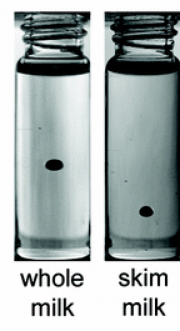
To create a mini-maglev device, Mirica and colleagues suspended a fluid-filled vial between two ice cube-sized magnets. They found that samples of milk, peanut butter and vegetable oil placed inside the vial would levitate a certain distance between the magnets. The distance, measured by a ruler, directly correlated with the sample’s density.
Based on density measurements, the team was then able to quickly estimate the salt content of different water samples and the relative fat content in different kinds of milk, cheese, and peanut butter.
"Potential applications of maglev may include evaluating the suitability of water for drinking or irrigation, assessing the content of fat in foods and beverages, or monitoring processing of grains,” Mirica said. “It’s extremely versatile and we’re still figuring out the most useful applications for this technology.”
With further development, the maglev method could be a much-needed new tool for the food industry, said Roger Clemens, an expert in food safety at the University of Southern California’s School of Pharmacy in Los Angeles.
On a production line, ingredients from many sources are mixed and processed very rapidly, making the task of ensuring food quality and safety very challenging, Clemens said. “We have come a long way, but we still don’t have adequate methods to rapidly screen for contaminants,” he said.
Currently, companies and regulatory agencies rely on a mishmash of old and new technologies to ensure quality control and safety. Analytical chemistry, X-ray and infrared technology, and lipid melting points are all common diagnostic methods, Clemens said.
“I see this maglev device as a potential new tool. I think it has a long way to go before anybody in the food industry could actually use it on a fast- moving processing line, but it’s intriguing to think about the possibilities,” he said.
Mirica and colleagues are now working to transform the maglev device into a useful tool that can be operated outside of the laboratory. “We’d like to further simplify the apparatus, make it smaller and more user friendly," Mirica said.
“They are on the right track,” Clemens said. “This is exactly the kind of outside-the-box innovation we need to improve the food safety industry.”
Provided by Inside Science News Service
-
Analyzing food and beverages with magnetic levitation
Jun 23, 2010 |
not rated yet |
0
-
Salmonella: Tough to crack when it’s in peanuts
Feb 11, 2009 |
not rated yet |
0
-
Microwaves offer fat chance to probe supermarket food
Sep 20, 2007 |
not rated yet |
0
-
Microwave Meter Measures Moisture and Density of In-Shell Peanuts
Nov 20, 2009 |
not rated yet |
0
-
Boiled peanuts pack big antioxidant punch
Oct 26, 2007 |
not rated yet |
0
-
Engineers build first sub-10-nm carbon nanotube transistor
Feb 01, 2012 |
4.9 / 5 (31) |
30
-
Something old, something new: Evolution and the structural divergence of duplicate genes
Jan 31, 2012 |
4.6 / 5 (7) |
1
-
The hidden nanoworld of ice crystals: Revealing the dynamic behavior of quasi-liquid layers
Jan 30, 2012 |
5 / 5 (3) |
1
-
Stock market network reveals investor clustering
Jan 27, 2012 |
3.9 / 5 (23) |
8
-
Of microchemistry and molecules: Electronic microfluidic device synthesizes biocompatible probes
Jan 26, 2012 |
5 / 5 (1) |
0
-
Stoichiometry
19 hours ago
-
Boiling and melting point of impure substances
20 hours ago
-
Safe nitrogen compound to decompose a 500 deg C in a furnace?
Feb 09, 2012
-
[ask]electron inside drinking water
Feb 08, 2012
-
How to avoid formation of Lithium Chromate ???
Feb 08, 2012
-
how to choose a reduced or oxidated form in a redox
Feb 08, 2012
- More from Physics Forums - Chemistry
More news stories
Fool's gold may prove an unlikely alternative to overexploited catalytic materials
Catalytic materials, which lower the energy barriers for chemical reactions, are used in everything from the commercial production of chemicals to catalytic converters in car engines. However, with current catalytic materials ...
10 hours ago |
4.6 / 5 (5) |
2
|
Unpicking HIV’s invisibility cloak
Drug researchers hunting for alternative ways to treat human immunodeficiency virus (HIV) infections may soon have a novel targetits camouflage coat. HIV hides inside a cloak unusually rich in a sugar ...
10 hours ago |
5 / 5 (4) |
0
No entry without protein recycling: Researchers discover new coherence in enzyme transport
The group of Prof. Dr. Ralf Erdmann at the Ruhr-Universität Bochum, Germany, discovered a connection of peroxisomal protein import and receptor export. In the Journal of Biological Chemistry, they disclo ...
10 hours ago |
not rated yet |
0
Under the microscope #7
In this video Dr Ingrid Graz shows us a thin layer of gold on top of rubber. Cracks in the gold allow it to stretch and we can use this for stretchable electronics.
12 hours ago |
not rated yet |
0
Hydrogen from acidic water: Researchers develop potential low cost alternative to platinum for splitting water
A technique for creating a new molecule that structurally and chemically replicates the active part of the widely used industrial catalyst molybdenite has been developed by researchers with the Lawrence Berkeley ...
Feb 09, 2012 |
5 / 5 (12) |
13
|
Google users warned of threat to smartphone wallets
Users of Google smartphone wallets were being warned on Friday that there is a way to crack pass codes intended to thwart thieves from going on illicit shopping sprees.
Anonymous knocks CIA website offline (Update)
The website of the Central Intelligence Agency was inaccessible on Friday after the hacker group Anonymous claimed to have knocked it offline.
Complex wiring of the nervous system may rely on a just a handful of genes and proteins
Researchers at the Salk Institute have discovered a startling feature of early brain development that helps to explain how complex neuron wiring patterns are programmed using just a handful of critical genes. ...
Putting the squeeze on planets outside our solar system
(PhysOrg.com) -- Using high-powered lasers, scientists at Lawrence Livermore National Laboratory and collaborators discovered that molten magnesium silicate undergoes a phase change in the liquid state, abruptly ...
NASA sees wide-eyed cyclone Jasmine
Cyclone Jasmine's eye has opened wider on NASA satellite imagery, as it moves through the Southern Pacific Ocean.
New error-correcting codes guarantee the fastest possible rate of data transmission
Error-correcting codes are one of the triumphs of the digital age. Theyre a way of encoding information so that it can be transmitted across a communication channel such as an optical fiber o ...