Clocking Ultra-fast Electron Bunches
July 30, 2010 by Kendra Snyder
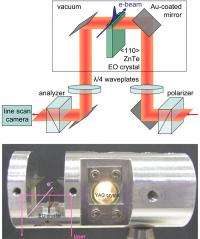
(top) Schematic layout of the electro-optical arrangement. (bottom) The electro-optical module with a YAG crystal for electron beam position monitor.
(PhysOrg.com) -- Brookhaven researchers have developed a device that acts like a high-tech stopwatch for speedy packs of electrons just trillionths of a second long. This new diagnostic tool could aid in the development of x-ray free electron lasers (FEL), sources that produce pulses of light up to one billion times brighter and 1,000 times shorter than those produced at conventional storage ring light sources.
Like a high-speed strobe light, the ultra-short bursts of light produced from an FEL allow scientists to take stop-motion pictures of chemical reactions, biological processes, and various other atomic-scale events. FELs create this valuable x-ray light by shooting a series of ultra-short bunches of electrons through an array of specialized magnets. The shorter the electron bunches, the more powerful the resulting light.
"In recent years, the bunch lengths of electrons in accelerators have decreased dramatically, producing extremely bright pulses of light that are on the same time scale as vibrations in molecules and the creation or breakage chemical bonds," said NSLS researcher Xi Yang. "But in order to synchronize the time-dependent process being studied with the x-ray pulse, we need a new set of beam diagnostics."
So how do scientists measure the length of these picosecond-scale pulses? It's not easy. There have been previous successful attempts, but only with limited resolution and complicated steps.
At the NSLS Source Development Laboratory (SDL), Brookhaven researchers have demonstrated a high-resolution measurement system that's nondestructive to the electron beam and can be easily transported among facilities.
In the setup (first proposed by Brookhaven researchers in 2002), a beam of electron bunches is sent across the top edge of a thin, "electro-optical" crystal. Traveling at close to the speed of light, each electron bunch emits an electric field that travels downward through the crystal. At the same time, a single, line-focused laser pulse is sent straight through the broad side of the crystal, where sections of the laser line are encoded with spatial information from the electron bunches. A special camera at the end of the device collects this data.
"Using this monitor, we are able to take robust measurements of the electron bunch length," Yang said. "The tolerance on timing jitters can be many picoseconds."
The results were published in the December 7, 2009 edition of Applied Physics Letters.
Now, the goal is to measure electron pulses an order of magnitude smaller, in femtosecond duration, or quadrillionth of a second range. The Brookhaven researchers hope to accomplish this resolution enhancement by using a thinner crystal, which will minimize the smearing of the electron beam while the laser probe travels through the crystal, giving the encoded spatial information less time to "degrade." This detailed picture will let scientists analyze fine structures within the pulses, such as micro-bunching - the arrangement of electrons within a larger bunch.
More information: X. Yang, T. Tsang, T. Rao, J.B. Murphy, Y. Shen, X.J. Wang, "Electron Bunch Length Monitors Using Spatially Encoded Electro-Optical Technique in an Orthogonal Configuration,"Appl. Phys. Lett., 95, 231106 (2009).
-
Tapering a Free-Electron Laser to Extract More Juice
Nov 20, 2009 |
not rated yet |
0
-
A Bunch of Electron Chicanery
Nov 21, 2006 |
not rated yet |
0
-
Highest X-ray energy used to probe materials
Jul 22, 2010 |
not rated yet |
0
-
Ultra-fast X-ray pulses reveal how a solid melts into a liquid
Apr 21, 2005 |
not rated yet |
0
-
Have Gun, Will Travel (at Light Speed)
Jan 25, 2007 |
not rated yet |
0
-
Engineers build first sub-10-nm carbon nanotube transistor
Feb 01, 2012 |
4.9 / 5 (30) |
30
-
Something old, something new: Evolution and the structural divergence of duplicate genes
Jan 31, 2012 |
4.6 / 5 (7) |
1
-
The hidden nanoworld of ice crystals: Revealing the dynamic behavior of quasi-liquid layers
Jan 30, 2012 |
5 / 5 (3) |
1
-
Stock market network reveals investor clustering
Jan 27, 2012 |
3.9 / 5 (23) |
8
-
Of microchemistry and molecules: Electronic microfluidic device synthesizes biocompatible probes
Jan 26, 2012 |
5 / 5 (1) |
0
-
Physical laws .... are they material?!!
52 minutes ago
-
increasing time of daylight
1 hour ago
-
Light & Sight
1 hour ago
-
Wind Turbine Power
4 hours ago
-
Steam Table issues
6 hours ago
-
electrostatic induction in a conductor should be immpossible
10 hours ago
- More from Physics Forums - General Physics
More news stories
Hovering not hard if you're top-heavy, researchers find
Top-heavy structures are more likely to maintain their balance while hovering in the air than are those that bear a lower center of gravity, researchers at New York University's Courant Institute of Mathematical Sciences ...
1 hour ago |
5 / 5 (1) |
1
|
SLAC, Stanford team focuses on high-energy electrons to treat cancer
Accelerator physicists at SLAC and cancer specialists from Stanford are working on a new technology that could dramatically reduce the time needed for cancer radiation treatments. The team ran an initial experiment ...
4 hours ago |
5 / 5 (1) |
0
Measurements from high-energy collisions lead to better understanding of why meson particles disappear
For several years, physicists at the Relativistic Heavy Ion Collider (RHIC) at Brookhaven National Laboratory (BNL), USA, have studied an unusual state of matter called the quarkgluon plasma, which they ...
4 hours ago |
not rated yet |
0
Quantum physicist explains $100K offer for proof scaled-up quantum computing is impossible
(PhysOrg.com) -- MIT researcher Scott Aaronson has certainly riled the physics community with his offer this past Friday, of $100,000 to anyone who can prove that scaled-up quantum computing is impossible. ...
Explained: Sigma
It's a question that arises with virtually every major new finding in science or medicine: What makes a result reliable enough to be taken seriously? The answer has to do with statistical significance -- but ...
Feb 09, 2012 |
5 / 5 (14) |
34
Grass to gas: Researchers' genome map speeds biofuel development
Researchers at the University of Georgia have taken a major step in the ongoing effort to find sources of cleaner, renewable energy by mapping the genomes of two originator cells of Miscanthus x giganteus, a large perenn ...
Researchers develop new method for creating tissue engineering scaffolds
Researchers at Northwestern University have developed a new method for creating scaffolds for tissue engineering applications, providing an alternative that is more flexible and less time-intensive than current technology.
Molecular profiling reveals differences between primary and recurrent ovarian cancers
There is a need to analyze tumor specimens at the time of ovarian cancer recurrence, according to a new study published in Molecular Cancer Therapeutics. Researchers used a diagnostic technology called molecular profiling to examine ...
C-sections linked to breathing problems in preterm infants
Research conducted at Yale School of Medicine shows that a cesarean (C-section) delivery, which was thought to be harmless, is associated with breathing problems in preterm babies who are small for gestational age.
Review: Netflix and Hulu's new scripted originals
Within just over a week, Netflix and Hulu are both debuting their first stabs at original scripted programming.
India probes Google over 'forex transactions'
Indian authorities are probing whether online giant Google broke domestic foreign-exchange transactions rules while shifting funds abroad, the Press Trust of India reported on Friday.