Nuclear physics incorporates a 'strange' flavor
July 30, 2010
Nuclear physics incorporates a 'strange' flavor

Enlarge

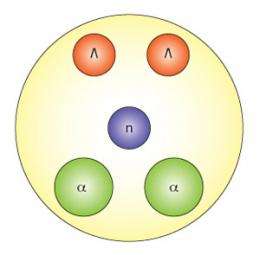
A schematic diagram of a double-hyperon beryllium nucleus. The usual 11 particles of this nucleus have been approximated to two helium nuclei (α) (each with two protons and two neutrons, one neutron (n) and two hyperon particles (Λ) to simplify theoretical calculations of their interactions. © 2010 Emiko Hiyama

Calculating the binding energy between hyperon particles contributes to understanding a new type of neutron star.

In 2009, physicists from Japan’s KEK high-energy proton accelerator announced the sighting of a rare event: an unusually bulky beryllium nucleus that, in addition to four and five neutrons, contained two particles called 'hyperons'.

Now, Emiko Hiyama at the RIKEN Nishina Center for Accelerator-Based Science, Wako, and her colleagues from several Japanese universities have presented a calculation that provides the most precise description available of the interactions between nuclei and hyperons in the double-hyperon beryllium nucleus observed at KEK1.

Hyperons—particles that contain at least one so-called ‘strange’ quark—exist for less than a billionth of a second before they decay. Scientists know relatively little about how hyperons interact with matter, but speculate that the hot, dense environment of a neutron star would allow these particles to exist in an almost stable state. If they are correct, a hyperon neutron star would be a new state of matter.

According to Hiyama, one of the main interests of hypernuclear physics is to understand interactions between baryons—particles such as protons and neutrons that consist of three quarks—and other particles. “Our study will contribute to understanding such interactions at the core of a neutron star.”

Quarks come in six so-called ‘flavors’: up, down, strange, charm, bottom and top. Only the up and down quarks, which make up the protons and in , are stable. High-energy collisions, such as those performed at KEK, are needed to produce the hyperons that contain the more massive strange quark.

Finding the interactions between the eleven particles that constitute the double-hyperon beryllium nucleus is prohibitively difficult. To simplify the calculation of this ‘many-body’ problem, Hiyama and her colleagues approximated the double-hyperon nucleus as five particles: two helium nuclei, one neutron and the two hyperon particles. This allowed them to predict the energy that binds the two hyperons together in the nucleus and compare their theoretical results with experimental data. Their calculations indicated that hyperons act to shrink the nucleus—an unusual effect, since nuclei are normally considered incompressible.

Hiyama’s calculations will be an essential tool to understand the attractive forces between hyperons in a neutron star, and will help researchers to analyze experimental results at Japan’s new proton accelerator complex, J-PARC, which is expected to produce multiple double-hyperon nuclei.

“At present, the only way to determine the energy of the hypernucleon is to perform these accurate many-body calculations,” says Hiyama.

More information: Hiyama, E., Kamimura, M., Yamamoto, Y. & Motoba, T. Five-body cluster structure of the double-Λ hypernucleus 11ΛΛBe. Physical Review Letters 104, 212502 (2010). http://prl.aps.org … /i21/e212502

Provided by RIKEN

4.4 /5 (13 votes)  

Filter


Move the slider to adjust rank threshold, so that you can hide some of the comments.


Display comments: newest first

Jigga
Jul 30, 2010

Rank: 1.4 / 5 (9)
..hyperons act to shrink the beryllium nucleus-an unusual effect..
Such insight can be understood intuitively with droplet model of atom nuclei, where nucleons are compressed heavily due the strong surface tension of high surface curvature of beryllium atom nuclei - beryllium nuclei are pretty tiny and lightweight ones. It's well known, inside of tiny water droplets the inner pressure of surface tension corresponds the hydrostatic pressure existing in the many hundreds meters depth. It affects many properties of water in tiny aerosols - for example such droplets don't freeze at zero temperature.

The hight pressure inside of beryllium nuclei leads into formation of strange phase of matter there in similar way, like inside of extremely dense neutron stars. Such behavior has its consequences - for example some nucleons are expelled from nucleus and they're revolving it at distance as so-called halo nuclei, thus balancing the presence of dense state of matter inside.
Jigga
Jul 30, 2010

Rank: 1.4 / 5 (9)
Analogously the surface of quark stars isn't very compact one with compare to common neutron stars. Such dense stars are rotating fast, so there is large difference in density of matter at core and at surface of star.

We can say, the very dense stars are losing their physical surface, thus changing into fuzzballs, which are common for dense black holes without physical surface beneath event horizon, which are changing into shinning quasars. The density of giant black holes changes smoothly from surface to their interior in similar way, like at the case of beryllium halo nuclei. The shinning surface of quasars above event horizon correspond the weak binded neutrons inside of these atoms. Analogously, the similar effect exist for heavy atoms, where surface electrons are forced to move with relativistic speed. There is large difference in ionization energy of the outer and inner electrons.
Rank 4.4 /5 (13 votes)
Relevant PhysicsForums posts
  • Steam Table issues
    created2 hours ago
  • electrostatic induction in a conductor should be immpossible
    created5 hours ago
  • Help! Physics Momentum/Impulse problem!
    created8 hours ago
  • Gauss' law cubes, how to prove
    created10 hours ago
  • what is significance of torque
    created11 hours ago
  • Difference between volume displaced fluid and volume of the object
    created12 hours ago
  • More from Physics Forums - General Physics

More news stories

Measurements from high-energy collisions lead to better understanding of why meson particles disappear

For several years, physicists at the Relativistic Heavy Ion Collider (RHIC) at Brookhaven National Laboratory (BNL), USA, have studied an unusual state of matter called the quark–gluon plasma, which they ...

Physics / General Physics

created 14 minutes ago | popularity not rated yet | comments 0

Physics research suggests new pathways for cancer progression

Observing that certain cancer cells may exhibit greater flexibility than normal cells, some scientists believe that this capability promotes rapid tumor growth. Now computer simulations developed by Boston University Biomedical ...

Physics / General Physics

created 23 hours ago | popularity 5 / 5 (1) | comments 0

Quantum physicist explains $100K offer for proof scaled-up quantum computing is impossible

(PhysOrg.com) -- MIT researcher Scott Aaronson has certainly riled the physics community with his offer this past Friday, of $100,000 to anyone who can prove that scaled-up quantum computing is impossible. ...

Physics / Quantum Physics

created Feb 08, 2012 | popularity 4.1 / 5 (11) | comments 32 | with audio podcast weblog

Explained: Sigma

It's a question that arises with virtually every major new finding in science or medicine: What makes a result reliable enough to be taken seriously? The answer has to do with statistical significance -- but ...

Physics / General Physics

created Feb 09, 2012 | popularity 5 / 5 (13) | comments 32

Physicists 'record' magnetic breakthrough

An international team of scientists has demonstrated a revolutionary new way of magnetic recording which will allow information to be processed hundreds of times faster than by current hard drive technology.

Physics / General Physics

created Feb 07, 2012 | popularity 4.5 / 5 (39) | comments 14 | with audio podcast


Mars Science Laboratory computer issue resolved

(PhysOrg.com) -- Engineers have found the root cause of a computer reset that occurred two months ago on NASA's Mars Science Laboratory and have determined how to correct it.

Advanced power-grid model finds low-cost, low-carbon future in West

(PhysOrg.com) -- The least expensive way for the Western U.S. to reduce greenhouse gas emissions enough to help prevent the worst consequences of global warming is to replace coal with renewable and other ...

Small modular reactor design could be a 'SUPERSTAR'

(PhysOrg.com) -- Though most of today's nuclear reactors are cooled by water, we've long known that there are alternatives; in fact, the world's first nuclear-powered electricity in 1951 came from a reactor ...

Clam fields found at deep, low-temperature Mariana vents

(PhysOrg.com) -- Scientists have marveled at the unusual life forms thriving at high temperature hydrothermal vents of the deep ocean.

Seeing colors in music, tasting flavors in shapes may happen in life's early months

Famed violinist Itzhak Perlman sees a deep forest green whenever he plays a B-flat on his Stradivarius' G string. The A on the E string is red.

Could Venus be shifting gear?

(PhysOrg.com) -- ESA’s Venus Express spacecraft has discovered that our cloud-covered neighbour spins a little slower than previously measured. Peering through the dense atmosphere in the infrared, the ...