NASA's Hibernating Mars Rover May Not Call Home
July 30, 2010
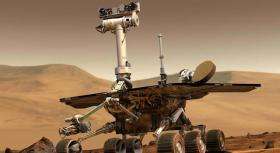
Artist's concept of Mars Exploration Rover. Image credit: NASA/JPL-Caltech/Cornell University
(PhysOrg.com) -- NASA mission controllers have not heard from the Mars Exploration Rover Spirit since March 22, and the rover is facing its toughest challenge yet -- trying to survive the harsh Martian winter.
The rover team anticipated Spirit would go into a low-power "hibernation" mode since the rover was not able to get to a favorable slope for its fourth Martian winter, which runs from May through November. The low angle of sunlight during these months limits the power generated from the rover's solar panels. During hibernation, the rover suspends communications and other activities so available energy can be used to recharge and heat batteries, and to keep the mission clock running.
On July 26, mission managers began using a paging technique called "sweep and beep" in an effort to communicate with Spirit.
"Instead of just listening, we send commands to the rover to respond back to us with a communications beep," said John Callas, project manager for Spirit and Opportunity at NASA's Jet Propulsion Laboratory in Pasadena, Calif. "If the rover is awake and hears us, she will send us that beep."
Based on models of Mars' weather and its effect on available power, mission managers believe that if Spirit responds, it most likely will be in the next few months. However, there is a very distinct possibility Spirit may never respond.
"It will be the miracle from Mars if our beloved rover phones home," said Doug McCuistion, director of NASA's Mars Exploration Program in Washington. "It's never faced this type of severe condition before -- this is unknown territory."
Because most of the rover's heaters were not being powered this winter, Spirit is likely experiencing its coldest internal temperatures yet -- minus 67 degrees Fahrenheit. During three previous Martian winters, Spirit communicated about once or twice a week with Earth and used its heaters to stay warm while parked on a sun-facing slope for the winter. As a result, the heaters were able to keep internal temperatures above minus 40 degrees Fahrenheit.
Spirit is designed to wake up from its hibernation and communicate with Earth when its battery charge is adequate. But if the batteries have lost too much power, Spirit's clock may stop and lose track of time. The rover could still reawaken, but it would not know the time of day, a situation called a "mission-clock fault." Spirit would start a new timer to wake up every four hours and listen for a signal from Earth for 20 minutes of every hour while the sun is up.
The earliest date the rover could generate enough power to send a beep to Earth was calculated to be around July 23. However, mission managers don't anticipate the batteries will charge adequately until late September to mid-October. It may be even later if the rover is in a mission-clock fault mode. If Spirit does wake up, mission managers will do a complete health check on the rover's instruments and electronics.
Based on previous Martian winters, the rover team anticipates the increasing haziness in the sky over Spirit will offset longer daylight for the next two months. The amount of solar energy available to Spirit then will increase until the southern Mars summer solstice in March 2011. If we haven't heard from it by March, it is unlikely that we will ever hear from it.
"This has been a long winter for Spirit, and a long wait for us," said Steve Squyres, the principal investigator for NASA's two rovers who is based at Cornell University. "Even if we never heard from Spirit again, I think her scientific legacy would be secure. But we're hopeful we will hear from her, and we're eager to get back to doing science with two rovers again."
Spirit and its twin, Opportunity, began exploring Mars in January 2004 on missions planned to last three months. Spirit has been nearly stationary since April 2009, while Opportunity is driving toward a large crater named Endeavour. Opportunity covered more distance in 2009 than in any prior year. Both rovers have made important discoveries about wet environments on ancient Mars that may have been favorable for supporting microbial life.
-
Mars rover Spirit misses communication session
Apr 01, 2010 |
not rated yet |
0
-
Controllers Cheer as Data Arrive from NASA's Spirit Rover
Nov 13, 2008 |
not rated yet |
0
-
Mars Rover Team Sets Low-Power Plan for NASA's Spirit
Nov 17, 2008 |
not rated yet |
0
-
NASA Posts Panorama to Celebrate Rover's 1,000th Martian Day
Oct 25, 2006 |
not rated yet |
0
-
Spirit Finishes Pre-Winter Drives
Feb 12, 2010 |
not rated yet |
0
-
Engineers build first sub-10-nm carbon nanotube transistor
Feb 01, 2012 |
4.9 / 5 (31) |
30
-
Something old, something new: Evolution and the structural divergence of duplicate genes
Jan 31, 2012 |
4.6 / 5 (7) |
1
-
The hidden nanoworld of ice crystals: Revealing the dynamic behavior of quasi-liquid layers
Jan 30, 2012 |
5 / 5 (3) |
1
-
Stock market network reveals investor clustering
Jan 27, 2012 |
3.9 / 5 (23) |
8
-
Of microchemistry and molecules: Electronic microfluidic device synthesizes biocompatible probes
Jan 26, 2012 |
5 / 5 (1) |
0
-
Scale of the Universe
2 hours ago
-
Titan's lack of impact craters
Feb 09, 2012
-
Real pictures of black hole eating a star?
Feb 08, 2012
-
Hypothetical way to travel faster than light, but not technically exceed lightspeed
Feb 06, 2012
-
How do scientists monitor the Sun's activity?
Feb 05, 2012
-
Search patterns in observational studies
Feb 05, 2012
- More from Physics Forums - General Astronomy
More news stories
NASA sees wide-eyed cyclone Jasmine
Cyclone Jasmine's eye has opened wider on NASA satellite imagery, as it moves through the Southern Pacific Ocean.
Space & Earth / Earth Sciences
1 hour ago |
not rated yet |
0
NASA sees Giovanna reach cyclone strength, threaten Madagascar
Tropical Storm 12S built up steam and became a cyclone on February 10, 2012 as NASA's Terra satellite passed overhead. Residents of east-central Madagascar should prepare for this cyclone to make landfall ...
Space & Earth / Earth Sciences
1 hour ago |
not rated yet |
0
Humans may have helped the decline of African rainforests 3000 years ago
(PhysOrg.com) -- Large areas of rainforests in Central Africa mysteriously disappeared over three thousand years ago, to be replaced by savannas. The prevailing theory has been that the cause was a change ...
Could Venus be shifting gear?
(PhysOrg.com) -- ESAs Venus Express spacecraft has discovered that our cloud-covered neighbour spins a little slower than previously measured. Peering through the dense atmosphere in the infrared, the ...
Space & Earth / Space Exploration
9 hours ago |
5 / 5 (7) |
7
|
Mars Science Laboratory computer issue resolved
(PhysOrg.com) -- Engineers have found the root cause of a computer reset that occurred two months ago on NASA's Mars Science Laboratory and have determined how to correct it.
Space & Earth / Space Exploration
10 hours ago |
4.7 / 5 (6) |
3
|
Google users warned of threat to smartphone wallets
Users of Google smartphone wallets were being warned on Friday that there is a way to crack pass codes intended to thwart thieves from going on illicit shopping sprees.
Anonymous knocks CIA website offline (Update)
The website of the Central Intelligence Agency was inaccessible on Friday after the hacker group Anonymous claimed to have knocked it offline.
Complex wiring of the nervous system may rely on a just a handful of genes and proteins
Researchers at the Salk Institute have discovered a startling feature of early brain development that helps to explain how complex neuron wiring patterns are programmed using just a handful of critical genes. ...
Putting the squeeze on planets outside our solar system
(PhysOrg.com) -- Using high-powered lasers, scientists at Lawrence Livermore National Laboratory and collaborators discovered that molten magnesium silicate undergoes a phase change in the liquid state, abruptly ...
The power of estrogen -- male snakes attract other males
A new study has shown that boosting the estrogen levels of male garter snakes causes them to secrete the same pheromones that females use to attract suitors, and turned the males into just about the sexiest ...
New error-correcting codes guarantee the fastest possible rate of data transmission
Error-correcting codes are one of the triumphs of the digital age. Theyre a way of encoding information so that it can be transmitted across a communication channel such as an optical fiber o ...
Jul 30, 2010
Rank: not rated yet
If she awakens soon enough.. might she be able to escape?
Imagine sand or mud mixed with moisture, frozen to a slush.. perhaps the ice crystals could provide better traction.
It would make an interesting experiment if nothing else.
Jul 30, 2010
Rank: not rated yet
Jul 31, 2010
Rank: 1.5 / 5 (2)
Jul 31, 2010
Rank: not rated yet
Jul 31, 2010
Rank: 5 / 5 (1)
Aug 01, 2010
Rank: not rated yet
The longest recorded survival of any mars rover.
Good job buddies :)
Aug 01, 2010
Rank: not rated yet
Aug 01, 2010
Rank: not rated yet