Some like it hot: How to heat a 'nano bathtub' the JILA way
July 30, 2010
Some like it hot: How to heat a 'nano bathtub' the JILA way

Enlarge

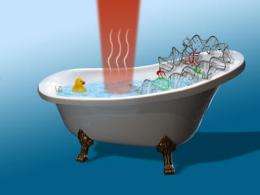
Infrared laser light heats the water in "nano bathtub" for JILA research on individual DNA molecules. Credit: K. Talbott, NIST

Researchers at JILA have demonstrated the use of infrared laser light to quickly and precisely heat the water in "nano bathtubs" -- tiny sample containers -- for microscopy studies of the biochemistry of single molecules and nanoparticles.

Described in a new paper, the JILA technique is faster, more controllable, and less prone to damaging expensive optics or accidentally altering chemistry than conventional methods using for bulk heating of microscope stages, optics and samples. The demonstration extends a technique used to study single living cells to the field of single-molecule microscopy. Fast, noncontact heating of very small samples is expected to enable new types of experiments with single molecules. For example, sudden, controlled jumps in temperature could be used to activate molecular processes and observe them in real time.

JILA is jointly operated by the National Institute of Standards and Technology and the University of Colorado at Boulder.

The JILA "bathtubs" consist of about 35 picoliters (trillionths of a liter, or roughly one-thirtieth of a nanoliter) of water on a glass slide. Gently focused light is used to heat a nanoscale column of water. By moving the laser beam, this column can be made to warm single RNA molecules attached to the slide. The samples are mounted above an inverted , used to study folding of tagged . The researchers simultaneously heated and observed folding of the molecules, comparing results obtained with the laser heating technique to measurements obtained with bulk heating.

The heating laser is directed at the samples from above, with the beam focused to a spot size of about 20 micrometers. The near-infrared light is just the right wavelength to excite vibrations in in the ; the vibrations quickly turn into heat. The laser offers a much larger dynamic temperature range (20 to 90 degrees Celsius, or 68 to 194 degrees Fahrenheit) than bulk heating methods, according to the paper. In early trials, the technique controlled bathtub heating to an accuracy of half a degree Celsius in less than 20 milliseconds across a micrometer-scale sample area.

"Exact sizes of the beam and sample area don't matter," says NIST/JILA Fellow David Nesbitt, senior author of the paper. "What's important is having time and temperature control over volumes of fluid small enough to be able to look at single molecules."

More information: E. D. Holmstrom and D.J. Nesbitt. Real-Time Infrared Overtone Laser Control of Temperature in Picoliter H2O Samples: "Nanobathtubs" for Single Molecule Microscopy. Journal of Physical Chemistry Letters 1, pages 2264-2268. Published online: July 7, 2010.

Provided by National Institute of Standards and Technology (news : web)

4.9 /5 (7 votes)  

Rank 4.9 /5 (7 votes)
Relevant PhysicsForums posts
  • Stoichiometry
    created10 hours ago
  • Boiling and melting point of impure substances
    created11 hours ago
  • Safe nitrogen compound to decompose a 500 deg C in a furnace?
    created18 hours ago
  • [ask]electron inside drinking water
    createdFeb 08, 2012
  • How to avoid formation of Lithium Chromate ???
    createdFeb 08, 2012
  • how to choose a reduced or oxidated form in a redox
    createdFeb 08, 2012
  • More from Physics Forums - Chemistry

More news stories

Fool's gold may prove an unlikely alternative to overexploited catalytic materials

Catalytic materials, which lower the energy barriers for chemical reactions, are used in everything from the commercial production of chemicals to catalytic converters in car engines. However, with current catalytic materials ...

Chemistry / Materials Science

created 2 hours ago | popularity 5 / 5 (1) | comments 1 | with audio podcast

Unpicking HIV’s invisibility cloak

Drug researchers hunting for alternative ways to treat human immunodeficiency virus (HIV) infections may soon have a novel target—its camouflage coat. HIV hides inside a cloak unusually rich in a sugar ...

Chemistry / Biochemistry

created 2 hours ago | popularity 5 / 5 (2) | comments 0

No entry without protein recycling: Researchers discover new coherence in enzyme transport

The group of Prof. Dr. Ralf Erdmann at the Ruhr-Universität Bochum, Germany, discovered a connection of peroxisomal protein import and receptor export. In the Journal of Biological Chemistry, they disclo ...

Chemistry / Biochemistry

created 2 hours ago | popularity not rated yet | comments 0

Hydrogen from acidic water: Researchers develop potential low cost alternative to platinum for splitting water

A technique for creating a new molecule that structurally and chemically replicates the active part of the widely used industrial catalyst molybdenite has been developed by researchers with the Lawrence Berkeley ...

Chemistry / Materials Science

created 21 hours ago | popularity 5 / 5 (11) | comments 11 | with audio podcast

Under the microscope #7

In this video Dr Ingrid Graz shows us a thin layer of gold on top of rubber. Cracks in the gold allow it to stretch and we can use this for stretchable electronics.

Chemistry / Other

created 4 hours ago | popularity not rated yet | comments 0


New understanding of DNA repair could eventually lead to cancer therapy

A research group in the Faculty of Medicine & Dentistry at the University of Alberta is hoping its latest discovery could one day be used to develop new therapies that target certain types of cancers.

Zuckerberg's focus drives Facebook's ascent

When Mark Zuckerberg showed up to rent Judy Fusco's Los Altos, Calif., house in the fall of 2004, soon after he'd arrived in Silicon Valley, the landlord was immediately struck by his confidence.

Antidepressants and pregnancy: Women must consider the impact of drugs on baby, and of depression on baby, themselves

Upon learning they are pregnant, most women dutifully nix the alcohol, sushi and caffeine. But what about antidepressants?

Both maternal and paternal age linked to autism

Older maternal and paternal age are jointly associated with having a child with autism, according to a recently published study led by researchers at The University of Texas Health Science Center at Houston (UTHealth).

Night, weekend delivery OK for babies with birth defects

Weekday delivery is no better than night or weekend delivery for infants with birth defects, according to a new study presented today at The Pregnancy Meeting, the Society for Maternal-Fetal Medicine's annual conference. ...

Sonic Cradle lands spot in TED exhibition

A Simon Fraser University graduate student project that melds music, meditation and modern technology has landed a rare spot as an exhibit at TEDActive 2012 in Palm Springs, California this month.