Nano 'pin art': NIST arrays are step toward mass production of nanowires
July 30, 2010
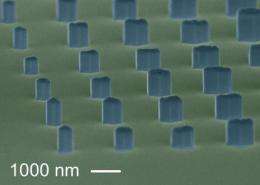
This is a colorized micrograph of semiconductor nanowires grown at NIST in a precisely controlled array of sizes and locations. Credit: K. Bertness, NIST
NIST researchers grow nanowires made of semiconductors -- gallium nitride alloys -- by depositing atoms layer-by-layer on a silicon crystal under high vacuum. NIST has the unusual capability to produce these nanowires without using metal catalysts, thereby enhancing luminescence and reducing defects. NIST nanowires also have excellent mechanical quality factors.
The latest experiments, described in Advanced Functional Materials, maintained the purity and defect-free crystal structure of NIST nanowires while controlling diameter and placement better than has been reported by other groups for catalyst-based nanowires. Precise control of diameter and placement is essential before nanowires can be widely used.
The key trick in the NIST technique is to grow the wires through precisely defined holes in a stencil-like mask covering the silicon wafer. The NIST nanowires were grown through openings in patterned silicon nitride masks. About 30,000 nanowires were grown per 76-millimeter-wide wafer. The technique controlled nanowire location almost perfectly. Wires grew uniformly through most openings and were absent on most of the mask surface.
Mask openings ranged from 300 to 1000 nanometers (nm) wide, in increments of 100 nm. In each opening of 300 nm or 400 nm, a single nanowire grew, with a well-formed hexagonal shape and a symmetrical tip with six facets. Larger openings produced more variable results. Openings of 400 nm to 900 nm yielded single-crystal nanowires with multifaceted tops. Structures grown in 1,000-nm openings appeared to be multiple wires stuck together. All nanowires grew to about 1,000 nm tall over three days.
NIST researchers analyzed micrographs to verify the uniformity of nanowire shape and size statistically. The analysis revealed nearly uniform areas of wires of the same diameter as well as nearly perfect hexagonal shapes.
Growing nanowires on silicon is one approach NIST researchers are exploring for making "nanowires on a chip" devices. Although the growth temperatures are too high—over 800 degrees Celsius—for silicon circuitry to tolerate, there may be ways to grow the nanowires first and then protect them during circuitry fabrication, lead author Kris Bertness says. The research was partially supported by the Defense Advanced Research Projects Agency (DARPA) Center on NanoscaleScience and Technology for Integrated Micro/Nano-Electromechanical Transducers (iMINT) at the University of Colorado at Boulder.
More information: K. A. Bertness, A. W. Sanders, D. M. Rourke, T. E. Harvey, A. Roshko, J.B. Schlager and N. A. Sanford. Controlled nucleation of GaN nanowires grown with molecular beam epitaxy. Advanced Functional Materials. Published online: July 13, 2010. DOI: 10.1002/adfm.201000381
Provided by National Institute of Standards and Technology (news : web)
-
Nanotechnology Breakthrough: Gallium Nitride Nanowires Grow Direction is Under Control
Jul 28, 2004 |
not rated yet |
0
-
Self-organized, one-dimensional Pt nanowires on Ge(001)
May 19, 2004 |
not rated yet |
0
-
Chemists measure copper levels in zinc oxide nanowires
Feb 19, 2008 |
not rated yet |
0
-
Low-Temperature Growth and Properties of ZnO Nanowires
Jun 01, 2004 |
not rated yet |
0
-
GaAs self-assembled nanowires could make chips smaller and faster
Apr 20, 2009 |
not rated yet |
0
-
Engineers build first sub-10-nm carbon nanotube transistor
Feb 01, 2012 |
4.9 / 5 (30) |
30
-
Something old, something new: Evolution and the structural divergence of duplicate genes
Jan 31, 2012 |
4.6 / 5 (7) |
1
-
The hidden nanoworld of ice crystals: Revealing the dynamic behavior of quasi-liquid layers
Jan 30, 2012 |
5 / 5 (3) |
1
-
Stock market network reveals investor clustering
Jan 27, 2012 |
3.9 / 5 (23) |
8
-
Of microchemistry and molecules: Electronic microfluidic device synthesizes biocompatible probes
Jan 26, 2012 |
5 / 5 (1) |
0
-
polymer nanocomposites
10 hours ago
-
Corrosion Tests on Magnesium
23 hours ago
-
polyethylene copper nanocomposite
Feb 09, 2012
-
Output of xrd analysis
Feb 08, 2012
-
Transport phenomena problem based on problems 18.B11 and 19B.6 from Bird, stewart, lw
Feb 06, 2012
-
Help with material selection - Car Piston
Feb 05, 2012
- More from Physics Forums - Materials & Chemical Engineering
More news stories
What lies beneath: Mapping hidden nanostructures
The ability to diagnose and predict the properties of materials is vital, particularly in the expanding field of nanotechnology. Electron and atom-probe microscopy can categorize atoms in thin sheets of material, ...
3 hours ago |
5 / 5 (1) |
1
'Dark plasmons' transmit energy
Microscopic channels of gold nanoparticles have the ability to transmit electromagnetic energy that starts as light and propagates via "dark plasmons," according to researchers at Rice University.
19 hours ago |
5 / 5 (6) |
1
|
New kind of solar cell could capture significantly more energy than current cells
New solar cells could increase the maximum efficiency of solar panels by over 25%, according to scientists from the University of Cambridge.
Feb 08, 2012 |
4.5 / 5 (12) |
14
|
Nanoshell whispering galleries improve thin solar panels
Visitors to Statuary Hall in the U.S. Capitol Building may have experienced a curious acoustic feature that allows a person to whisper softly at one side of the cavernous, half-domed room and for another on ...
Nanotechnology / Nanomaterials
Feb 07, 2012 |
4.3 / 5 (6) |
6
|
Nanotube therapy takes aim at breast cancer stem cells
Wake Forest Baptist Medical Center researchers have again proven that injecting multiwalled carbon nanotubes (MWCNTs) into tumors and heating them with a quick, 30-second laser treatment can kill them.
Nanotechnology / Bio & Medicine
Feb 09, 2012 |
5 / 5 (1) |
0
|
New understanding of DNA repair could eventually lead to cancer therapy
A research group in the Faculty of Medicine & Dentistry at the University of Alberta is hoping its latest discovery could one day be used to develop new therapies that target certain types of cancers.
Hovering not hard if you're top-heavy, researchers find
Top-heavy structures are more likely to maintain their balance while hovering in the air than are those that bear a lower center of gravity, researchers at New York University's Courant Institute of Mathematical Sciences ...
Grass to gas: Researchers' genome map speeds biofuel development
Researchers at the University of Georgia have taken a major step in the ongoing effort to find sources of cleaner, renewable energy by mapping the genomes of two originator cells of Miscanthus x giganteus, a large perenn ...
Night, weekend delivery OK for babies with birth defects
Weekday delivery is no better than night or weekend delivery for infants with birth defects, according to a new study presented today at The Pregnancy Meeting, the Society for Maternal-Fetal Medicine's annual conference. ...
Sonic Cradle lands spot in TED exhibition
A Simon Fraser University graduate student project that melds music, meditation and modern technology has landed a rare spot as an exhibit at TEDActive 2012 in Palm Springs, California this month.
Drug halts organ damage in inflammatory genetic disorder
A new study shows that Kineret (anakinra), a medication approved for the treatment of rheumatoid arthritis, is effective in stopping the progression of organ damage in people with neonatal-onset multisystem inflammatory disease ...