Engineers prepare to seal ruptured oil well
July 31, 2010 by Matt Davis
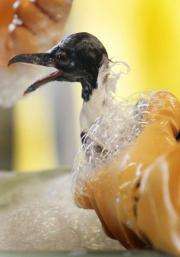
A distressed oil-soaked bird is cleaned at a wildlife rehabilitation facility in Buras, Louisiana

Enlarge

An oil-soaked Laughing Gull is cleaned at the Fort Jackson Wildlife Rehabilitation Center in Buras, Louisiana. Engineers Saturday readied a plan to permanently seal a damaged Gulf of Mexico well, despite delays to the process caused by debris left behind by a recent tropical storm.

Engineers Saturday readied a plan to permanently seal a damaged Gulf of Mexico well, despite delays to the process caused by debris left behind by a recent tropical storm.

As the work continued, incoming BP boss Bob Dudley vowed his company would not abandon residents affected by the spill after the well is finally sealed.

BP hopes to drown the well in an operation dubbed a "static kill," in which mud and will be injected down into the ruptured wellhead via a cap installed on July 15.

Dudley on Friday said the operation had been pushed back a day, saying "we are hopeful by Tuesday the static kill will have been performed."

The US pointman on the crisis, Coast Guard Admiral Thad Allen, said Friday the delay was needed to allow engineers to clear debris from the damaged wellhead caused by Tropical Storm Bonnie, which briefly halted spill operations.

But BP senior vice president Kent Wells said the company was confident the static kill would proceed successfully.

A cap in place for two weeks has shown no sign of leaks, "giving us more confidence that this well has integrity," which is a positive sign for the operation, Wells said at a technical briefing Friday.

Wells said BP hopes the static kill will be able to overcome the flow of oil, but that a second sealing method -- via an intercept through a relief well -- would go ahead afterwards regardless.

BP said the relief well is likely to intersect the existing well deep below the within eight to 10 days, allowing the second sealing process -- a bottom kill -- by the end of August.

Making his first trip to the region since being named to replace outgoing BP CEO Tony Hayward, Dudley said Friday the firm's focus would shift to long-term recovery for the region now that spill is being contained.

"We've had some good news on the oil... but that doesn't mean we're done," Dudley told reporters in Mississippi, one of the five states hit by the massive oil spill.

"We'll be here for years," he said, as BP announced a 100-million-dollar charitable fund to aid unemployed rig workers who are experiencing economic hardship due to the US government's ongoing moratorium on deepwater drilling.

Dudley will take over as BP's chief executive on October 1, when Hayward, who was widely criticized for his handling of the crisis, hands over the reins.

With the focus now moving towards mitigating the long-term impact of the worst-ever US oil spill, Dudley said there would be signs that the operation was changing.

Miles of protective boom will be withdrawn from coastlines, and fewer clean-up crews in hazmat suits would be seen on beaches as oil stopped washing ashore.

"So you'll probably see that kind of a pullback. But commitment, absolutely no pullback," he pledged.

It remains unknown just how much oil has spilled into the Gulf since the BP-leased Deepwater Horizon rig exploded and sank in April, killing 11 workers. Best estimates put the amount at between three to 5.3 million barrels.

Allen said a team of experts was carrying out an "oil budget" to calculate how much was released, how much was captured and how much has evaporated, adding he hoped the report would be released in the coming days.

"It's something we ultimately need to know," Allen said.

In another encouraging sign, the NOAA said southern Florida and the US eastern seaboard was not likely to experience any effects from the remaining surface oil, as had been feared, as the " continues to degrade and is hundreds of miles away from the loop current."

With the leak capped "the light sheen remaining on the Gulf's surface will continue to biodegrade and disperse but will not travel far," said Jane Lubchenco, the National Oceanic and Atmospheric Administration chief.

(c) 2010 AFP


Rank 5 /5 (2 votes)
Related Stories
Relevant PhysicsForums posts
  • Discrepancy between oxygen and carbon-dioxide levels
    created19 hours ago
  • where gems are found in the world
    created22 hours ago
  • Wind Waves in Reservoir ~ Wind run-up and Wind set-up
    createdFeb 08, 2012
  • Balance of oxygen in the atmosphere
    createdFeb 01, 2012
  • The case for a methanol-based economy
    createdJan 30, 2012
  • Weather in a rotating cylinder
    createdJan 25, 2012
  • More from Physics Forums - Earth

More news stories

Humans may have helped the decline of African rainforests 3000 years ago

(PhysOrg.com) -- Large areas of rainforests in Central Africa mysteriously disappeared over three thousand years ago, to be replaced by savannas. The prevailing theory has been that the cause was a change ...

Space & Earth / Environment

created 11 hours ago | popularity 4.2 / 5 (5) | comments 10 | with audio podcast report

Could Venus be shifting gear?

(PhysOrg.com) -- ESA’s Venus Express spacecraft has discovered that our cloud-covered neighbour spins a little slower than previously measured. Peering through the dense atmosphere in the infrared, the ...

Space & Earth / Space Exploration

created 7 hours ago | popularity 5 / 5 (5) | comments 7 | with audio podcast

Mars Science Laboratory computer issue resolved

(PhysOrg.com) -- Engineers have found the root cause of a computer reset that occurred two months ago on NASA's Mars Science Laboratory and have determined how to correct it.

Space & Earth / Space Exploration

created 8 hours ago | popularity 5 / 5 (5) | comments 3 | with audio podcast

Clam fields found at deep, low-temperature Mariana vents

(PhysOrg.com) -- Scientists have marveled at the unusual life forms thriving at high temperature hydrothermal vents of the deep ocean.

Space & Earth / Earth Sciences

created 8 hours ago | popularity not rated yet | comments 0 | with audio podcast

NASA budget will axe Mars deal with Europe: scientists

US President Barack Obama's budget proposal to be submitted next week for 2013 will cut NASA's budget by 20 percent and eliminate a major partnership with Europe on Mars exploration, scientists said Thursday.

Space & Earth / Space Exploration

created 10 hours ago | popularity 5 / 5 (1) | comments 15


CIA website offline, Anonymous takes credit

The website of the Central Intelligence Agency was unresponsive on Friday after the hacker group Anonymous claimed to have knocked it offline.

Q&A: Obama and the birth control controversy

(AP) -- What birth control debate? A half-century after the introduction of the pill, acceptance of birth control by American women is virtually universal.

Complex wiring of the nervous system may rely on a just a handful of genes and proteins

Researchers at the Salk Institute have discovered a startling feature of early brain development that helps to explain how complex neuron wiring patterns are programmed using just a handful of critical genes. ...

The power of estrogen -- male snakes attract other males

A new study has shown that boosting the estrogen levels of male garter snakes causes them to secrete the same pheromones that females use to attract suitors, and turned the males into just about the sexiest ...

New error-correcting codes guarantee the fastest possible rate of data transmission

Error-correcting codes are one of the triumphs of the digital age. They’re a way of encoding information so that it can be transmitted across a communication channel — such as an optical fiber o ...

Curry spice component may help slow prostate tumor growth

Curcumin, an active component of the Indian curry spice turmeric, may help slow down tumor growth in castration-resistant prostate cancer patients on androgen deprivation therapy (ADT), a study from researchers ...