The boundless promise -- and mystery -- of glass
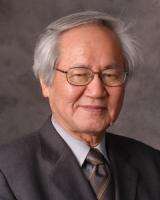
For more than 40 years, Rensselaer Professor Minoru Tomozawa has been pioneering new innovations in a field that most people take for granted: glass.
More than panes in a window or screens on a television, glass is at the center of many critical technologies, including communications. Tomozawa's particular focus is the temperature at which liquid "freezes" to become a solid glass. He is known for developing an elegant technique for determining this temperature after the glass has cooled into its final form. It is for creating this technique, which employs infrared spectroscopy, that the American Ceramic Society (ACerS) recently honored Tomozawa with the George W. Morey Award.
"Dr. Tomozawa is one of the world's leading authorities on glass science. He has been a leader in glass research for over 40 years," the ACerS Glass and Optical Materials Division said in its citation. "While many of his accomplishments would qualify him for the George W. Morey Award, this year's award specifically recognizes his development of a new technique for determination of the fictive temperature of glasses as indicated by the position of infrared absorption bands and the application of this technique to a wide number of problems in glass science."
The Morey Award is given annually and recognizes outstanding achievements in the field of glass science and technology.
Glass is essentially a frozen liquid, said Tomozawa, a professor in the Department of Materials Science and Engineering at Rensselaer. The material looks like a solid but has the structure of a liquid. To make most types of glass, silica is paired with other materials, melted, and then cooled into a specific shape. The length of time and temperatures at which the liquid cools significantly impact the glass volume and other properties of the resulting glass. This means even with identical ingredients and inputs, the actual method of melting and cooling the glass is of critical importance to the final product. This is particularly true for the liquid-crystal display glass used in countless computer monitors, televisions, and hand-held devices.
Knowing the exact temperature at which different silicate cools into glass, called the fictive temperature, is therefore critical for glass manufacturers. The fictive temperature of a glass changes depending on how fast or slow the liquid cools. Previously, there was no simple, non-destructive method for determining the fictive temperature of glass that had already cooled. Tomozawa and his research team developed a simple new technique for using infrared spectroscopy to determine the fictive temperature and, in turn, predict some glass properties more accurately. This technique has been used by many glass researchers, allowing them to obtain the accurate relationship between cooling rate of the melt and resulting glass properties.
"If you have a piece of glass, you can use our technique to tell its fictive temperature and how it was made," said Tomozawa, who has been working on this project for about 10 years. "By determining the fictive temperature, we can then know exactly what kind of properties the glass has. The properties of glass are a function of its fictive temperature."
The relationship between the fictive temperature and glass properties also has proven to be useful in practical applications. One example is that glasses exhibiting little property change with fictive temperature are known to be more crack-resistant, he said.
Tomozawa's ongoing investigations into fictive temperature are funded by the National Science Foundation.
Also of interest to Tomozawa, who worked as a materials engineer in the electronics industry in Japan before taking up glass research and joining the Rensselaer faculty in 1969, is the "mixed alkali effect." Dating back 120 years to the early inventors of the first mercury thermometer, scientists at the time noticed that thermometers exposed to a succession of boiling water and ice-cold temperatures would grow inaccurate. This phenomenon was dubbed "zero point depression," and was found to be more evident when the glass contained two different alkaline oxides, such as sodium oxide and potassium oxide. Subsequently, glasses containing two different alkaline oxides were found to exhibit various other peculiar properties as well. Researchers around the globe know of this mysterious behavior of mixed alkali glasses, but they're still not sure why it occurs.
"Some people call the glassy state the 'final frontier,' as we've already clarified the gas state and solid state of materials. This is evident when you look at the funny things that happen when you mix two alkaline oxides," Tomozawa said. "This is a great puzzle that dates back more than 100 years. There are some applications to solving the puzzle, but more than anything, it's an intellectual curiosity that is driving people - including myself and one of my students - to solve it."
Tomozawa received his bachelor's degree in electrochemistry from Yokohama National University in Japan, and went on to earn his doctoral degree in metallurgy and materials science from the University of Pennsylvania. He has authored and edited several books on glass science, and is a fellow of the American Ceramic Society.
Provided by Rensselaer Polytechnic Institute


