Ancient bone find may change Filipino history
August 3, 2010 by Cecil Morella
A 67,000-year-old foot bone found in the Philippines

Enlarge

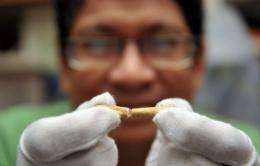
Professor Armand Mijares, an achaeologist from the University of the Philippines, holds up a 67,000-year-old foot bone. The bone could prove that the Philippines was first settled some 67,000 years ago, thousands of years earlier than previously thought.

Archaeologists have found a foot bone that could prove the Philippines was first settled by humans 67,000 years ago, thousands of years earlier than previously thought, the National Museum said Tuesday.

The bone, found in an extensive cave network, predates the 47,000-year-old Tabon Man that is previously known as the first human to have lived in the country, said Taj Vitales, a researcher with the museum's archaeology section.

"This would make it the oldest human remains ever found in the Philippines," Vitales told AFP.

from the University of the Philippines and the National Museum dug up the third metatarsal bone of the right foot in 2007 in the Callao caves near Penablanca, about 335 kilometres (210 miles) north of Manila.

Their report on "Callao Man" was released in the latest edition of the after tests in France established the fossil's age, said professor Armand Mijares, the expedition leader.

"It broke the barriers," Mijares said, explaining that previous evidence put the first human settlements in the Philippines and nearby islands around Tabon Man.

"It pushed that back to nearly 70,000 years."

Cut marks on bones of deer and wild boar found around it suggest Callao Man could have hunted and was skilled with tools, although no cutting or other implements were found during the dig, according to Mijares.

"This individual was small-bodied. It's difficult to say whether he was male or female," he said.

Mijares stressed the finding that Callao Man belongs to Homo sapiens was still only provisional. Some of the bone's features were similar to Homo habilis and Homo floresiensis -- which are from humans.

Existing evidence suggests that Homo sapiens, modern man, first appeared in Africa about 200,000 years ago.

Homo habilis is considered a predecessor to Homo sapiens while is thought to be a short, human-like species that once existed on an in the Late Pleistocene stage.

To determine whether Callao Man was human, Mijares said his team planned to secure permits to pursue further excavations in the Callao caves and hopefully find other parts of the skeleton, tools, or fossils of other potential humans.

Mijares said Callao Man also shared some features of today's Aetas, a short, curly-haired and dark-skinned people who are thought to be directly descended from the first inhabitants of the Philippines.

The discovery also suggests that raft or boat-building crafts would have been around at that time.

"The hypothesis is that the Philippines, which is surrounded by bodies of water, was first reached by humans aboard rafts," Vitales said.

But he said there was no consensus on whether the first settlers came from mainland Asia, neighbouring Southeast Asian islands or elsewhere.

Archaeologists have been exploring the Callao caves system since the 1970s. "Generally caves are used as habitations and burial sites," Vitales said.

Tabon Man, the fossilised fragments of a skull and jawbone from three individuals, was discovered along with stone flake tools by a National Museum team in a cave on the western Philippine island of Palawan in May 1962.

(c) 2010 AFP

4.8 /5 (13 votes)  

Filter


Move the slider to adjust rank threshold, so that you can hide some of the comments.


Display comments: newest first

kevinrtrs
Aug 03, 2010

Rank: 2.7 / 5 (3)
The older the better - more prestige associated with it. Unfortunately that's how it works. My bone is older than yours.

How did they date the bone? It's not stated in the article as far as I can see at a glimpse.
Ethelred
Aug 04, 2010

Rank: 5 / 5 (2)
One website has this
Mijares said they were able to approximate its age through a method called “uranium-series dating."
Another has this
Its carbon dating puts it at approximately 67,000 years old.
Since the first was quoting the researcher it is more likely. However I have absolutely no trust of Philippino archeologists after the outright fraud that took place previously there without some serious signs of testing by reliable labs.

http://en.wikiped...m_dating

Which gives a half-life for the isotope of thorium used as 75,000 years. Which, I suspect, might make the dating iffy at that time range. Also from what I can see of the technique they likely were dating the cave. They sure weren't dating the bone itself.

I would like to see more information on the dating techniques used.

Some of the other articles had really weird speculation at the end. Looked like nationalism might have been getting in the way of reality. Piltdown anyone?

Ethelred
bhiestand
Aug 04, 2010

Rank: 4.5 / 5 (2)
They used U-series ablation.

I'm not a fan of the sloppy wording in these articles, though. This doesn't prove the Philippines was first settled at any time, it proves the Philippines had homo sapiens (or habilis, or floresiensis) 65-67k years ago. There's no reason either species couldn't have been there earlier.
bhiestand
Aug 04, 2010

Rank: 4.5 / 5 (2)
I should note that this isn't my field, and I'm not at all familiar with these researchers, but they seem particularly cautious in the actual paper.

They used a lot of qualifiers and don't seem to be trying to make any large, sweeping claims. They know damned well this could be any small-bodied hominid, and they expressed that well.
Choice
Aug 06, 2010

Rank: not rated yet
This hominid could also have been a scavenger, rather than a hunter.
I'd like to see how the dating is being done.
Rank 4.8 /5 (13 votes)
Related Stories
Relevant PhysicsForums posts
  • Protease cleavage
    created3 hours ago
  • Pertubance in a model
    created10 hours ago
  • Cancer drugs and Alzheimer's, Oh my!
    created18 hours ago
  • Squishing cells
    created18 hours ago
  • Any books/articles for evolutionary stable strategy models in humans?
    createdFeb 09, 2012
  • Science behind the bore feeling?
    createdFeb 09, 2012
  • More from Physics Forums - Biology

More news stories

Employers feel no love for unscrupulous practice of 'service sweethearting'

A new study led by two Florida State University marketing professors finds that some frontline service employees who are rewarded for hikes in customer loyalty and satisfaction also may engage in "service ...

Other Sciences / Economics & Business

created 4 hours ago | popularity 4 / 5 (1) | comments 4

A frank discussion of the power law and linking correlation to causation

(PhysOrg.com) -- Michael Stumpf a mathematics professor at Imperial College in London, and Mason Porter a lecturer at Oxford have teamed together to write and publish a perspective piece in Science regarding the in ...

Other Sciences / Mathematics

created 10 hours ago | popularity 5 / 5 (2) | comments 2 | with audio podcast report

Sonic Cradle lands spot in TED exhibition

A Simon Fraser University graduate student project that melds music, meditation and modern technology has landed a rare spot as an exhibit at TEDActive 2012 in Palm Springs, California this month.

Other Sciences / Other

created 6 hours ago | popularity not rated yet | comments 0

The question of life in the ancient world

There’s a general feeling that we don’t get the Greeks – ancient or modern. Many, including heads of state like Angela Merkel, visibly shake their head in exasperation, rightly or wrongly, at ...

Other Sciences / Archaeology & Fossils

created 9 hours ago | popularity 1 / 5 (1) | comments 4

Chilean miners' rescue capsule on show in London

The capsule used to rescue Chilean miners trapped underground for two months goes on display Saturday at the Science Museum in London -- the first time it has been seen in Europe.

Other Sciences / Other

created 8 hours ago | popularity not rated yet | comments 0


Google users warned of threat to smartphone wallets

Users of Google smartphone wallets were being warned on Friday that there is a way to crack pass codes intended to thwart thieves from going on illicit shopping sprees.

NASA sees wide-eyed cyclone Jasmine

Cyclone Jasmine's eye has opened wider on NASA satellite imagery, as it moves through the Southern Pacific Ocean.

NASA sees Giovanna reach cyclone strength, threaten Madagascar

Tropical Storm 12S built up steam and became a cyclone on February 10, 2012 as NASA's Terra satellite passed overhead. Residents of east-central Madagascar should prepare for this cyclone to make landfall ...

CIA website offline, Anonymous takes credit

The website of the Central Intelligence Agency was unresponsive on Friday after the hacker group Anonymous claimed to have knocked it offline.

Complex wiring of the nervous system may rely on a just a handful of genes and proteins

Researchers at the Salk Institute have discovered a startling feature of early brain development that helps to explain how complex neuron wiring patterns are programmed using just a handful of critical genes. ...

Putting the squeeze on planets outside our solar system

(PhysOrg.com) -- Using high-powered lasers, scientists at Lawrence Livermore National Laboratory and collaborators discovered that molten magnesium silicate undergoes a phase change in the liquid state, abruptly ...