Marine Pied Piper leads Nemo astray
August 3, 2010
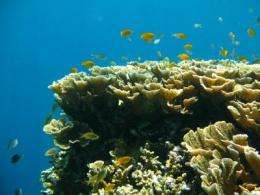
A damselfish swims around a coral reef. Credit: Steve Simpson
The growing amount of human noise pollution in the ocean could lead fish away from good habitat and off to their death, according to new research from a UK-led team working on the Great Barrier Reef.
After developing for weeks at sea, baby tropical fish rely on natural noises to find the coral reefs where they can survive and thrive. However, the researchers found that short exposure to artificial noise makes fish become attracted to inappropriate sounds.
In earlier research, Dr Steve Simpson, Senior Researcher in the University of Bristol's School of Biological Sciences discovered that baby reef fish use sounds made by fish, shrimps and sea urchins as a cue to find coral reefs. With human noise pollution from ships, wind farms and oil prospecting on the increase, he is now concerned that this crucial behaviour is coming under threat.
He said: "When only a few weeks old, baby reef fish face a monumental challenge in locating and choosing suitable habitat. Reef noise gives them vital information, but if they can learn, remember and become attracted towards the wrong sounds, we might be leading them in all the wrong directions."
Using underwater nocturnal light traps, Dr Simpson and his team collected baby damselfish as they were returning to coral reefs. The fish were then put into tanks with underwater speakers playing natural reef noise or a synthesised mix of pure tones. The next night the fish were put into specially designed choice chambers (long tubes with contrasting conditions at each end in which fish can move freely towards the end they prefer) with natural or artificial sounds playing. All the fish liked the reef noise, but only the fish that had experienced the tone mix swam towards it, the others were repelled by it.
Dr Simpson said: "This result shows that fish can learn a new sound and remember it hours later, debunking the 3-second memory myth."
His collaborator, Dr Mark Meekan added: "It also shows that they can discriminate between sounds and, based on their experience, become attracted to sounds which might really mess up their behaviour on the most important night of their life."
In noisy environments the breakdown of natural behaviour could have devastating impacts on success of populations and the replenishment of future fish stocks.
Dr Simpson said: "Anthropogenic noise has increased dramatically in recent years, with small boats, shipping, drilling, pile driving and seismic testing now sometimes drowning out the natural sounds of fish and snapping shrimps. If fish accidentally learn to follow the wrong sounds, they could end up stuck next to a construction site or follow a ship back out to sea."
The study is published in Behavioral Ecology and was carried out at Lizard Island Research Station.
-
Baby corals dance their way home
May 15, 2010 |
not rated yet |
0
-
Scientists call for coral reef regulations
Aug 04, 2006 |
not rated yet |
0
-
Underwater noise harming fish
Aug 26, 2007 |
not rated yet |
0
-
Fishy future written in the genes
Sep 30, 2008 |
not rated yet |
0
-
Isolation a threat to Great Barrier Reef fish
Jul 06, 2010 |
not rated yet |
0
-
Engineers build first sub-10-nm carbon nanotube transistor
Feb 01, 2012 |
4.9 / 5 (31) |
30
-
Something old, something new: Evolution and the structural divergence of duplicate genes
Jan 31, 2012 |
4.6 / 5 (7) |
1
-
The hidden nanoworld of ice crystals: Revealing the dynamic behavior of quasi-liquid layers
Jan 30, 2012 |
5 / 5 (3) |
1
-
Stock market network reveals investor clustering
Jan 27, 2012 |
3.9 / 5 (23) |
8
-
Of microchemistry and molecules: Electronic microfluidic device synthesizes biocompatible probes
Jan 26, 2012 |
5 / 5 (1) |
0
-
Mitosis
3 hours ago
-
Stem cell question.
4 hours ago
-
Protease cleavage
10 hours ago
-
Pertubance in a model
17 hours ago
-
Cancer drugs and Alzheimer's, Oh my!
Feb 09, 2012
-
Squishing cells
Feb 09, 2012
- More from Physics Forums - Biology
More news stories
The power of estrogen -- male snakes attract other males
A new study has shown that boosting the estrogen levels of male garter snakes causes them to secrete the same pheromones that females use to attract suitors, and turned the males into just about the sexiest ...
15 hours ago |
4.8 / 5 (6) |
1
|
Grass to gas: Researchers' genome map speeds biofuel development
Researchers at the University of Georgia have taken a major step in the ongoing effort to find sources of cleaner, renewable energy by mapping the genomes of two originator cells of Miscanthus x giganteus, a large perenn ...
12 hours ago |
3.8 / 5 (5) |
0
|
Miami battling invasion of giant African snails
No one knows how they got there. But an invasion of African giant snails has southern Florida in a panic over potential crop damage, disease and general yuckiness surrounding the slimy gastropods.
19 hours ago |
4 / 5 (1) |
4
Experts reveal how plants don't get sunburn
(PhysOrg.com) -- Experts at the University of Glasgow have discovered how plants survive the harmful rays of the sun.
15 hours ago |
4.8 / 5 (5) |
0
|
Protein libraries in a snap
(PhysOrg.com) -- A Rice University undergraduate will depart with not only a degree but also a possible patent for his invention of an efficient way to create protein libraries, an important component of biomolecular ...
19 hours ago |
4.8 / 5 (4) |
1
|
Anonymous knocks CIA website offline (Update)
The website of the Central Intelligence Agency was inaccessible on Friday after the hacker group Anonymous claimed to have knocked it offline.
Google users warned of threat to smartphone wallets
Users of Google smartphone wallets were being warned on Friday that there is a way to crack pass codes intended to thwart thieves from going on illicit shopping sprees.
New error-correcting codes guarantee the fastest possible rate of data transmission
Error-correcting codes are one of the triumphs of the digital age. Theyre a way of encoding information so that it can be transmitted across a communication channel such as an optical fiber o ...
Humans may have helped the decline of African rainforests 3000 years ago
(PhysOrg.com) -- Large areas of rainforests in Central Africa mysteriously disappeared over three thousand years ago, to be replaced by savannas. The prevailing theory has been that the cause was a change ...
New power source discovered
(PhysOrg.com) -- Researchers at the Massachusetts Institute of Technology (MIT) and RMIT University have made a breakthrough in energy storage and power generation.
Small modular reactor design could be a 'SUPERSTAR'
(PhysOrg.com) -- Though most of today's nuclear reactors are cooled by water, we've long known that there are alternatives; in fact, the world's first nuclear-powered electricity in 1951 came from a reactor ...
Aug 04, 2010
Rank: not rated yet
The ocean is certainly less noisy now than it was during 1942-1945. Never has there been more ships at sea, or more ships exploding, bombs dropping, torpedoes detonating, ships sinking or firing, than during WWII.
But I guess there is no immediate crisis to profit from, or anything worthwhile to be learned, from events that occurred so long ago.