Quantum networks advance with entanglement of photons, solid-state qubits
August 4, 2010 By Steve Bradt
Quantum networks advance with entanglement of photons, solid-state qubits

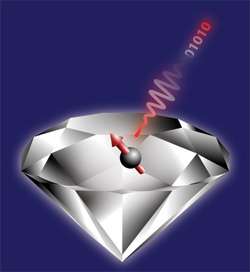
An impurity in a diamond is illuminated with a powerful laser beam after which it emits a single photon. The oscillations of the emitted photon are entangled with the spin of the electrons in the impurity and this entanglement can be used to send quantum information over long distances. (Illustration: Yiwen Chu, Harvard University).

A team of Harvard physicists led by Mikhail D. Lukin has achieved the first-ever quantum entanglement of photons and solid-state materials. The work marks a key advance toward practical quantum networks, as the first experimental demonstration of a means by which solid-state quantum bits, or "qubits," can communicate with one another over long distances.

Quantum networking applications such as long-distance communication and distributed computing would require the nodes that process and store quantum data in to be connected to one another by entanglement, a state where two different atoms become indelibly linked such that one inherits the properties of the other.

"In and , a big question has been whether or how it would be possible to actually connect qubits, separated by long distances, to one another," says Lukin, professor of physics at Harvard and co-author of a paper describing the work in this week's issue of the journal Nature. "Demonstration of quantum entanglement between a solid-state material and photons is an important advance toward linking qubits together into a quantum network."

Quantum entanglement has previously been demonstrated only with photons and individual ions or atoms.

"Our work takes this one step further, showing how one can engineer and control the interaction between individual photons and matter in a solid-state material," says first author Emre Togan, a graduate student in physics at Harvard. "What's more, we show that the photons can be imprinted with the information stored in a qubit."

, famously termed "spooky action at a distance" by a skeptical Albert Einstein, is a fundamental property of . It allows one to distribute over tens of thousands of kilometers, limited only by how fast and how far members of the entangled pair can propagate in space.

The new result builds upon earlier work by Lukin's group to use single atom impurities in diamonds as qubits. Lukin and colleagues have previously shown that these impurities can be controlled by focusing laser light on a diamond lattice flaw where nitrogen replaces an atom of carbon. That previous work showed that the so-called spin degrees of freedom of these impurities make excellent quantum memory.

Lukin and his co-authors now say that these impurities are also remarkable because, when excited with a sequence of finely tuned microwave and laser pulses, they can emit photons one at a time, such that photons are entangled with quantum memory. Such a stream of single photons can be used for secure transmission of information.

"Since photons are the fastest carriers of quantum information, and spin memory can robustly store quantum information for relatively long periods of time, entangled spin-photon pairs are ideal for the realization of quantum networks," Lukin says. "Such a network, a quantum analog to the conventional internet, could allow for absolutely secure communication over long distances."

Provided by Harvard University (news : web)

4.7 /5 (14 votes)  

Filter


Move the slider to adjust rank threshold, so that you can hide some of the comments.


Display comments: newest first

DigiMc
Aug 06, 2010

Rank: not rated yet
Why is it important that emitted photon is entangled, since when received, it will collapse into random state?
Or is the point that they can measure when either side becomes measured/unentangled, which would enable transmission of information equivalent to Morse's code?
Rank 4.7 /5 (14 votes)
Related Stories
Relevant PhysicsForums posts
  • second law of thermodynamics
    created4 hours ago
  • Static Electric Orbiting of H2O Droplet to Knitting Needle
    created4 hours ago
  • Acousto optical modulators
    created6 hours ago
  • Jerk during Gravitation
    created7 hours ago
  • 2 springs attached by a rigid massless bar
    created7 hours ago
  • Thermal conductivity value of (.17-.20)W/m.K
    created8 hours ago
  • More from Physics Forums - Classical Physics

More news stories

Borexino Collaboration succeeds in spotting pep neutrinos emitted from the sun

(PhysOrg.com) -- To learn more about how the sun works, scientists study particles that are emitted from it into space due to thermonuclear reactions that occur inside; by applying known physics principles, ...

Physics / General Physics

created 15 hours ago | popularity 4.6 / 5 (7) | comments 0 | with audio podcast report

Explained: Sigma

It's a question that arises with virtually every major new finding in science or medicine: What makes a result reliable enough to be taken seriously? The answer has to do with statistical significance -- but ...

Physics / General Physics

created 15 hours ago | popularity 5 / 5 (10) | comments 25

Physics research suggests new pathways for cancer progression

Observing that certain cancer cells may exhibit greater flexibility than normal cells, some scientists believe that this capability promotes rapid tumor growth. Now computer simulations developed by Boston University Biomedical ...

Physics / General Physics

created 12 hours ago | popularity 5 / 5 (1) | comments 0

Quantum physicist explains $100K offer for proof scaled-up quantum computing is impossible

(PhysOrg.com) -- MIT researcher Scott Aaronson has certainly riled the physics community with his offer this past Friday, of $100,000 to anyone who can prove that scaled-up quantum computing is impossible. ...

Physics / Quantum Physics

created Feb 08, 2012 | popularity 4.1 / 5 (11) | comments 31 | with audio podcast weblog

Physicists build highly efficient 'no-waste' laser

A team of University of California, San Diego researchers has built the smallest room-temperature nanolaser to date, as well as an even more startling device: a highly efficient, "thresholdless" laser that ...

Physics / General Physics

created Feb 08, 2012 | popularity 4.9 / 5 (20) | comments 5 | with audio podcast


'Dark plasmons' transmit energy

Microscopic channels of gold nanoparticles have the ability to transmit electromagnetic energy that starts as light and propagates via "dark plasmons," according to researchers at Rice University.

Hydrogen from acidic water: Researchers develop potential low cost alternative to platinum for splitting water

A technique for creating a new molecule that structurally and chemically replicates the active part of the widely used industrial catalyst molybdenite has been developed by researchers with the Lawrence Berkeley ...

Ultraviolet protection molecule in plants yields its secrets

Lying around in the sun all day is hazardous not just for humans but also for plants, which have no means of escape. Ultraviolet (UV) radiation from the sun can damage proteins and DNA inside cells, leading ...

FDA-approved drug rapidly clears amyloid from the brain, reverses Alzheimer's symptoms in mice

Neuroscientists at Case Western Reserve University School of Medicine have made a dramatic breakthrough in their efforts to find a cure for Alzheimer's disease. The researchers' findings, published in the journal Science, show t ...

Anyone can learn to be more inventive, cognitive researcher says

There will always be a wild and unpredictable quality to creativity and invention, says Anthony McCaffrey, a cognitive psychology researcher at the University of Massachusetts Amherst, because an "Aha moment" is rare and ...

Cell biologists describes mechanism by which some people may be more susceptible to colon cancer

An international research team led by cell biologists at the University of California, Riverside has uncovered a new insight into colon cancer, the third leading cause of cancer-related deaths in the United ...