Smell the love
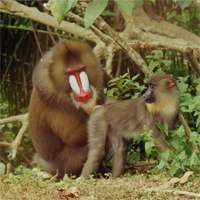
(PhysOrg.com) -- Mandrills can use body odour to identify potential mates, researchers have found, in a study which lends new support to the theory that humans also have the ability to "sniff out" suitable partners.
The findings, which are reported by an international team of scientists in a paper today (Wednesday, 4 August), suggest that scent and smell play a far more pivotal role in primates' mate selection than previously thought.
Researchers also found that mandrills can use odour to identify members of the same family or kin group, thereby avoiding the potentially devastating genetic consequences of inbreeding.
They identified strong parallels between the specific chemical compounds that determine a mandrill's individual scent, and the pattern of their "major histocompatibility complex" or "MHC" genes.
These genes are known to play an important part in immunity, but also in mate choice for both humans and mandrills. In each case individuals appear to seek out partners with a different MHC pattern to their own on an "opposites attract" basis, resulting in greater diversity of immune response in the offspring they produce.
Scientists had also speculated that primates might be able to identify different MHC genotypes through smell, but no explicit link had been found - until now.
"Our results strongly suggest that smell allows mandrills to transmit information about their own genetic quality and similarity to one another," Dr. Leslie Knapp, from the Department of Biological Anthropology at the University of Cambridge, who led the research, said.
"By using smell they can then identify potential partners with the appropriate genes."
"What we can infer for humans is that there are some very old behaviours at play here. Our early ancestors may have relied on smell in a similar way, and although we may think choosing a partner has more to do with looks or sound, smell can play an important role in the process."
The findings are reported in the new issue of Proceedings of the Royal Society B. They were produced as part of an ongoing research project funded by the Leverhulme Trust and involving an international team of researchers led by Dr. Knapp.
Mandrills are a primate cousin of humans, and a natural subject for such a study because they have scent or "sternal" glands on their chests, from which they emit their body odour.
Scientists have traditionally struggled to explain why these glands exist. Male mandrills were, until recently, thought to use their brightly coloured faces to advertise their compatibility. Charles Darwin himself suggested a link between colour and attractiveness in 1871 when he reflected that "no other member of the whole class of mammals is coloured in so extraordinary a manner as the adult male mandrill."
To test the theory that body odour may in fact be more significant, Dr. Joanna Setchell, from Durham University, took swabs and hairs from male and female mandrills' sternal glands while they were undergoing routine veterinary inspections at the Centre International de Recherche Médicales in Franceville, Gabon.
This allowed the team to analyse the chemical composition of each mandrill's body odour. The results were then cross-referred with data about the same mandrills' MHC genotypes.
They found that particular odour-types were consistent with particular MHC gene patterns, suggesting that mandrills use odour as an indication of genetic compatibility. Overall, male mandrills were found to give off a more complex scent than females, perhaps because they are aiming to attract as many females as they can.
The research found a weak relationship between the colouring of male mandrills and their MHC genotype, which implies that smell, rather than colour, is the principal means through which mandrills communicate their suitability as a mate.
For humans, the findings offer evidence that we may possess a similar ability to identify partners with an appropriately different MHC genotype, or family members with the same make-up, using our sense of smell.
Previous research had already identified a possible, but unconfirmed, link. Cases have been recorded where people claimed it was their partner's smell, rather than their looks or the sound of their voice, which attracted them. In other studies, women were able to identify their babies by smell alone.
"Scent is a very difficult attribute to study in some ways, because not many mammals have a scent gland that enables you to test the theory," Dr. Knapp added. "Mandrills are perfect because both males and females have these sternal glands."
"Scientists have long speculated about what their purpose might be. It would appear that we finally know. To be able to answer a question that has been unsolved since Darwin's day feels quite amazing."
Provided by University of Cambridge


