Seeing a Stellar Explosion in 3D (w/ Video)
August 4, 2010
Seeing a Stellar Explosion in 3D

Enlarge

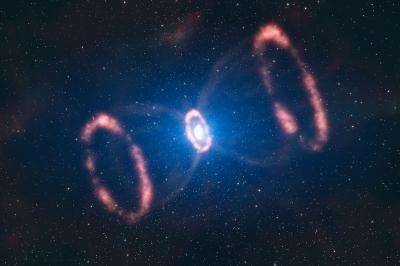
This artist’s impression of the material around a recently exploded star, known as Supernova 1987A (or SN 1987A), is based on observations which have for the first time revealed a three dimensional view of the distribution of the expelled material. The observations were made by astronomers using ESO’s Very Large Telescope. The original blast was not only powerful, according to the new results. It was also more concentrated in one particular direction. This is a strong indication that the supernova must have been very turbulent, supporting the most recent computer models. This image shows the different elements present in SN 1987A: two outer rings, one inner ring and the deformed, innermost expelled material. Credit: ESO/L. Calcada

(PhysOrg.com) -- Astronomers using ESO’s Very Large Telescope have for the first time obtained a three-dimensional view of the distribution of the innermost material expelled by a recently exploded star. The original blast was not only powerful, according to the new results. It was also more concentrated in one particular direction. This is a strong indication that the supernova must have been very turbulent, supporting the most recent computer models.

Unlike the Sun, which will die rather quietly, arriving at the end of their brief life explode as supernovae, hurling out a vast quantity of material. In this class, Supernova 1987A (SN 1987A) in the rather nearby occupies a very special place. Seen in 1987, it was the first naked-eye supernova to be observed for 383 years, and because of its relative closeness, it has made it possible for astronomers to study the of a massive star and its aftermath in more detail than ever before. It is thus no surprise that few events in modern astronomy have been met with such an enthusiastic response by scientists.

SN 1987A has been a bonanza for astrophysicists. It provided several notable observational ‘firsts’, like the detection of from the collapsing inner stellar core triggering the explosion, the localisation on archival photographic plates of the star before it exploded, the signs of an asymmetric explosion, the direct observation of the radioactive elements produced during the blast, observation of the formation of dust in the supernova, as well as the detection of circumstellar and interstellar material.

This video is not supported by your browser at this time.

This artist’s impression of the material around a recently exploded star, known as Supernova 1987A (or SN 1987A), is based on observations which have for the first time revealed a three dimensional view of the distribution of the expelled material.

New observations making use of a unique instrument, SINFONI, on ESO’s Very Large Telescope (VLT) have provided even deeper knowledge of this amazing event, as astronomers have now been able to obtain the first-ever 3D reconstruction of the central parts of the exploding material.

This view shows that the explosion was stronger and faster in some directions than others, leading to an irregular shape with some parts stretching out further into space.

The first material to be ejected from the explosion travelled at an incredible 100 million km per hour, which is about a tenth of the speed of light or around 100 000 times faster than a passenger jet. Even at this breakneck speed it has taken 10 years to reach a previously existing ring of gas and dust puffed out from the dying star. The images also demonstrate that another wave of material is travelling ten times more slowly and is being heated by radioactive elements created in the explosion.

"We have established the velocity distribution of the inner ejecta of Supernova 1987A,” says lead author Karina Kjær. “Just how a supernova explodes is not very well understood, but the way the star exploded is imprinted on this inner material. We can see that this material was not ejected symmetrically in all directions, but rather seems to have had a preferred direction. Besides, this direction is different to what was expected from the position of the ring.”

This video is not supported by your browser at this time.

Zoom on SN1987A. Credit: ESO

Such asymmetric behaviour was predicted by some of the most recent computer models of supernovae, which found that large-scale instabilities take place during the explosion. The new observations are thus the first direct confirmation of such models.

SINFONI is the leading instrument of its kind, and only the level of detail it affords allowed the team to draw their conclusions. Advanced adaptive optics systems counteracted the blurring effects of the Earth's atmosphere while a technique called integral field spectroscopy allowed the astronomers to study several parts of the supernova’s chaotic core simultaneously, leading to the build-up of the 3D image.

“Integral field spectroscopy is a special technique where for each pixel we get information about the nature and velocity of the gas,” says Kjær. “This means that besides the normal picture we also have the velocity along the line of sight. Because we know the time that has passed since the explosion, and because the material is moving outwards freely, we can convert this velocity into a distance. This gives us a picture of the inner ejecta as seen straight on and from the side.”

More information: This research will appear in Astronomy and Astrophysics (“The 3-D Structure of SN 1987A’s inner Ejecta”, by K. Kjaer et al.). http://www.aanda.o … 61/201014538

Provided by ESO (news : web)

Filter


Move the slider to adjust rank threshold, so that you can hide some of the comments.


Display comments: newest first

omatumr
Aug 04, 2010

Rank: 1 / 5 (1)
Thanks for the beautiful images!

They conform that the explosion does not homogenize the supernova debris.

This is exactly what we observed in meteorites, beginning in the early 1970s ["Xenon in carbonaceous chondrites", Nature Phys. Sci. 240, 99-101 (1972); "Strange xenon, extinct superheavy elements and the solar neutrino puzzle", Science 195, 208-209 (1977); "Isotopes of tellurium, xenon and krypton in the Allende meteorite retain record of nucleosynthesis", Nature 277, 615-620 (1979)].

Chemical and isotopic variations inside the Earth and across the Solar System today were inherited directly from the parent supernova [ "Noble gas anomalies and synthesis of the chemical elements", Meteoritics 15 (1980) 117-138; "The noble gas record of the terrestrial planets", Geochemical Journal 15, 247-267 (1981); "Isotopic ratios in Jupiter confirm intra-solar diffusion",
Meteoritics and Planetary Science 33, A97, abstract 5011 (1998)].

Oliver K. Manuel
Rank 5 /5 (13 votes)
Related Stories
Relevant PhysicsForums posts
  • What is this spectrum I took?
    created9 hours ago
  • Orientation of Space
    created9 hours ago
  • Geologically Active Moon Now: NASA
    created16 hours ago
  • advice on building a science fair telescope
    created21 hours ago
  • Rise of the Sun
    created22 hours ago
  • Uncertainty of planetary orbital period
    createdFeb 19, 2012
  • More from Physics Forums - General Astronomy

More news stories

Spitzer finds solid buckyballs in space

(PhysOrg.com) -- Astronomers using data from NASA's Spitzer Space Telescope have, for the first time, discovered buckyballs in a solid form in space. Prior to this discovery, the microscopic carbon spheres ...

Space & Earth / Astronomy

created 11 hours ago | popularity 4.7 / 5 (12) | comments 6 | with audio podcast

Going up: Japan builder eyes space elevator

A Japanese construction firm claimed Wednesday it could execute an out-of-this-world plan to put tourists in space within 40 years by building an elevator that stretches a quarter of the way to the moon.

Space & Earth / Space Exploration

created 18 hours ago | popularity 3.5 / 5 (13) | comments 24

ENASA satellite finds Earth's clouds are getting lower

(PhysOrg.com) -- Earth's clouds got a little lower -- about one percent on average -- during the first decade of this century, finds a new NASA-funded university study based on NASA satellite data. The results ...

Space & Earth / Earth Sciences

created 15 hours ago | popularity 5 / 5 (8) | comments 9 | with audio podcast

Fresh scandal embroils US climate science debate

A fresh scandal over climate change has erupted in the United States after leaked documents appeared to show a right-wing funded campaign to influence how climate science is taught in schools.

Space & Earth / Environment

created 7 hours ago | popularity 4.4 / 5 (7) | comments 6

World's oceans get an acid bath

Among the repercussions of global climate change, the effect of ocean acidification on marine life is one of the least-understood variables.

Space & Earth / Environment

created 14 hours ago | popularity 4.3 / 5 (6) | comments 4 | with audio podcast


Researchers build first physical 'metatronic' circuit

(PhysOrg.com) -- The technological world of the 21st century owes a tremendous amount to advances in electrical engineering, specifically, the ability to finely control the flow of electrical charges using ...

Faster than light neutrinos? More like faulty wiring

You can shelf your designs for a warp drive engine (for now) and put the DeLorean back in the garage; it turns out neutrinos may not have broken any cosmic speed limits after all.

Physicists surprised by disappearing and reappearing superconductivity in iron selenium chalcogenides

Superconductivity is a rare physical state in which matter is able to conduct electricity -- maintain a flow of electrons -- without any resistance. This phenomenon can only be found in certain materials at low temperatures, ...

Scientists create potent molecules aimed at treating muscular dystrophy

While RNA is an appealing drug target, small molecules that can actually affect its function have rarely been found. But now scientists from the Florida campus of The Scripps Research Institute have for the first time designed ...

Stanford research team cracks animated NuCaptcha

(PhysOrg.com) -- The research team from Stanford University, led by Elie Bursztein, that previously had cracked regular CAPTCHAs and then audio CAPTCHAs, now has also successfully cracked the animated version called NuCapt ...

Less is more: Study of tiny droplets could have big impact on industrial applications

(PhysOrg.com) -- Under a microscope, a tiny droplet slides between two fine hairs like a roller coaster on a set of rails until — poof — it suddenly spreads along them, a droplet no more.