Unprecedented look at oxide interfaces reveals unexpected structures on atomic scale
August 4, 2010
Unprecedented look at oxide interfaces reveals unexpected structures on atomic scale

Enlarge

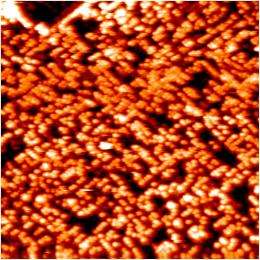
A new scanning tunneling microscopy and low energy electron diffraction technique developed at Oak Ridge National Laboratory captured this 50 nm x 50 nm image of an oxide surface. Each bright dot is a single atom of material.

Thin layers of oxide materials and their interfaces have been observed in atomic resolution during growth for the first time by researchers at the Center for Nanophase Materials Sciences at the Department of Energy's Oak Ridge National Laboratory, providing new insight into the complicated link between their structure and properties.

"Imagine you suddenly had the ability to see in color, or in 3-D," said the CNMS's Sergei Kalinin. "That is how close we have been able to look at these very small interfaces."

The paper was published online in ACS Nano with ORNL's Junsoo Shin as lead author.

A component of magnetoelectronics and , oxide interfaces have the potential to replace silicon-based microelectronic devices and improve the power and memory retention of other electronic technologies.

However, oxide interfaces are difficult to analyze at the because once the oxides are removed from their growth chamber they become contaminated. To circumvent this problem, ORNL researchers led by Art Baddorf built a unique system that allows and low energy electron diffraction to capture images of the top layer of the oxide while in situ, or still in the vacuum chamber where the materials were grown by powerful laser pulses.

Many studies of similar oxide interfaces utilize a look from the side, typically achieved by aberration corrected scanning (STEM). The ORNL team has used these cross-sectional images to map the oxide organization.

However, like a sandwich, oxide interfaces may be more than what they appear from the side. In order to observe the interactive layer of the top and bottom oxide, the group has used scanning tunneling microscopy to get an atomically resolved view of the surface of the oxide, and observed its evolution during the growth of a second oxide film on top.

"Instead of seeing a perfectly flat, square lattice that scientists thought these interfaces were before, we found a different and very complicated atomic ordering," said Baddorf. "We really need to reassess what we know about these materials."

Oxides can be used in different combinations to produce unique results. For instance, isolated, two oxides may be insulators but together the interface may become conductive. By viewing the atomic structure of one oxide, scientists can more effectively couple oxides to perform optimally in advanced technological applications such as transistors.

Kalinin says the correct application of these interface-based materials may open new pathways for development of computer processors and energy storage and conversion devices, as well as understanding basic physics controlling these materials.

"In the last 10 years, there has been only limited progress in developing beyond-silicon information technologies," Kalinin said. "Silicon has limitations that have been reached, and this has motivated people to explore other options."

Atomic resolution of interface structures during oxide growth will better enable scientists to identify defects of certain popular combinations and could help narrow selections of oxides to spur new or more efficient commercial applications.

Provided by Oak Ridge National Laboratory (news : web)

4.9 /5 (15 votes)  

Filter


Move the slider to adjust rank threshold, so that you can hide some of the comments.


Display comments: newest first

vivcollins
Aug 04, 2010

Rank: not rated yet
does this also apply to the oxides used in superconductor research?
Jigga
Aug 04, 2010

Rank: 1.7 / 5 (6)
Nope, they're of layered structure

http://www.news.c....STM.jpg
Jigga
Aug 05, 2010

Rank: 1.7 / 5 (6)
Films prepared by pulsed laser deposition and/or molecular-beam epitaxy are indeed amorphous, because they were cooled fast.

http://trace.tenn...iss/300/
Rank 4.9 /5 (15 votes)
Relevant PhysicsForums posts
  • polymer nanocomposites
    createdFeb 10, 2012
  • Corrosion Tests on Magnesium
    createdFeb 09, 2012
  • polyethylene copper nanocomposite
    createdFeb 09, 2012
  • Output of xrd analysis
    createdFeb 08, 2012
  • Transport phenomena problem based on problems 18.B11 and 19B.6 from Bird, stewart, lw
    createdFeb 06, 2012
  • Help with material selection - Car Piston
    createdFeb 05, 2012
  • More from Physics Forums - Materials & Chemical Engineering

More news stories

What lies beneath: Mapping hidden nanostructures

The ability to diagnose and predict the properties of materials is vital, particularly in the expanding field of nanotechnology. Electron and atom-probe microscopy can categorize atoms in thin sheets of material, ...

Nanotechnology / Nanophysics

created 17 hours ago | popularity 5 / 5 (3) | comments 1

New kind of solar cell could capture significantly more energy than current cells

New solar cells could increase the maximum efficiency of solar panels by over 25%, according to scientists from the University of Cambridge.

Nanotechnology / Nanophysics

created Feb 08, 2012 | popularity 4.5 / 5 (12) | comments 14 | with audio podcast

Nanoshell whispering galleries improve thin solar panels

Visitors to Statuary Hall in the U.S. Capitol Building may have experienced a curious acoustic feature that allows a person to whisper softly at one side of the cavernous, half-domed room and for another on ...

Nanotechnology / Nanomaterials

created Feb 07, 2012 | popularity 4.3 / 5 (6) | comments 6 | with audio podcast

'Dark plasmons' transmit energy

Microscopic channels of gold nanoparticles have the ability to transmit electromagnetic energy that starts as light and propagates via "dark plasmons," according to researchers at Rice University.

Nanotechnology / Nanophysics

created Feb 09, 2012 | popularity 4.8 / 5 (8) | comments 1 | with audio podcast

Revealing how a battery material works

Since its discovery 15 years ago, lithium iron phosphate (LiFePO4) has become one of the most promising materials for rechargeable batteries because of its stability, durability, safety and ability to deliver ...

Nanotechnology / Nanomaterials

created Feb 08, 2012 | popularity 5 / 5 (5) | comments 0 | with audio podcast


Anonymous knocks CIA website offline (Update)

The website of the Central Intelligence Agency was inaccessible on Friday after the hacker group Anonymous claimed to have knocked it offline.

New error-correcting codes guarantee the fastest possible rate of data transmission

Error-correcting codes are one of the triumphs of the digital age. They’re a way of encoding information so that it can be transmitted across a communication channel — such as an optical fiber o ...

Google users warned of threat to smartphone wallets

Users of Google smartphone wallets were being warned on Friday that there is a way to crack pass codes intended to thwart thieves from going on illicit shopping sprees.

Humans may have helped the decline of African rainforests 3000 years ago

(PhysOrg.com) -- Large areas of rainforests in Central Africa mysteriously disappeared over three thousand years ago, to be replaced by savannas. The prevailing theory has been that the cause was a change ...

New power source discovered

(PhysOrg.com) -- Researchers at the Massachusetts Institute of Technology (MIT) and RMIT University have made a breakthrough in energy storage and power generation.

The power of estrogen -- male snakes attract other males

A new study has shown that boosting the estrogen levels of male garter snakes causes them to secrete the same pheromones that females use to attract suitors, and turned the males into just about the sexiest ...