Push-Button Logic on the Nanoscale
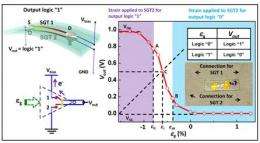
(PhysOrg.com) -- Circuits that can perform logic operations at the push of a button are a dime-a-dozen these days, but a breakthrough by researchers in the USA has meant they can be smaller and simpler than ever before. Using a single material as both the button and the circuit for the first time, scientists at the Georgia Institute of Technology have created tiny logic circuits that can be used as the basis of nanometer-scale robotics and processors.
Professor Zhong Lin (ZL) Wang, who leads the research, explains how the peculiar properties of zinc oxide have made this work possible. “Zinc oxide is unique because of its coupled piezoelectric and semiconductor properties.” The piezoelectric effect occurs when a strain on a material, caused by pushing on it for example, reversibly changes the crystal structure in one direction enough to make an electric field.
The mechanical motion induces a voltage from one side of the material to the other. Semiconductors have the ability to conduct electricity, or not, depending on some external factor. In zinc oxide, these two characteristics combine and the transport of electric current is influenced by the piezoelectric effect, meaning that changes in strain result in changes in the material’s ability to conduct electricity. This is what is known as the piezotronic effect.
By having the zinc oxide in the form of a nanowire, (diameter 300 nanometers; length 400 micrometers), and bonded with metals at each end, Wang has effectively produced a tiny transistor, which is gated (open or shut, with electricity either flowing or not) by the strain applied to the nanowire.
In results published in Advanced Materials this week, Wang and his colleagues show how by combining an appropriate number of these transistors in various arrangements, systems can be made that can process the basic logic functions of NAND, NOR, and XOR, as well as act as multiplexers (MUX) and demultiplexors (DEMUX).
Until now, logic processors have relied on the use of CMOS technology, using two Complementary components, a Metal Oxide and a Semiconductor, such as silicon. In CMOS processors, an electric signal is required to operate the gate. If a mechanical stimulus is required, yet a further component must be added to the system. By contrast, Wang claims his work represents a “brand new approach toward logic operation that performs mechanic-electrical coupled and controlled actions in one structure unit using a single material (which is zinc oxide)…This is the very first demonstration of mechanical action-induced electronic operation with the introduction of a new driving mechanism in comparison to existing silicon-based logic operations. This is also the first demonstration of its kind using nanowires.”
Working in the nanoscale presents its own challenges, and the most difficult parts of this work were synthesizing high-quality nanowires and manipulating them on the substrate so they would work in a synchronized way. But Wang is now confident they have achieved a good control over the process, and the results testify that this is the case.
The logic circuits are not as fast as those currently in use and based on CMOS, but Wang does not see this as a problem. In fact, he sees the applications of the two technologies as being complementary. “The strain-gated logic devices are designed to interface with the ambient environment, which is associated with low-frequency mechanical actions, and the aim and targeting applications are different from those of conventional silicon devices which aim at speed.” Envisaged applications include nanorobotics, transducers, micromachines, human-computer interfacing, and microfluidics (where tiny channels carry various liquids, usually to be mixed for reaction tightly controlled ways).
The group intends to join the new strain-gated transducers to sensors and energy-drawing components they have previously prepared also from zinc oxide nanowires to make “self-sustainable, all-nanowire-based, multifunctional self-powered autonomous intelligent nanoscale systems.” It seems we won’t even need to push a button anymore.
More information: W. Z. Wu, Y. G. Wei, and Z. L. Wang, “Strain-Gated Piezotronic Logic Nanodevices”, Advanced Materials 2010, DOI: 10.1002/adma.201001925
Provided by Wiley


