Diving Robot Discovers Life in the Slow Lane
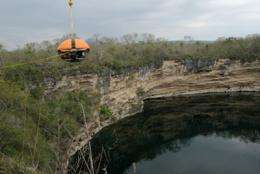
Scientists have found amazingly diverse microbial life in the world's deepest water-filled sinkhole, even down where sunlight can't reach. The discovery adds new insight into life’s ability to thrive in Earth's most extreme environments. This research also could aid the search for life elsewhere in our solar system, such as on Jupiter's moon Europa.
A deep-diving robot exploring the depths of the world's deepest water-filled sinkhole has found an amazing diversity of microbial life, even down where sunlight can't reach.
The discovery re-affirms life's resilience and ability to thrive in extreme environments on Earth, and possibly on other planets as well, scientists say.
The robot, named DEPTHX, dove about 900 feet (275 m) deep toward the bottom of the Zacaton sinkhole in northeastern Mexico. Over almost 50 dives, the craft retrieved samples of water and microbes lining the limestone sinkhole.
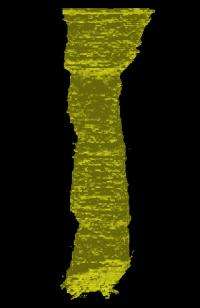
Among these samples, researchers were able to identify more than 100 types of microbes, including three new phyla of bacteria never before discovered. The scientists also used data gathered by the robot's 54 onboard sonars to create high-resolution three-dimensional maps of the underground hole, which had never before been explored to such depths.
Sinkholes are depressions in the ground that are thought to be formed by the chemical dissolution of carbonate rocks, leaving behind a void that can fill up with water or air.
The Zacatón sinkhole is about 344 feet (105 m) across, and is filled with water that stays about 86 degrees Fahrenheit (30 degrees Celsius) throughout the year. The water contains sulfuric compounds that serve as a food source for some of the life within.
"It's a vertical column that goes straight down into the Earth," said researcher John Spear of the Colorado School of Mines. "We didn’t know how deep before we went down."
Digging up microbes
To collect samples, DEPTHX is equipped with a sipper that sucks up water and stores it in sealed plastic bags. The craft also has a robotic arm that reached out and dug into the walls of the sinkhole to collect solid samples.
The researchers retrieved these samples when DEPTHX came back to the surface, and brought them back to the lab to do DNA analysis to figure out what kind of life was there.
Spear and his colleagues found microbes living both in the water and in thick mats coating the sinkhole's walls. After a certain depth, sunlight can no longer penetrate, so instead of getting energy from light, the organisms glean fuel from hydrogen sulfide and other energy-rich compounds. "Instead of photosynthesis, they're doing chemosynthesis, pulling carbon off of limestone," Spear said. "In the subsurface field we call it life in the slow lane - they have to take advantage of whatever's there."
In fact, life is teeming in the slow lane, the scientists found.
The researchers were stunned at the wealth of life they discovered, including so many species of microbes that they represent between 75 and 80 percent of the known microbial life on Earth, not to mention a few unknown types.
"It tells us that we still don't know the extent of diversity of life, which is an important thing in and of itself," Spear told Astrobiology Magazine. "When you can find three new phyla of bacteria without really trying that hard, how much out there are we missing?"
And if life can survive in this extreme environment, it offers hope that some form of life may exist on other planets or moons that have similar conditions.
Exploring other worlds
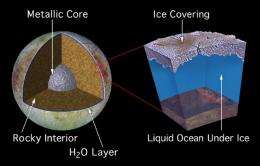
While exploring unknown spots on Earth is incredibly exciting, the researchers designed DEPTHX with even loftier destinations in mind. They hope to eventually use a similar robot to explore other worlds, particularly Jupiter's moon Europa.
That moon is an appealing target for astrobiologists because it is thought to host underground oceans of liquid water beneath a frozen ice crust. Since water is thought to be necessary for life, those oceans could be good spots to look for microbial extraterrestrial life.
"This is a first-generation attempt at something that could be used to go underneath the ice on Europa," Spear said.
If a robot were sent to Europa, it would have to autonomously navigate through space, land on the moon’s surface, dig through the ice sheet, explore the ocean underneath for microscopic life, and then transmit its findings back to Earth.
That's a tall order for current robotic technology, but the scientists see it as a realistic goal.
Spear and his colleagues detailed their findings in the March 2010 issue of the journal Astrobiology. NASA funds the DEPTHX project through its ASTEP (Astrobiology Science and Technology for Exploring Planets) program.
Provided by Astrobio.net


