Robot Speaks the Language of Kids
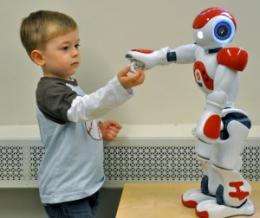
(PhysOrg.com) -- Researchers are studying whether a small robot with a big personality holds the potential to help children with autism.
A robot delivers a karate chop or makes drumming motions and a child imitates the robot, taking delight in a novel playmate. But if a child with autism imitates the robot, much more than that may occur.
Two researchers with the Center for Health, Intervention, and Prevention (CHIP) at the University of Connecticut are studying whether a small robot with a big personality holds the potential to help children with autism improve both their motor and their social communication skills.
“Anecdotal evidence suggests interventions using robot-child interactions may enhance motor and social communication skills of children with low- and high-functioning Autism Spectrum Disorders (ASD), but there are very few clinical trials currently testing robot-child interactions as therapy for ASD,” says Anjana Bhat, a principal investigator with CHIP.
Bhat, an assistant professor of kinesiology in the Neag School of Education, recently received a two-year, $404,639 grant from the National Institute of Mental Health (NIMH) to design a series of robot-child interactions that would help improve the gross motor skills and the imitative and turn-taking abilities of children with ASD. The second two-year phase of the project will include a clinical trial of the intervention with 20 children with ASD and 20 typically developing children between the ages of four and eight.
During her post-doctoral work in the field of autism, Bhat learned about the motor impairments of children with ASD, such as poor motor coordination, balance, and difficulty imitating complex movements. She became particularly interested in this area because research suggests impairments in these areas contribute to the social-communication impairments of children with ASD.
Before applying for the NIMH grant, Bhat and her co-investigator, Timothy Gifford, director of CHIP’s Advanced Interactive Technology Center and a robotics lab in UConn’s psychology department, conducted a pilot study using a seven-inch robot they bought off the shelf and programmed themselves.
For the federally funded project, Bhat and Gifford have purchased a two-foot-tall robot named Nao from Aldebaran Robotics in France, using internal equipment grant funds.
Nao introduces himself, extends his hand for a shake, announces that children like to play with him, and takes a bow. Nao even performs elaborate Tai Chi routines with accompanying music. But, most importantly for the researchers, the robot can be programmed to incrementally increase the complexity of its routines over time, as the children progress through therapy.
Bhat and Gifford have begun using Nao in sessions with children in Bhat’s Infant and Child Development Laboratory on campus. As part of the first phase of the study, the researchers will have five children with ASD and 16 typically developing children interact individually with Nao during eight separate sessions. Each session will include four or five robot actions to imitate.
“So far, our data suggest that robot-child interactions are a highly motivating context for children, those with and without autism,” Bhat says. “Children not only connect with the robot but also with the tester who controls the robot, as they both share the novel experience together.”
Bhat says that children with ASD typically feel more comfortable with robots than with other people initially, because robot interactions are simpler and more predictable and the children are in control of the social interaction. “Robots also are fully-embodied beings that encourage children to engage in whole body interactions,” she adds. “Children with ASD typically enjoy playing with them, and respond with imitative behavior often delayed during interactions with other people.”
Bhat says robots could initially serve as intermediaries between therapists and children with ASD, until a connection is made, and may help extend the reach of clinicians. “Often children with ASD have intense therapy needs - often 30 to 40 hours per week - and a robot could perform some of the tasks typically performed by an untrained individual and could support the clinician by delivering more standardized interventions,” she says.
Gifford says that eventually, robotics systems will have the potential to collect video and kinematic data of a child’s fine and gross motor performance and may further reduce the human resources required to deliver intensive interventions and perform frequent assessments.
“The ultimate goal will be to extend the capabilities of therapists and bring this technology to the target population in a useful, affordable way,” he says. “Someday perhaps, robots could be used in a variety of settings, such as schools and homes, as well as clinicians’ offices.”
Kerry Marsh, an associate professor of psychology and PI with CHIP, and Deborah Fein, Board of Trustees Distinguished Professor of Psychology and CHIP affiliate, are collaborators on this project.


