Planets Align for the Perseid Meteor Shower
August 6, 2010 by Dr. Tony Phillips
Planets Align for the Perseid Meteor Shower

Enlarge

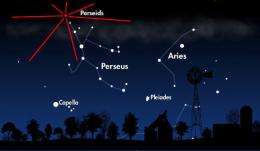
Looking northeast around midnight on August 12th-13th. The red dot is the Perseid radiant. Although Perseid meteors can appear in any part of the sky, all of their tails will point back to the radiant.

You know it's a good night when a beautiful alignment of planets is the second best thing that's going to happen. Thursday, August 12th, is such a night.

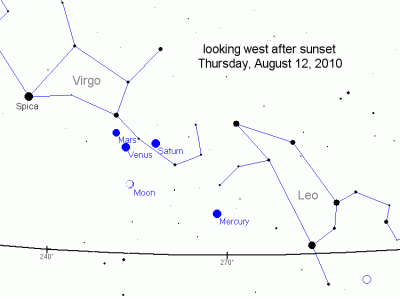
The show begins at sundown when Venus, Saturn, Mars and the crescent Moon pop out of the western twilight in tight conjunction. All four heavenly objects will fit within a circle about 10 degrees in diameter, beaming together through the dusky colors of sunset. No telescope is required to enjoy this naked-eye event: sky map:
Planets Align for the Perseid Meteor Shower
Enlarge


The planets will hang together in the western sky until 10 pm or so. When they leave, following the sun below the horizon, you should stay, because that is when the Perseid begins. From 10 pm until dawn, will flit across the starry sky in a display that's even more exciting than a planetary get-together.

The is caused by debris from Comet Swift-Tuttle. Every 133 years the huge comet swings through the and leaves behind a trail of dust and gravel. When Earth passes through the debris, specks of comet-stuff hit the atmosphere at 140,000 mph and disintegrate in flashes of light. These meteors are called Perseids because they fly out of the constellation Perseus.

Swift-Tuttle's debris zone is so wide, Earth spends weeks inside it. Indeed, we are in the outskirts now, and sky watchers are already reporting a trickle of late-night Perseids. The trickle could turn into a torrent between August 11th and 13th when Earth passes through the heart of the debris trail.

2010 is a good year for Perseids because the Moon won't be up during the midnight-to-dawn hours of greatest activity. Lunar glare can wipe out a good meteor shower, but that won't be the case this time.

As Perseus rises and the night deepens, meteor rates will increase. For sheer numbers, the best time to look is during the darkest hours before dawn on Friday morning, Aug. 13th, when most observers will see dozens of Perseids per hour.

For best results, get away from city lights. The darkness of the countryside multiplies the visible meteor rate 3- to 10-fold. A good dark sky will even improve the planetary alignment, allowing faint Mars and Saturn to make their full contribution to the display. Many families plan camping trips to coincide with the Perseids. The Milky Way arching over a mountain campground provides the perfect backdrop for a meteor shower.

Enjoy the show!

Provided by Science@NASA

4.1 /5 (18 votes)  

Rank 4.1 /5 (18 votes)
Related Stories
Relevant PhysicsForums posts
  • Titan's lack of impact craters
    createdFeb 09, 2012
  • Real pictures of black hole eating a star?
    createdFeb 08, 2012
  • Hypothetical way to travel faster than light, but not technically exceed lightspeed
    createdFeb 06, 2012
  • How do scientists monitor the Sun's activity?
    createdFeb 05, 2012
  • Search patterns in observational studies
    createdFeb 05, 2012
  • Derivation of Pogson's law
    createdFeb 03, 2012
  • More from Physics Forums - General Astronomy

More news stories

NASA sees wide-eyed cyclone Jasmine

Cyclone Jasmine's eye has opened wider on NASA satellite imagery, as it moves through the Southern Pacific Ocean.

Space & Earth / Earth Sciences

created 20 minutes ago | popularity not rated yet | comments 0

NASA sees Giovanna reach cyclone strength, threaten Madagascar

Tropical Storm 12S built up steam and became a cyclone on February 10, 2012 as NASA's Terra satellite passed overhead. Residents of east-central Madagascar should prepare for this cyclone to make landfall ...

Space & Earth / Earth Sciences

created 19 minutes ago | popularity not rated yet | comments 0

Humans may have helped the decline of African rainforests 3000 years ago

(PhysOrg.com) -- Large areas of rainforests in Central Africa mysteriously disappeared over three thousand years ago, to be replaced by savannas. The prevailing theory has been that the cause was a change ...

Space & Earth / Environment

created 12 hours ago | popularity 4.2 / 5 (5) | comments 10 | with audio podcast report

Could Venus be shifting gear?

(PhysOrg.com) -- ESA’s Venus Express spacecraft has discovered that our cloud-covered neighbour spins a little slower than previously measured. Peering through the dense atmosphere in the infrared, the ...

Space & Earth / Space Exploration

created 8 hours ago | popularity 5 / 5 (5) | comments 7 | with audio podcast

Mars Science Laboratory computer issue resolved

(PhysOrg.com) -- Engineers have found the root cause of a computer reset that occurred two months ago on NASA's Mars Science Laboratory and have determined how to correct it.

Space & Earth / Space Exploration

created 9 hours ago | popularity 5 / 5 (5) | comments 3 | with audio podcast


CIA website offline, Anonymous takes credit

The website of the Central Intelligence Agency was unresponsive on Friday after the hacker group Anonymous claimed to have knocked it offline.

Complex wiring of the nervous system may rely on a just a handful of genes and proteins

Researchers at the Salk Institute have discovered a startling feature of early brain development that helps to explain how complex neuron wiring patterns are programmed using just a handful of critical genes. ...

The power of estrogen -- male snakes attract other males

A new study has shown that boosting the estrogen levels of male garter snakes causes them to secrete the same pheromones that females use to attract suitors, and turned the males into just about the sexiest ...

New error-correcting codes guarantee the fastest possible rate of data transmission

Error-correcting codes are one of the triumphs of the digital age. They’re a way of encoding information so that it can be transmitted across a communication channel — such as an optical fiber o ...

Small modular reactor design could be a 'SUPERSTAR'

(PhysOrg.com) -- Though most of today's nuclear reactors are cooled by water, we've long known that there are alternatives; in fact, the world's first nuclear-powered electricity in 1951 came from a reactor ...

Curry spice component may help slow prostate tumor growth

Curcumin, an active component of the Indian curry spice turmeric, may help slow down tumor growth in castration-resistant prostate cancer patients on androgen deprivation therapy (ADT), a study from researchers ...