Turning down the noise in graphene
August 6, 2010 by Lynn Yarris
Turning down the noise in graphene

Enlarge

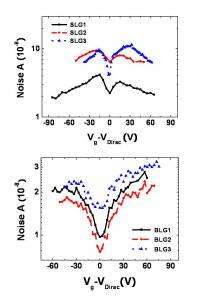
New noise model shows all single layer graphene samples with an M-shaped pattern of noise (top) and all bi-layer graphene samples with a V-shaped noise pattern.

(PhysOrg.com) -- Graphene is a two-dimensional crystalline sheet of carbon atoms - meaning it is only one atom thick - through which electrons can race at nearly the speed of light - 100 times faster than they can move through silicon. This plus graphene's incredible flexibility and mechanical strength make the material a potential superstar for the electronics industry. However, whereas the best electronic materials feature a strong signal and weak background noise, attaining this high signal-to-noise ratio has been a challenge for both single and bi-layers of graphene, especially when placed on a substrate of silica or some other dielectric. One of the problems facing device developers has been the lack of a good graphene noise model.

Working with the unique nanoscience capabilities of the Molecular Foundry at the U.S. Department of Energy (DOE)'s Lawrence Berkeley National Laboratory, a multi-institutional team of researchers has developed the first model of signal-to-noise-ratios for low frequency noises in on silica. Their results show noise patterns that run just the opposite of noise patterns in other electronic materials.

Berkeley Lab materials scientist Yuegang Zhang led a study in which it was determined that for graphene on silica, the background signal noise is minimal near the region in the graphene where the of states (the number of energy states available to each electron) is lowest. For semiconductors, such as silicon, in the region where electron density states is low the background noise is at its highest. However, there were distinct differences in the noise patterns of single and bi-layer graphene.

"In this work, we present the four-probe low frequency noise characteristics in single- and bi-layer graphene samples, using a back-gated device structure that helps simplify the physics in understanding the interactions between the graphene and the silica substrate," says Zhang. "For single-layer graphene we found that the noise was reduced either close to or far away from the lowest electron density of states, sometimes referred to as the Dirac point for graphene, forming an M-shaped pattern. For the bi-layer graphene, we found a similar noise reduction near the Dirac point but an increase away from that point, forming a V-shaped pattern. The noise data near the Dirac point correlated to spatial-charge inhomogeneity."

The results of this research are reported in the journal Nano Letters in a paper titled "Effect of Spatial Charge Inhomogeneity on 1/f Noise Behavior in Graphene." Co-authoring the paper with Zhang were Guangyu Xu, Carlos
Torres Jr., Fei Liu, Emil Song, Minsheng Wang, Yi Zhou, Caifu Zeng and Kang Wang.

Lead author Guangyu Xu, a physicist with the Department of Electrical Engineering at the University of California (UC) Los Angeles, says the spatial charge inhomogeneity responsible for the graphene's unique noise patterns was probably caused by the charge impurities near the graphene-substrate interface.

"Our experiment carefully rules out other possible extrinsic factors that might influence the result," Xu says. "We conclude the correlation between the anomalous noise feature and the spatial charge inhomogeneity, is one
of the main carrier scattering mechanisms for unsuspended graphene samples."

Xu says this model of low frequency noise characteristics in graphene should be a significant help for fabricating electronic devices because biasing at the low regime can be designed into the device.

"This will benefit the high signal-to-noise ratio in graphene," Xu says.

Provided by Lawrence Berkeley National Laboratory (news : web)

4.8 /5 (11 votes)  

Rank 4.8 /5 (11 votes)
Related Stories
Relevant PhysicsForums posts
  • polymer nanocomposites
    createdFeb 10, 2012
  • Corrosion Tests on Magnesium
    createdFeb 09, 2012
  • polyethylene copper nanocomposite
    createdFeb 09, 2012
  • Output of xrd analysis
    createdFeb 08, 2012
  • Transport phenomena problem based on problems 18.B11 and 19B.6 from Bird, stewart, lw
    createdFeb 06, 2012
  • Help with material selection - Car Piston
    createdFeb 05, 2012
  • More from Physics Forums - Materials & Chemical Engineering

More news stories

What lies beneath: Mapping hidden nanostructures

The ability to diagnose and predict the properties of materials is vital, particularly in the expanding field of nanotechnology. Electron and atom-probe microscopy can categorize atoms in thin sheets of material, ...

Nanotechnology / Nanophysics

created 17 hours ago | popularity 5 / 5 (3) | comments 1

New kind of solar cell could capture significantly more energy than current cells

New solar cells could increase the maximum efficiency of solar panels by over 25%, according to scientists from the University of Cambridge.

Nanotechnology / Nanophysics

created Feb 08, 2012 | popularity 4.5 / 5 (12) | comments 14 | with audio podcast

Nanoshell whispering galleries improve thin solar panels

Visitors to Statuary Hall in the U.S. Capitol Building may have experienced a curious acoustic feature that allows a person to whisper softly at one side of the cavernous, half-domed room and for another on ...

Nanotechnology / Nanomaterials

created Feb 07, 2012 | popularity 4.3 / 5 (6) | comments 6 | with audio podcast

'Dark plasmons' transmit energy

Microscopic channels of gold nanoparticles have the ability to transmit electromagnetic energy that starts as light and propagates via "dark plasmons," according to researchers at Rice University.

Nanotechnology / Nanophysics

created Feb 09, 2012 | popularity 4.8 / 5 (8) | comments 1 | with audio podcast

Revealing how a battery material works

Since its discovery 15 years ago, lithium iron phosphate (LiFePO4) has become one of the most promising materials for rechargeable batteries because of its stability, durability, safety and ability to deliver ...

Nanotechnology / Nanomaterials

created Feb 08, 2012 | popularity 5 / 5 (5) | comments 0 | with audio podcast


Anonymous knocks CIA website offline (Update)

The website of the Central Intelligence Agency was inaccessible on Friday after the hacker group Anonymous claimed to have knocked it offline.

New error-correcting codes guarantee the fastest possible rate of data transmission

Error-correcting codes are one of the triumphs of the digital age. They’re a way of encoding information so that it can be transmitted across a communication channel — such as an optical fiber o ...

Google users warned of threat to smartphone wallets

Users of Google smartphone wallets were being warned on Friday that there is a way to crack pass codes intended to thwart thieves from going on illicit shopping sprees.

Humans may have helped the decline of African rainforests 3000 years ago

(PhysOrg.com) -- Large areas of rainforests in Central Africa mysteriously disappeared over three thousand years ago, to be replaced by savannas. The prevailing theory has been that the cause was a change ...

New power source discovered

(PhysOrg.com) -- Researchers at the Massachusetts Institute of Technology (MIT) and RMIT University have made a breakthrough in energy storage and power generation.

The power of estrogen -- male snakes attract other males

A new study has shown that boosting the estrogen levels of male garter snakes causes them to secrete the same pheromones that females use to attract suitors, and turned the males into just about the sexiest ...