Higher temperatures to slow Asian rice production
August 9, 2010
Higher temperatures to slow Asian rice production

Enlarge

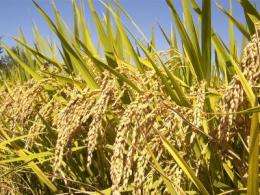
Around three billion people eat rice every day, and more than 60 percent of the world's one billion poorest and undernourished people who live in Asia depend on rice as their staple food. Credit: IRRI

the world's most important crop for ensuring food security and addressing poverty—will be thwarted as temperatures increase in rice-growing areas with continued climate change, according to a new study by an international team of scientists.

The research team found evidence that the net impact of projected temperature increases will be to slow the growth of production in Asia. Rising temperatures during the past 25 years have already cut the yield growth rate by 10-20 percent in several locations.

Published in the online early edition the week of Aug. 9, 2010 in —a peer-reviewed, scientific journal from the United States—the report analyzed six years of data from 227 irrigated rice farms in six major rice-growing countries in Asia, which produces more than 90 percent of the world's rice.

"We found that as the daily minimum temperature increases, or as nights get hotter, rice yields drop," said Jarrod Welch, lead author of the report and graduate student of economics at the University of California, San Diego.

This is the first study to assess the impact of both daily maximum and minimum temperatures on irrigated rice production in farmer-managed rice fields in tropical and subtropical regions of Asia.

"Our study is unique because it uses data collected in farmers' fields, under real-world conditions," said Welch. "This is an important addition to what we already know from controlled experiments."

"Farmers can be expected to adapt to changing conditions, so real-world circumstances, and therefore outcomes, might differ from those in controlled experimental settings," he added.

Around three billion people eat rice every day, and more than 60 percent of the world's one billion poorest and undernourished people who live in Asia depend on rice as their staple food. A decline in rice production will mean more people will slip into poverty and hunger, the researchers said.

"Up to a point, higher day-time temperatures can increase rice yield, but future yield losses caused by higher night-time temperatures will likely outweigh any such gains because temperatures are rising faster at night," said Welch. "And if day-time temperatures get too high, they too start to restrict rice yields, causing an additional loss in production."

"If we cannot change our rice production methods or develop new rice strains that can withstand higher temperatures, there will be a loss in rice production over the next few decades as days and nights get hotter. This will get increasingly worse as temperatures rise further towards the middle of the century," he added.

Provided by University of California - San Diego (news : web)


Rank 5 /5 (1 vote)
Related Stories
Relevant PhysicsForums posts
  • Mitosis
    created3 hours ago
  • Stem cell question.
    created4 hours ago
  • Protease cleavage
    created10 hours ago
  • Pertubance in a model
    created17 hours ago
  • Cancer drugs and Alzheimer's, Oh my!
    createdFeb 09, 2012
  • Squishing cells
    createdFeb 09, 2012
  • More from Physics Forums - Biology

More news stories

The power of estrogen -- male snakes attract other males

A new study has shown that boosting the estrogen levels of male garter snakes causes them to secrete the same pheromones that females use to attract suitors, and turned the males into just about the sexiest ...

Biology / Plants & Animals

created 15 hours ago | popularity 4.8 / 5 (6) | comments 1 | with audio podcast

Grass to gas: Researchers' genome map speeds biofuel development

Researchers at the University of Georgia have taken a major step in the ongoing effort to find sources of cleaner, renewable energy by mapping the genomes of two originator cells of Miscanthus x giganteus, a large perenn ...

Biology / Biotechnology

created 12 hours ago | popularity 3.8 / 5 (5) | comments 0 | with audio podcast

Miami battling invasion of giant African snails

No one knows how they got there. But an invasion of African giant snails has southern Florida in a panic over potential crop damage, disease and general yuckiness surrounding the slimy gastropods.

Biology / Ecology

created 19 hours ago | popularity 4 / 5 (1) | comments 4

Experts reveal how plants don't get sunburn

(PhysOrg.com) -- Experts at the University of Glasgow have discovered how plants survive the harmful rays of the sun.

Biology / Cell & Microbiology

created 15 hours ago | popularity 4.8 / 5 (5) | comments 0 | with audio podcast

Protein libraries in a snap

(PhysOrg.com) -- A Rice University undergraduate will depart with not only a degree but also a possible patent for his invention of an efficient way to create protein libraries, an important component of biomolecular ...

Biology / Cell & Microbiology

created 19 hours ago | popularity 4.8 / 5 (4) | comments 1 | with audio podcast


Anonymous knocks CIA website offline (Update)

The website of the Central Intelligence Agency was inaccessible on Friday after the hacker group Anonymous claimed to have knocked it offline.

Google users warned of threat to smartphone wallets

Users of Google smartphone wallets were being warned on Friday that there is a way to crack pass codes intended to thwart thieves from going on illicit shopping sprees.

New error-correcting codes guarantee the fastest possible rate of data transmission

Error-correcting codes are one of the triumphs of the digital age. They’re a way of encoding information so that it can be transmitted across a communication channel — such as an optical fiber o ...

Humans may have helped the decline of African rainforests 3000 years ago

(PhysOrg.com) -- Large areas of rainforests in Central Africa mysteriously disappeared over three thousand years ago, to be replaced by savannas. The prevailing theory has been that the cause was a change ...

New power source discovered

(PhysOrg.com) -- Researchers at the Massachusetts Institute of Technology (MIT) and RMIT University have made a breakthrough in energy storage and power generation.

Small modular reactor design could be a 'SUPERSTAR'

(PhysOrg.com) -- Though most of today's nuclear reactors are cooled by water, we've long known that there are alternatives; in fact, the world's first nuclear-powered electricity in 1951 came from a reactor ...