Is solar power cheaper than nuclear power?
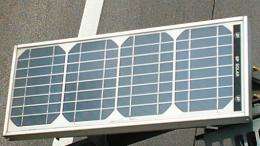
August 9, 2010 by Miranda Marquit
Image source: Wikipedia.org
One of the issues associated with shifting from using fossil fuels to alternative energy sources is the cost. While adherents of alternative energy tout its benefits, many are skeptical, pointing out that such alternatives are just too expensive. Advocates of nuclear power point out that it is less polluting (if you don't count storage of spent fuel) than fossil fuels, and that it costs less than alternatives like solar power.
A new study out of Duke University, though, casts doubt on the idea that nuclear power is cheaper than solar power. Using information from North Carolina, the study shows that solar power may be more cost efficient than nuclear power. With costs dropping on the production of photovoltaic cells, and with solar cells becoming increasingly efficient, it appears that -- in North Carolina at least -- solar installations offer a viable alternative to nuclear power, which is the source for about 20% of the electricity in the U.S.
The Energy Collective reports that some of the issues not addressed in the Duke study. Issues that may further support the idea that solar power could become a viable, cheap form of power in the not so distant future:
Two factors not stressed in the study bolster the case for solar even more:
1) North Carolina is not a “sun-rich” state. The savings found in North Carolina are likely to be even greater for states with more sunshine -Arizona, southern California, Colorado, New Mexico, west Texas, Nevada and Utah.
2) The data include only PV-generated electricity, without factoring in what is likely the most encouraging development in solar technology: concentrating solar power (CSP). CSP promises utility scale production and solar thermal storage, making electrical generation practical for at least six hours after sunset.
Power costs are generally measured in cents per kilowatt hour - the cost of the electricity needed to illuminate a 1,000 watt light bulb (for example) for one hour. When the cost of a kilowatt hour (kWh) of solar power fell to 16 cents earlier this year, it “crossed over” the trend-line associated with nuclear power.
Of course, fossil fuels still represent about 70% of the electricity production in the U.S., and there is probably still some way to go before solar power (and other alternatives) reach a level of cost efficiency that would result in more widespread use. But perhaps this study offers encouragement -- and justification -- for using resources for further development of solar power technology.
More information: Osha Davidson, "Study: Solar power is cheaper than nuclear," The Energy Collective (July 27, 2010), http://theenergyco … aper-nuclear .
John Blackburn and Sam Cunningham, "Solar and Nuclear Costs - The Historic Crossover", http://www.ncwarn. … t_final1.pdf
© 2010 PhysOrg.com
-
Desert power: A solar renaissance
Apr 01, 2008 |
not rated yet |
0
-
Ground broken on Nevada solar plant
Feb 13, 2006 |
not rated yet |
0
-
Will China's Planned Solar Field Lower the Cost of Alternative Energy?
Sep 14, 2009 |
not rated yet |
0
-
German solar industry faces subsidy cut: minister
Jan 19, 2010 |
not rated yet |
0
-
U.S. to support some solar power research
May 01, 2008 |
not rated yet |
0
-
Engineers build first sub-10-nm carbon nanotube transistor
Feb 01, 2012 |
4.9 / 5 (31) |
30
-
Something old, something new: Evolution and the structural divergence of duplicate genes
Jan 31, 2012 |
4.6 / 5 (7) |
1
-
The hidden nanoworld of ice crystals: Revealing the dynamic behavior of quasi-liquid layers
Jan 30, 2012 |
5 / 5 (3) |
1
-
Stock market network reveals investor clustering
Jan 27, 2012 |
3.9 / 5 (23) |
8
-
Of microchemistry and molecules: Electronic microfluidic device synthesizes biocompatible probes
Jan 26, 2012 |
5 / 5 (1) |
0
-
Calling function with no input argument
7 hours ago
-
Force free body diagram problem on gym equipment
8 hours ago
-
Empirical data regarding shower heads and water
16 hours ago
-
feed hold button on CNC lathe
Feb 09, 2012
-
RFAC in Fortran
Feb 09, 2012
-
dynamics 2/32
Feb 08, 2012
- More from Physics Forums - General Engineering
More news stories
Google users warned of threat to smartphone wallets
Users of Google smartphone wallets were being warned on Friday that there is a way to crack pass codes intended to thwart thieves from going on illicit shopping sprees.
11 minutes ago |
not rated yet |
0
CIA website offline, Anonymous takes credit
The website of the Central Intelligence Agency was unresponsive on Friday after the hacker group Anonymous claimed to have knocked it offline.
1 hour ago |
5 / 5 (2) |
7
New error-correcting codes guarantee the fastest possible rate of data transmission
Error-correcting codes are one of the triumphs of the digital age. Theyre a way of encoding information so that it can be transmitted across a communication channel such as an optical fiber o ...
Technology / Computer Sciences
10 hours ago |
5 / 5 (3) |
5
|
Small modular reactor design could be a 'SUPERSTAR'
(PhysOrg.com) -- Though most of today's nuclear reactors are cooled by water, we've long known that there are alternatives; in fact, the world's first nuclear-powered electricity in 1951 came from a reactor ...
Technology / Energy & Green Tech
9 hours ago |
4.2 / 5 (10) |
19
|
Advanced power-grid model finds low-cost, low-carbon future in West
(PhysOrg.com) -- The least expensive way for the Western U.S. to reduce greenhouse gas emissions enough to help prevent the worst consequences of global warming is to replace coal with renewable and other ...
Technology / Energy & Green Tech
9 hours ago |
3.7 / 5 (3) |
7
|
NASA sees wide-eyed cyclone Jasmine
Cyclone Jasmine's eye has opened wider on NASA satellite imagery, as it moves through the Southern Pacific Ocean.
NASA sees Giovanna reach cyclone strength, threaten Madagascar
Tropical Storm 12S built up steam and became a cyclone on February 10, 2012 as NASA's Terra satellite passed overhead. Residents of east-central Madagascar should prepare for this cyclone to make landfall ...
Complex wiring of the nervous system may rely on a just a handful of genes and proteins
Researchers at the Salk Institute have discovered a startling feature of early brain development that helps to explain how complex neuron wiring patterns are programmed using just a handful of critical genes. ...
The power of estrogen -- male snakes attract other males
A new study has shown that boosting the estrogen levels of male garter snakes causes them to secrete the same pheromones that females use to attract suitors, and turned the males into just about the sexiest ...
Humans may have helped the decline of African rainforests 3000 years ago
(PhysOrg.com) -- Large areas of rainforests in Central Africa mysteriously disappeared over three thousand years ago, to be replaced by savannas. The prevailing theory has been that the cause was a change ...
Could Venus be shifting gear?
(PhysOrg.com) -- ESAs Venus Express spacecraft has discovered that our cloud-covered neighbour spins a little slower than previously measured. Peering through the dense atmosphere in the infrared, the ...
Aug 09, 2010
Rank: 3.8 / 5 (12)
Aug 09, 2010
Rank: 2.4 / 5 (17)
Aug 09, 2010
Rank: 3.6 / 5 (11)
Aug 09, 2010
Rank: 2.3 / 5 (15)
Why not? Every house or village could in proper location could have it's own unit consisting of solar / wind plant, batteries and converters. It's feasible technology, it's just still too expensive.
Aug 09, 2010
Rank: 3.6 / 5 (13)
Solar or wind cannot be used as an individual powersource in all locations. Plus what if your array goes offline?
You require a grid, whether locally or nonlocally fed for peak consistency.
Would you care to clarify your stance on nuclear?
Aug 09, 2010
Rank: 4.3 / 5 (7)
http://atomicinsi...-on.html
Aug 09, 2010
Rank: 3.8 / 5 (6)
The paper ignores all other cost projections for nuclear.
•A 2003 study conducted by a multidisciplinary team at MIT titled The Future of Nuclear Power which was updated with new data in 2009.
•A 2005 report by the World Nuclear Association titled The New Economics of Nuclear Power
•A 2010 OECD study titled Projected Costs of Generating Electricity: 2010 Edition
Most new nuclear (75%) will be built outside the OECD in China, Russia etc... at a cost of $1500-2000 per KW.
Aug 09, 2010
Rank: 3.5 / 5 (6)
On a related note, we've all seen that decades old document on the procedures for changing a light bulb in a nuclear plant. I wonder what the cost of nuclear would be if only the /necessary/ red tape were left in place and the /unnecessary/ red tape were lifted.
Aug 09, 2010
Rank: 3.9 / 5 (11)
You don't really seem to understand current nuclear technology.
Aug 09, 2010
Rank: 1.2 / 5 (12)
Aug 09, 2010
Rank: 4.4 / 5 (5)
Francium has a maximum half life of only 22 minutes, for francium-223 (from the wiki page). How would it be used for nuclear power generation? I hadn't heard about such a system before.
Aug 09, 2010
Rank: 4.2 / 5 (6)
Aug 09, 2010
Rank: 4.1 / 5 (7)
There are systems to store solar energy in molten salt systems. You just have to produce more power than you need during the day. Also, at night you don't need as much power when people are sleeping. At these off peak hours you can rely on wind, tidal or wave, existing nuclear, stored solar, etc. The distributed design is preferable too. You do need a grid, but solar allows for having the equivalent of thousands of nuclear plants spread out. This makes power transmission easier and a more robust system against damage, either intentional or not.
Aug 09, 2010
Rank: 3.7 / 5 (3)
Aug 09, 2010
Rank: 5 / 5 (3)
Aug 09, 2010
Rank: 2.8 / 5 (6)
Aug 09, 2010
Rank: 3.8 / 5 (5)
Distributed grid would be great, but it cannot be the only solution, especially when relying on intermittent power like wind and solar. We should pursue baseload power from nuclear, preferential peak power from renewables (wind, solar, etc), and CNG to make up the difference.
Aug 09, 2010
Rank: 2 / 5 (4)
You don't really seem to understand current nuclear technology."
You don't really seem to understand *current* nuclear technology.
Aug 09, 2010
Rank: 4 / 5 (7)
The study's intellectual dishonestly is breathtaking. The article fails to mention that the quoted solar cost is after state and federal subsidies that literally pay ~2/3 of the cost. Official US govt. (EIA) statistics show that solar PV costs 40 cents/kW-hr compared to 12 cents for nuclear. Solar thermal costs 26. And these costs don't even factor in cost related to intermittentcy.
http://www.eia.do...ion.html
Aug 09, 2010
Rank: 4.2 / 5 (5)
Nuclear power is cheap and secure power.
Aug 09, 2010
Rank: 4 / 5 (4)
Sadly, it's a -and I really hate to use the phrase-"if you build it, they will come" type of alternative, and either some independently-minded, enterprising people do it, or the the same old players will snatch it up and run with it just as soon as the critical point in the cost/benefit analysis is reached.
The only way to interrupt this scenario, as I've suggested elsewhere, is to Enact a new Development Authority, a la the TVA, to fund the R&D, and coordinate the development and deployment of the resources and technology.
Otherwise, it'll be the same story- the little, visionary guys will start it up, saturate the supply and flounder because of fierce competition,
the costs associated with re-tooling and reinvestment minimizing profitability, and then the Big Dogs will snap it up, and begin dictating rates
Aug 09, 2010
Rank: 5 / 5 (4)
Yeah, there is SO much Francium around.
Aug 10, 2010
Rank: 5 / 5 (2)
Electronic equipment evolves so quickly that solar cells will quickly become cheaper and more efficient. One need only to look at how rapidly computers have evolved to realize that once they are widely marketed, they will be preferable to 'dirtier' alternatives.
The waste from nuclear power plants must never be taken out of the equation. Every technology must be measured by it's cradle-to-grave costs. Downstream consequences must be factored in. Fossil fuels seemed great until CO2 was taken into account.
Aug 10, 2010
Rank: not rated yet
My bad but I tought it was all about transformed nuclear waste?
Anyway seawater has lot of uranium. About 80000 years worth by curent use.
And about "the news" i won by it. Not yet at least. I belive in the next generation of solar panels.
Aug 10, 2010
Rank: 4 / 5 (6)
I think solar is fine for home, but residential uses a meager fraction of the total electrical power needed by the country. Its great that a home can cover itself but you have any idea how much space you need to cover a steel mill, or a plant that makes mono crystalline silicon? :)
Aug 10, 2010
Rank: 4 / 5 (4)
I like how people think that nuclear waste is waste. It just means it is no longer efficient to use in the plant it came from. It may be sitting away under a mountain in a barrel but at 400-600C it is still pretty usefull, but not in a plant designed for 1200-1500C fuel. Pebble bed reactors have solved this issue, Once it can no longer adequately heat the gasses in those plants- you can take those old spheres and place them in a big steam boiler. No worry about not enough water, or the spheres breaking from temperature or pressure change. If anything our old waste should be encased and utilized immediately in low grade plants.
Aug 10, 2010
Rank: 3.7 / 5 (3)
Aug 10, 2010
Rank: 4.3 / 5 (6)
Aug 10, 2010
Rank: 3 / 5 (4)
Rubbish, a cubic mile laid over 3 sq miles is 1/3 mile thick.
Assuming 10 hours illumination @1000W/m2 and 20% efficiency you need one square mile. That 840m of 1m2 silicon ingot, not including saw kerf, so one mile inclusive.
The cost at $4 per peak watt is $2 billion.
OK so the output is daytime only, where most demand lies, but can you really build and run a nucular (heh) plant for $2 billion?
Aug 10, 2010
Rank: 4.2 / 5 (5)
France and sweden commonly build reactors for less than 2 billion.
Aug 10, 2010
Rank: 4 / 5 (4)
Assessment of Parabolic Trough and Power Tower Solar Technology Cost and Performance Forecasts - Sargent & Lundy LLC Consulting Group Chicago, Illinois, for NREL.
Bottom line on solar thermal - If we built the equivalent of a few nuclear reactors worth, the costs WOULD come down to 3.5 to 6.2 cents / kwh. Thermal storage adds nothing to the cost / kwh because only needs insulated tanks of cheap sand and gravel, and though collector area remains constant per kwh, required generator capacity and install cost is reduced (eg. a single generator running 24 hrs / day puts out a lot more kwh than one running 8 hrs / day).
Read the study. Very reputable engineering firm, have in past designed nuclear plants in Illinois, many other generating facilities.
Aug 10, 2010
Rank: 1 / 5 (2)
"EDF Said to Raise Flamanville Costs, Delay Reactor"
http://www.busine...tor.html
"In Finland, Nuclear Renaissance Runs Into Trouble"
http://www.nytime...uke.html
Aug 10, 2010
Rank: 2.3 / 5 (4)
Aug 11, 2010
Rank: 2.8 / 5 (4)
This is just the opposite. There is not enough energy falling on your home to power it. You need to go way out to open land, maybe way way out into the desert to get your solar fix, so the wiring infrastructure will be more with solar.
Aug 11, 2010
Rank: 3.5 / 5 (4)
Solar has land issues and is only really good for about 6 hours a day. Factor that into its efficiency. The intense heat of Thorium reactors is also useful for industrial processes and treating salt or waste water. Solar is great, but we need both. Plus, thorium breeder thermal rockets ... "don't leave home without them".
Aug 11, 2010
Rank: 3 / 5 (2)
I humbly suggest that you read "Wind Power" by Paul Gipe. Your suggestion that solar or wind cannot be used as an individual power source in all locations seems based on lack of information.
Aug 11, 2010
Rank: 2 / 5 (1)
People who understand the problem do factor that into efficiency and the "abundance" of solar is where storage comes into play. Size storage properly, and you could go for days without full sunshine. Even during cloudy days, approximately 30% of the available energy gets through. I think it likely that the researchers took this into consideration.
I think this article's point is that technology is improving solar and wind as sources of alternative energy. Add to that improvements in storage are also in the works. With solar down to $0.16 /kWh it becomes cost effective. As future advancements hit the market, the cost will drop further.
Aug 11, 2010
Rank: 3.7 / 5 (3)
How many wind turbines do you think could be supported in a city block? Do you think that would be enough to power the city block without subsequent feeding from nonlocal sources?
Hence why you need a grid. Seriously, use your head. For each turbine you put up you change the wind dynamics of the immediate area. You will require transformers, switching stations, and controllers. Individual homes will not run on wind or solar alone. It is not feasible for every individual to be the sheppard of their own power. We will always require a grid, regardless of what fuels it. GaryB is correct.
How about we do it properly.
Aug 11, 2010
Rank: 5 / 5 (1)
What does that mean?
Different fuels for different reactor types. When you speak of "current" technology it's a little misleading.
There are some pilot and research reactors out there, but Gen IV reactors aren't build for power yet. Countries currently building reactors require uranium. SOME current reactors can run on modified fuels that have recovered some of the U-235 or plutonium from used fuels, but the processing costs right now are HUGE. It's been shown that it can be done, but it's not commercially viable yet. As such I wouldn't deem it as current.
People talking about fast breeders and pebble bed reactors and other Gen IV designs need to realize that no one's building them for power yet.
Aug 11, 2010
Rank: 5 / 5 (1)
Personally, I think you are simplifying things too much. On a clear day, there's 1-kW / m^2 of solar energy. Appropriate sizing of the array is essential. With proper storage, I am willing to bet that most US homes could get by with a 5-kW array. A 10-kW array would likely be overkill for many homes, but would provide significant room to spare for most.
Aug 11, 2010
Rank: 5 / 5 (3)
I am not going to argue with you about it since it is clear that you are unaware that off-grid homes exist in the US. As one of many examples, see this site...http://www.off-grid.net/ and try this link, too http://www.bing.c...p;sc=8-0
People have been doing this for decades. GaryB is more likely an industry shill who expects people to take his non-evidence based authoritarian position at face value. Unfortunately, he is not presenting the full story.
Aug 12, 2010
Rank: 3 / 5 (2)
The US and France built and used them for electricity before 1960 so I'm not sure where you've gotten that information. They are not widespread by any means, but your statement is incorrect.
In the re-enrichment process if you shunt the neutrons away from the reactor core the reaction stops as it runs out of fuel. This is current reactor design, and it is not in service in the US. I never said offgrid homes didn't exist. Find me a whole city block that is off grid and then your point can stand. Until then a grid is necessary.
Aug 12, 2010
Rank: not rated yet
I more meant what reactor type. I don't know what your terminology means in the context of how a typical fission reactor works (ie. re-enrichment, shunting of neutrons, and the reactor core "running out of fuel"). Always looking to learn.
Aug 12, 2010
Rank: 5 / 5 (1)
Generally shutoff/control rods (made from neutron absorbing cadmium or cobalt) are used to control the neutron flux in a reactor. They absorb the neutrons in the moderator to prevent them from causing further fissions.
Some reactors also have "poisons" that are soluble and are injected into the moderator (if it is a liquid moderator) to absorb more neutrons (I think gadollinium is used for that).
Finally some will just dump the moderator (if it's a liquid moderator and not graphite). Dumping the moderator removes the moderator's ability to slow neutrons to the point where they'll cause a fission and will kill the chain reaction (since fast neutrons rarely cause fissions and cannot sustain a chain reaction). Often the moderator is the coolant though so it wouldn't work for all reactors.
Aug 12, 2010
Rank: 3.7 / 5 (3)
Basically all forms of Breeder require neutron re-enrichment. Primary ones that are feasible and in some cases are currently built or in process: ITER, IFR (SFR, GFR, LFR), TBR, and TWR. There are about 80 more acronyms I could toss out but those are simply modifications of these design types.
Aug 12, 2010
Rank: 2.3 / 5 (3)
I'm looking forward to fast breeders and other Gen IV becoming the "current technology".
Aug 12, 2010
Rank: 3 / 5 (2)
I really don't understand what neutron re-enrichment is. Are you referring to how in a breeder the material that is fissioning (either U-233, U-235, or Pu-239 generally) produces fast neutrons that are absorbed by the U-238/Th-232 to produce a fissile material (Pu-239 from U-238/U-233 from Th-232)? If the neutrons aren't coming from fission, where are they coming from?
I get the technology, I think the terminology is just throwing me right now.
Aug 12, 2010
Rank: not rated yet
Aug 13, 2010
Rank: not rated yet
Sea water dude, sea water. Uranium cost is a small fraction of the generation cost so it could go up quite a bit without huge effect. But, it does depend on getting a breeder reactor industry going. I'd go for thorium thermal breeders but wish Mr. Gates well with his traveling wave stuff.
Aug 14, 2010
Rank: not rated yet
But home nuke is $.15-30kwhr in the US.. Home PV panels are under $2k/kw. So in home units, solar is cheaper than nuke.
Next solar happens when peak happens, thus far more valuable than nuke which many times has to about give it's power away.
Storage with lead batteries is $10/kwhr/yr. Thus buying cheap night power, selling it and solar in the day makes quite a profit today at time of day rates. !!
Aug 15, 2010
Rank: not rated yet
What is wrong with geothermal? It would seem reasonable considering the large number of existing firms that have expertise in drilling and others in power generation. In theory, low quality thermal could heat municipal buildings etc. before recyling back down the "rat hole". 24/7 Power under our feet. It has been said in the past that dry oil/gas wells could be utilized to further reduce infrastructure costs. The heat is THERE, just how deep...
Aug 16, 2010
Rank: 5 / 5 (3)
Aug 16, 2010
Rank: not rated yet
What?
Except lead batteries have to be replaced every 3 to 5 years. Factor that cost in as they cannot be disposed of through traditional means.
Aug 20, 2010
Rank: not rated yet