Gulf relief well crews watch for tropical weather
August 10, 2010 By JEFFREY COLLINS , Associated Press Writer
Gulf relief well crews watch for tropical weather (AP)

Enlarge

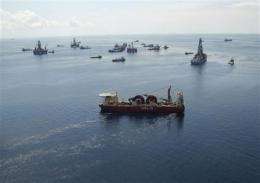
In this Tuesday, Aug. 3, 2010 picture, a support vessel, foreground center, and others surround the Helix Q4000, background center, used to perform the static kill operation, at the site of the Deepwater Horizon Oil Spill in Gulf of Mexico, off the coast of Louisiana. (AP Photo/Gerald Herbert)

(AP) -- Crews finishing work meant to forever stop oil from leaking from a blown-out undersea well into the Gulf may have one more hurdle to overcome: the weather.

The National Hurricane Center is watching a cluster of thunderstorms in the far eastern that forecasters say may pass near the oil spill site, just as BP's drills the final 100 feet of a relief well that it hopes - if the weather holds up - will intersect with the broken one as early as Friday.

The system could blow into a tropical storm, but forecasters don't think it'll turn into a hurricane, and BP hasn't made plans to suspend drilling.

"We are keeping a very close eye on the weather and will adjust if necessary," BP spokesman John Curry said Monday.

Finishing the new well and sealing the broken one with mud and cement should be the final act of the three-month oil spill drama that has upended the lives of fishermen and others along the Gulf Coast.

One man will guide a drill more than two miles beneath the seafloor and three miles from the surface, trying to hit a target less than half the size of a dartboard. The drill is about as wide as a grapefruit.

"It's like being in a hot air balloon 18,000 feet up and hitting a salad plate on your front lawn," said Eric Smith, associate director of the Tulane Energy Institute.

But the man BP has picked to finish the job, John Wright, has hit the mark every time, capping wells across the world in four decades of work.

"Out of 40 relief wells that I've drilled, we've never missed yet. I've got high confidence we will take care of this problem as soon as we can get there," Wright said in a June video put out by BP.

If Wright hits the mark, engineers will perform a "bottom kill" by pouring in mud and cement to permanently seal the blown-out well that's spewed an estimated 207 million gallons since April.

If he misses, engineers will pull the drill bit up, pour concrete in the off-track hole and then try again.

A "static kill" last week pushed mud and cement into the top of the crippled well, leaving very little chance oil could leak into the Gulf again, officials said.

The government's point man for the spill, retired Coast Guard Adm. Thad Allen, is planning a three-day trip to Louisiana, Mississippi and Alabama this week to talk with local officials about how to speed up cleanup as the peak of hurricane season approaches.

Oil spill costs continue to mount for BP. The oil giant announced Monday it has spent $6.1 billion responding to the spill since the April 20 explosion on the Deepwater Horizon killed 11 workers, sending the rig to the bottom of the sea and oil spewing 5,000 feet underwater.

Also, the Justice Department and BP announced they have finished negotiations to implement a $20 billion fund for victims of the Gulf oil spill and that BP has made a $3 billion initial deposit.

©2010 The Associated Press. All rights reserved. This material may not be published, broadcast, rewritten or redistributed.


Rank not rated yet
Related Stories
Relevant PhysicsForums posts
  • Discrepancy between oxygen and carbon-dioxide levels
    created16 hours ago
  • where gems are found in the world
    created19 hours ago
  • Wind Waves in Reservoir ~ Wind run-up and Wind set-up
    createdFeb 08, 2012
  • Balance of oxygen in the atmosphere
    createdFeb 01, 2012
  • The case for a methanol-based economy
    createdJan 30, 2012
  • Weather in a rotating cylinder
    createdJan 25, 2012
  • More from Physics Forums - Earth

More news stories

Could Venus be shifting gear?

(PhysOrg.com) -- ESA’s Venus Express spacecraft has discovered that our cloud-covered neighbour spins a little slower than previously measured. Peering through the dense atmosphere in the infrared, the ...

Space & Earth / Space Exploration

created 4 hours ago | popularity 5 / 5 (4) | comments 6 | with audio podcast

Humans may have helped the decline of African rainforests 3000 years ago

(PhysOrg.com) -- Large areas of rainforests in Central Africa mysteriously disappeared over three thousand years ago, to be replaced by savannas. The prevailing theory has been that the cause was a change ...

Space & Earth / Environment

created 8 hours ago | popularity 5 / 5 (3) | comments 8 | with audio podcast report

Mars Science Laboratory computer issue resolved

(PhysOrg.com) -- Engineers have found the root cause of a computer reset that occurred two months ago on NASA's Mars Science Laboratory and have determined how to correct it.

Space & Earth / Space Exploration

created 5 hours ago | popularity 5 / 5 (5) | comments 3 | with audio podcast

Clam fields found at deep, low-temperature Mariana vents

(PhysOrg.com) -- Scientists have marveled at the unusual life forms thriving at high temperature hydrothermal vents of the deep ocean.

Space & Earth / Earth Sciences

created 4 hours ago | popularity not rated yet | comments 0 | with audio podcast

Two new moons for Jupiter

Advances in technology have lead to the discovery of new planets outside of our Solar System, and now even new moons in our own backyard.

Space & Earth / Space Exploration

created 4 hours ago | popularity not rated yet | comments 2


Hovering not hard if you're top-heavy, researchers find

Top-heavy structures are more likely to maintain their balance while hovering in the air than are those that bear a lower center of gravity, researchers at New York University's Courant Institute of Mathematical Sciences ...

Grass to gas: Researchers' genome map speeds biofuel development

Researchers at the University of Georgia have taken a major step in the ongoing effort to find sources of cleaner, renewable energy by mapping the genomes of two originator cells of Miscanthus x giganteus, a large perenn ...

Drug halts organ damage in inflammatory genetic disorder

A new study shows that Kineret (anakinra), a medication approved for the treatment of rheumatoid arthritis, is effective in stopping the progression of organ damage in people with neonatal-onset multisystem inflammatory disease ...

Cochlear implants may be safe, effective for organ transplant patients

Cochlear implants may be a safe, effective option for some organ transplant patients who've lost their hearing as an unfortunate consequence of their transplant-related drug regime, researchers report.

Researchers develop new method for creating tissue engineering scaffolds

Researchers at Northwestern University have developed a new method for creating scaffolds for tissue engineering applications, providing an alternative that is more flexible and less time-intensive than current technology.

Molecular profiling reveals differences between primary and recurrent ovarian cancers

There is a need to analyze tumor specimens at the time of ovarian cancer recurrence, according to a new study published in Molecular Cancer Therapeutics. Researchers used a diagnostic technology called molecular profiling to examine ...