Mosasaur fossil at Natural History Museum of L.A. County re-explores 85-million-year-old sea monster
August 10, 2010
Mosasaur fossil at Natural History Museum of L.A. County re-explores 85-million-year-old sea monster

Enlarge

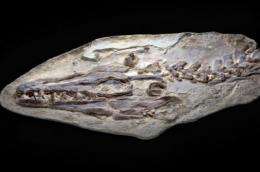
The Natural History Museum of Los Angeles County's mosasaur fossil contains four slabs, which make up a virtually complete, 20-foot specimen. Pictured here is the skull portion of the specimen. Credit: Courtesy of the Dinosaur Institute, NHM

One of the ocean's most formidable marine predators, the marine mosasaur Platecarpus, lived in the Cretaceous Period some 85 million years ago and was thought to have swum like an eel. That theory is debunked in a new paper published today in the journal PLoS ONE. An international team of scientists have reconceived the animal's morphology, or body plan, based on a spectacular specimen housed at the Natural History Museum of Los Angeles County.

The paper was co-authored by a team of four scientists: Johan Lindgren (Lund University, Lund, Sweden), Michael W. Caldwell, Takuya Konishi (University of Alberta, Edmonton, Alberta, Canada), and Luis M. Chiappe, Director of the Natural History Museum's Dinosaur Institute.

The mosasaur specimen was discovered in Kansas in 1969, and acquired by the NHM shortly thereafter. It contains four slabs, which make up a virtually complete, 20-foot specimen. Dr. Chiappe spurred a modern preparation of the specimen, and assembled the paper's research team. "It is one of several exceptional fossils that will be featured in Dinosaur Mysteries," said Chiappe, curator of the 15,000-square foot landmark exhibition that opens at the museum in 2011.
Mosasaur fossil at Natural History Museum of L.A. County re-explores 85-million-year-old sea monster
Enlarge

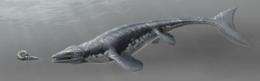
One of the ocean’s most formidable marine predators, the mosasaur Platecarpus, lived in the Cretaceous Period some 85 million years ago and was thought to have swum like an eel. Mosasaurs were lizard-like in appearance and known for their ferociousness. Credit: Illustration by Stephanie Abramowciz, NHM Dinosaur Institute

In the meantime, the fossil will be temporarily on display at the museum's Dino Lab, a working lab located on the second floor of the museum, where paleontologists prepare fossils in full view of the public.

The specimen is "the finest preserved mosasaur in existence," according to Dr. Johan Lindgren, lead author of the published study. It retains traces of a partial body outline, putative skin color markings, external scales, a downturned tail, branching bronchial tubes, and stomach contents (fish).

Using it, the scientists demonstrate that a streamlined body plan and crescent-shaped tail fin were already well established in Platecarpus, and that these key features evolved very early in the evolution of mosasaurs. Noting the highly specialized tail fin, the new study assert that mosasaurs were better swimmers than previously thought — and that they swam more like sharks than eels.

The findings underscore how these adaptations for fully aquatic existence evolved rapidly and convergently in several groups of Mesozoic marine reptiles, as well as in extant whales. "This fossil shows evolution in action, how a successful design was developed time after time by different groups of organisms adapting to life in similar environments," said Chiappe. "It highlights once again the potential for new discoveries to challenge well-established interpretations about dinosaurs and other animals that lived with them."

"From this beautifully preserved specimen it seems that advanced, shark like swimming began in mosasaurs millions of years earlier than we previously thought," said Dr. Kevin Padian, a paleontologist at the University of California, Berkeley, not involved in the paper. "This study is the best possible proof that active research by curators and staff is the most essential component of a museum dedicated to educating the public."

Provided by Natural History Museum of Los Angeles County

4.8 /5 (5 votes)  

Rank 4.8 /5 (5 votes)
Related Stories
Relevant PhysicsForums posts
  • Mitosis
    created8 hours ago
  • Stem cell question.
    created9 hours ago
  • Protease cleavage
    created15 hours ago
  • Pertubance in a model
    created22 hours ago
  • Cancer drugs and Alzheimer's, Oh my!
    createdFeb 09, 2012
  • Squishing cells
    createdFeb 09, 2012
  • More from Physics Forums - Biology

More news stories

A frank discussion of the power law and linking correlation to causation

(PhysOrg.com) -- Michael Stumpf a mathematics professor at Imperial College in London, and Mason Porter a lecturer at Oxford have teamed together to write and publish a perspective piece in Science regarding the in ...

Other Sciences / Mathematics

created 22 hours ago | popularity 5 / 5 (4) | comments 8 | with audio podcast report

Employers feel no love for unscrupulous practice of 'service sweethearting'

A new study led by two Florida State University marketing professors finds that some frontline service employees who are rewarded for hikes in customer loyalty and satisfaction also may engage in "service ...

Other Sciences / Economics & Business

created 16 hours ago | popularity 4 / 5 (1) | comments 7

The question of life in the ancient world

There’s a general feeling that we don’t get the Greeks – ancient or modern. Many, including heads of state like Angela Merkel, visibly shake their head in exasperation, rightly or wrongly, at ...

Other Sciences / Archaeology & Fossils

created 21 hours ago | popularity 1.3 / 5 (3) | comments 4

Sonic Cradle lands spot in TED exhibition

A Simon Fraser University graduate student project that melds music, meditation and modern technology has landed a rare spot as an exhibit at TEDActive 2012 in Palm Springs, California this month.

Other Sciences / Other

created 18 hours ago | popularity not rated yet | comments 0

US workers are 'giving away the store,' costing firms billions

Nearly 70 percent of the nation's service employees give away free goods and services – from hamburgers to cable TV – costing companies billions of dollars a year, according to a groundbreaking study.

Other Sciences / Economics & Business

created Feb 09, 2012 | popularity 3.3 / 5 (3) | comments 10


Anonymous knocks CIA website offline (Update)

The website of the Central Intelligence Agency was inaccessible on Friday after the hacker group Anonymous claimed to have knocked it offline.

New error-correcting codes guarantee the fastest possible rate of data transmission

Error-correcting codes are one of the triumphs of the digital age. They’re a way of encoding information so that it can be transmitted across a communication channel — such as an optical fiber o ...

Small modular reactor design could be a 'SUPERSTAR'

(PhysOrg.com) -- Though most of today's nuclear reactors are cooled by water, we've long known that there are alternatives; in fact, the world's first nuclear-powered electricity in 1951 came from a reactor ...

New power source discovered

(PhysOrg.com) -- Researchers at the Massachusetts Institute of Technology (MIT) and RMIT University have made a breakthrough in energy storage and power generation.

The power of estrogen -- male snakes attract other males

A new study has shown that boosting the estrogen levels of male garter snakes causes them to secrete the same pheromones that females use to attract suitors, and turned the males into just about the sexiest ...

Advanced power-grid model finds low-cost, low-carbon future in West

(PhysOrg.com) -- The least expensive way for the Western U.S. to reduce greenhouse gas emissions enough to help prevent the worst consequences of global warming is to replace coal with renewable and other ...