Protein structure reveals how tumor suppressor turns on and off
August 10, 2010
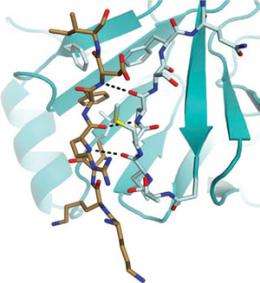
This diagram shows the structural interactions at the binding site between the enzyme protein phosphatase (cyan) and the retinoblastoma protein (brown). Image from Hirschi et al., Nature Structural & Molecular Biology.
(PhysOrg.com) -- New findings by UCSC cancer researchers reveal the molecular mechanisms involved in opening and closing a gate that controls the cycle of cell growth and division.
The retinoblastoma tumor suppressor protein acts like a gate in the cycle of cell growth and division--a gate that stays open in many types of cancer, allowing cells to multiply out of control. New findings by cancer researchers at the University of California, Santa Cruz, reveal the molecular mechanisms involved in opening and closing that gate.
"We really need to understand how these proteins work at a mechanistic level if we're ever going to successfully target them with drugs," said Seth Rubin, assistant professor of chemistry and biochemistry at UC Santa Cruz. "The easiest type of drug to make is one that knocks out a protein function, but in this case you want the protein to function--you want it to be a gate that opens and closes at the right times."
The retinoblastoma protein was already known to be regulated by the addition and removal of phosphate groups. An enzyme called cyclin-dependent kinase adds phosphates (a process called phosphorylation), while another enzyme called protein phosphatase 1 removes them. When the retinoblastoma protein is phosphorylated, the gate is open and the cell cycle proceeds to cell division; the gate closes when the phosphates are removed.
Rubin's team used x-ray crystallography to figure out the three-dimensional structure of the retinoblastoma protein with the phosphatase enzyme bound to it. To their surprise, they found that when the phosphatase attaches to the protein to close the gate, it binds to the same site known to be used by the kinase when it adds phosphates and opens the gate. So the two enzymes are competing for the same "docking site" needed to control the gate.
"It explains how the binding of the phosphatase not only acts to close the gate by removing phosphates, but then keeps the gate closed by blocking access to the docking site so that the kinase can't get on and open the gate," Rubin said.
The researchers reported their findings in the August 8 issue of Nature Structural & Molecular Biology. Alexander Hirschi, a graduate student in molecular, cell, and developmental biology, is the lead author of the paper. Coauthors include Rachel Steinhardt, a graduate student in chemistry and biochemistry, and Matthew Cecchini and Frederick Dick of the London Regional Cancer Program of the Children's Health Research Institute in Ontario, Canada.
Hirschi performed most of the crystallography work involved in determining the protein structure. The researchers then carried out biochemical experiments to show that the two enzymes actually do compete for the same binding site in order to carry out their respective functions. Finally, the UCSC group teamed up with Canadian cancer researchers Cecchini and Dick to perform experiments in living cells.
Laboratory studies in cultured cells confirmed that the regulation of cell growth and division involves competition between kinase and phosphatase for the binding site on the retinoblastoma protein. In one experiment, the researchers used a mutant version of phosphatase unable to perform its normal phosphate-removing function to show that simply by binding to the retinoblastoma protein it was able to block the action of the kinase.
Kinases are already key targets in drug discovery efforts. Understanding the competitive interplay between kinases and phosphatases may help guide those efforts, Rubin said. "This kind of research is necessary to develop a fundamental understanding of these key proteins and may lead to new ways of targeting them," he said.
Provided by University of California - Santa Cruz (news : web)
-
Key enzyme discovered to be master regulator in protein-protein reactions
Mar 24, 2010 |
not rated yet |
0
-
How one virus uses mimicry to replicate successfully
Oct 31, 2007 |
not rated yet |
0
-
Yale scientists map cell signaling network
Nov 30, 2005 |
not rated yet |
0
-
Study reveals the regulatory mechanism of key enzyme
Sep 20, 2007 |
not rated yet |
0
-
Boost for new cancer therapies
Dec 14, 2006 |
not rated yet |
0
-
Engineers build first sub-10-nm carbon nanotube transistor
Feb 01, 2012 |
4.9 / 5 (31) |
30
-
Something old, something new: Evolution and the structural divergence of duplicate genes
Jan 31, 2012 |
4.6 / 5 (7) |
1
-
The hidden nanoworld of ice crystals: Revealing the dynamic behavior of quasi-liquid layers
Jan 30, 2012 |
5 / 5 (3) |
1
-
Stock market network reveals investor clustering
Jan 27, 2012 |
3.9 / 5 (23) |
8
-
Of microchemistry and molecules: Electronic microfluidic device synthesizes biocompatible probes
Jan 26, 2012 |
5 / 5 (1) |
0
-
Is Everyday Technology Killing Us?
Feb 08, 2012
-
Exercise and weight loss
Feb 08, 2012
-
Why do we have head aches? Our brains can't feel anything.
Feb 07, 2012
-
"The end of diseases" by David Agus, interview from Daily Show with Jon Stewart
Feb 04, 2012
-
Oncolytic adenovirus
Feb 04, 2012
-
Nutrition label stuffs and diets
Feb 02, 2012
- More from Physics Forums - Medical Sciences
More news stories
Complex wiring of the nervous system may rely on a just a handful of genes and proteins
Researchers at the Salk Institute have discovered a startling feature of early brain development that helps to explain how complex neuron wiring patterns are programmed using just a handful of critical genes. ...
12 hours ago |
4.9 / 5 (9) |
1
|
Team isolates nerve cells involved in storing long term memory and gene proteins associated with them
(Medical Xpress) -- A research team in Taiwan has succeeded in isolating two nerve cells in fruit fly brains that are believed to be the major players in allowing for the formation of long term memories. Furthermore, ...
Seeing colors in music, tasting flavors in shapes may happen in life's early months
Famed violinist Itzhak Perlman sees a deep forest green whenever he plays a B-flat on his Stradivarius' G string. The A on the E string is red.
Medicine & Health / Psychology & Psychiatry
19 hours ago |
4.5 / 5 (2) |
2
|
Both maternal and paternal age linked to autism
Older maternal and paternal age are jointly associated with having a child with autism, according to a recently published study led by researchers at The University of Texas Health Science Center at Houston (UTHealth).
Medicine & Health / Psychology & Psychiatry
16 hours ago |
4.3 / 5 (3) |
0
|
New understanding of DNA repair could eventually lead to cancer therapy
A research group in the Faculty of Medicine & Dentistry at the University of Alberta is hoping its latest discovery could one day be used to develop new therapies that target certain types of cancers.
16 hours ago |
4.8 / 5 (6) |
0
|
Anonymous knocks CIA website offline (Update)
The website of the Central Intelligence Agency was inaccessible on Friday after the hacker group Anonymous claimed to have knocked it offline.
New error-correcting codes guarantee the fastest possible rate of data transmission
Error-correcting codes are one of the triumphs of the digital age. Theyre a way of encoding information so that it can be transmitted across a communication channel such as an optical fiber o ...
Humans may have helped the decline of African rainforests 3000 years ago
(PhysOrg.com) -- Large areas of rainforests in Central Africa mysteriously disappeared over three thousand years ago, to be replaced by savannas. The prevailing theory has been that the cause was a change ...
New power source discovered
(PhysOrg.com) -- Researchers at the Massachusetts Institute of Technology (MIT) and RMIT University have made a breakthrough in energy storage and power generation.
Small modular reactor design could be a 'SUPERSTAR'
(PhysOrg.com) -- Though most of today's nuclear reactors are cooled by water, we've long known that there are alternatives; in fact, the world's first nuclear-powered electricity in 1951 came from a reactor ...
Google users warned of threat to smartphone wallets
Users of Google smartphone wallets were being warned on Friday that there is a way to crack pass codes intended to thwart thieves from going on illicit shopping sprees.