Rain contributes to cycling patterns of clouds
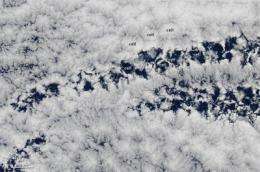
Like shifting sand dunes, some clouds disappear in one place and reappear in another. New work this week in Nature shows why: Rain causes air to move vertically, which breaks down and builds up cloud walls. The air movement forms patterns in low clouds that remain cohesive structures even while appearing to shift about the sky, due to a principle called self-organization.
These clouds, called open-cell clouds that look like honeycombs, cover much of the open ocean. Understanding how their patterns evolve will eventually help scientists build better models for predicting climate change. This is the first time researchers have shown the patterns cycle regularly and why.
"The pattern of the clouds affects how much of the sun's energy gets reflected back into space," said atmospheric scientist Hailong Wang of the Department of Energy's Pacific Northwest National Laboratory, a coauthor on the study led by physicist Graham Feingold at the National Oceanic and Atmospheric Administration.
"We've teased out the fundamental reasons why the open-cell clouds oscillate. Being able to simulate these clouds in computer models, we gain more insights into the physics behind the phenomenon. This will help us to better interpret measurements in the real atmosphere and represent these clouds in climate models," Wang said.
In addition, this is the first time researchers have shown that open-cell clouds follow the principles of self-organizing systems -- they spontaneously form dynamic, coherent structures that tend to repair themselves and resist change. Such clouds join other self-organizing networks such as flocks of birds, shifting sand dunes or bubbles in boiling water.
Convection Imperfection
Open-cell clouds are low, flat clouds that look like a quilt to someone looking down from an airplane. The quilt patches are frames of cloud that are clear in the middle, similar to a honeycomb. These honeycomb clouds develop from atmospheric convection, which is air movement caused by warm air rising and cold air falling.
The white parts of the honeycomb clouds reflect sunshine back into space, but the open spaces let energy through to warm up the planet. Because these clouds cover a lot of the ocean, climate scientists need to incorporate the clouds into computer models.
The simplest explanation for their appearance is what is known as Rayleigh-Benard convection. This classic form of convection can be seen between two horizontal, flat plates separated by a thin liquid layer: Heat up the bottom and warm liquid rises, pushing cold liquid near the top downward. The updrafts and downdrafts mold the liquid into vertical walls. If the bottom heats uniformly, the flow causes the top surface to break up into hexagonal cells, looking like a honeycomb. A honeycomb structure, it turns out, is one of the most effective way to transfer heat.
This occurs on a large scale in our atmosphere from the surface up to a couple kilometers (less than two miles). But the earth's ocean is not a uniform surface and it doesn't warm the atmosphere evenly from below. That's one reason why open-cell clouds do not organize into perfect hexagons.
Also, the atmosphere is much more complex than a laboratory experiment. Other factors interfere with this type of convection such as aerosols, tiny particles of dirt around which cloud drops form. The number of aerosols determines the size of cloud drops and whether to form rain. To test the role of aerosols and rain, the international team led by Feingold at NOAA's Earth System Research Laboratory in Boulder, Colo., used computer simulations and satellite images to explore how open-cell clouds develop and oscillate.
Shifting Showers
First, the team started with a computer model called the Weather Research and Forecasting model, which a team of scientists developed at the National Center for Atmospheric Research in Boulder, Colo. and NOAA. Wang and others improved upon it to study interactions of aerosols and low clouds.
For this study, they simulated fields of honeycomb clouds sitting below one kilometer (about 3/4 of a mile) over the ocean, where they are known as marine stratocumulus clouds. The team fed the clouds with just enough aerosols to produce rain and create the expected honeycomb shapes.
Though the open-cell clouds always looked like a honeycomb, the individual cells deformed and reformed over a couple hours. To determine why they changed in this way, the team took the open-cell clouds and examined air flow and rain along the cell walls.
Strong updrafts coincided with the presence of the thick vertical walls, the scientists found. Over time, however, these regions accumulated enough water to rain, which caused downdrafts. When adjacent downdrafts approached the ocean surface, they flowed outward and collided -- air converged and formed new updrafts. The air in the downdrafts cooled off initially by evaporation of raindrops, but warmed up again near the ocean, starting the updraft cycle again but shifted over in space.
This cycling of falling rain, downdrafts and updrafts caused cloud walls and their cells to disappear but reappear somewhere else in the field. The honeycomb-structure of the clouds remained, but cells shifted in space. The authors call these shifts oscillations in open cells.
The Real World
The team then looked at satellite images of real clouds. They used pictures of cloud fields at different times and corrected for them being blown about by wind flowing horizontally. Over time, they saw bright white spaces replaced by dark empty ones, and again replaced by bright whiteness. The team's computer model had replicated these oscillating light-dark cycles.
Wind and rain measurements also supported the simulation. Instruments on a ship on the ocean measured wind up to one kilometer high. The data showed outflows from rain in different parts of the sky collide at the ocean surface and flow back up. Instruments that measured precipitation showed periodic rainfall that coincided with the shifting cloud pattern.
Taken together, the set of experiments showed that rain causes open-cell clouds to form spontaneously, oscillate in the sky and resist change in the overall pattern. These are three characteristics of complex systems that self-organize and form a cell structure, such as flocks of birds or bubbles on a boiling surface.
More information: Graham Feingold, Ilan Koren, Hailong Wang, Huiwen Xue, and Wm. Alan Brewer, Precipitation-generated oscillations in open cellular cloud fields, Nature, August 12, 2010. DOI 10.1038/nature09314
Provided by DOE/Pacific Northwest National Laboratory


