Evidence of new solar activity from observations of aurora in New Zealand
August 13, 2010
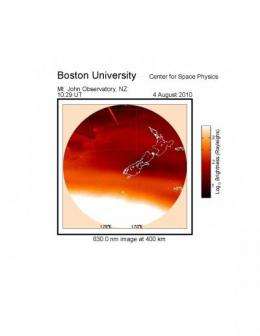
This is an all-sky view of the upper atmosphere as photographed in the red light (630.0 nm) of oxygen from the Mt. John Observatory in New Zealand. This fish-eye lens image displays emissions from a height of 400 km above the Earth’s surface (features in upper left are buildings obstructing view to northwest). Just below the lower coast of South Island, the faint emission extending west-to-east is called a Stable Auroral Red (SAR) arc, a manifestation of oxygen atoms heated by hot electrons in the ionosphere. The brightness levels (about 300 Rayleigh units) are ten to twenty times fainter than can be seen by the naked eye. Further to the south, the area colored white is a brighter form of red emission called Diffuse Aurora, produced by in influx of electrons from the magnetosphere; it is still invisible to the unaided eye, but only by factors of two to three. Strong visible aurora, the familiar "curtains of red and green emission" would be still further toward the South Pole, beyond the field of view shown. This Boston University image of sub-visual aurora at mid-latitudes is the first unambiguous case of a SAR arc in the Southern Hemisphere during the new cycle of solar activity. Credit: Boston University Center for Space Physics
Scientists from Boston University's Center for Space Physics (CSP) announced that they have sub-visual evidence of the onset of a new cycle of solar-terrestrial activity. The key results being reported deal with the fact that recent auroral displays at high latitudes (ones visible to the naked eye) were accompanied by far less luminous glows in the atmosphere at lower latitudes.
"It's exciting to see the return of aurora to mid-latitudes," Dr. Steve Smith said, referring to the periodic occurrence of emissions in the Earth's atmosphere that have intrigued observers from ancient to modern times.
What has fascinated space scientists in recent years is the delayed onset of such effects. Typically, the Sun has an activity cycle of about 11 years, with flares and ejections of electrically charged particles (called the solar wind) that cause changes in the Earth's magnetic field that produce, as a side product, luminous emissions in the atmosphere. Such effects are subdued during so-called solar minimum years (e.g., in 1996-1997) and very prominent in solar maximum years (e.g., 2001-2002). Thus, the onset of a new wave of such activity had been expected to be well underway by 2009, but the Sun remained surprisingly quiet. Now, in 2010 there are finally signs of the cycle re-appearing.
The observations made by the BU team used an all-sky camera located at the Mt. John Observatory in Lake Tekapo, New Zealand. "This is essentially a fish-eye lens that is used to view the full sky, and the images are captured with a very sensitive digital CCD camera," explained Jeffrey Baumgardner, who designed and built the instrument.
Smith, who was born in New Zealand and is now a Senior Research Scientist in the BU Center for Space Physics, explained that "The emissions we study come from regions ranging from 200-400 km (125-250 miles) above the surface. These gases are caused to glow by energy input from above, energy that flows downward along the Earth's magnetic field lines."
The curtains of glowing gasses capable of being seen by the human eye are long been called aurora borealis when near polar regions in the northern hemisphere, and aurora australis in southern polar regions. In the accompanying image, the emissions observed come from regions more distant from the poles than where classic aurora occur. These emissions are below naked eye detection limits. The brighter feature far to the south that is captured by the CCD camera is not an example of the classically narrow and dynamic curtain aurora, but of emission far more diffuse in space. They are caused by a steady influx of electrons that hit oxygen atoms and excite them to glow in a typically red light. Separated from it, is an even fainter arc that extends from east to west just south of New Zealand, again captured in the red glow of oxygen atoms. This emission is due to collisions between hot electrons and oxygen atoms in the Earth's ionosphere. Such features are called Stable Auroral Red (SAR) arcs and form an active topic of current research in space physics.
"This image of a SAR arc from New Zealand is perhaps the first-ever case of imaging an unambiguous SAR arc in the southern hemisphere," said Michael Mendillo, Professor of Astronomy at BU.
SAR arcs show where energy from the Van Allen Radiation Belts of electrically charged particles trapped in the Earth's magnetosphere deposits heat into the ionosphere. The narrow dimension of a SAR arc shows that the energy input is confined to a small extent (100 km or 60 miles) in latitude, but in bands that can extend completely around the globe in longitude.
"We fully expect that a similar SAR arc occurred in the northern hemisphere, but it was cloudy at our observatory in Boston that night, and so one was not seen," Smith explained. "We hope in the years ahead to have many cases of SAR arcs in our data from both hemispheres, and then examine the full global distribution of such effects," he added. "Looking to see if the energy input is simultaneously the same or different in each hemisphere is a forefront topic in the study of solar-induced storms in our upper atmosphere."
Provided by Boston University Medical Center
-
Image: Aurora Australis Observed from the International Space Station
Jun 23, 2010 |
not rated yet |
0
-
Cluster takes first look at acceleration processes driving aurora
Apr 13, 2010 |
not rated yet |
0
-
Chandra probes high-voltage auroras on Jupiter
Mar 02, 2005 |
not rated yet |
0
-
Autonomous Antarctic Observatories Gather Space Weather Data
Apr 09, 2009 |
not rated yet |
0
-
Aurora alert: The Sun is waking up (w/ Video)
Aug 02, 2010 |
not rated yet |
0
-
Engineers build first sub-10-nm carbon nanotube transistor
Feb 01, 2012 |
4.9 / 5 (30) |
30
-
Something old, something new: Evolution and the structural divergence of duplicate genes
Jan 31, 2012 |
4.6 / 5 (7) |
1
-
The hidden nanoworld of ice crystals: Revealing the dynamic behavior of quasi-liquid layers
Jan 30, 2012 |
5 / 5 (3) |
1
-
Stock market network reveals investor clustering
Jan 27, 2012 |
3.9 / 5 (23) |
8
-
Of microchemistry and molecules: Electronic microfluidic device synthesizes biocompatible probes
Jan 26, 2012 |
5 / 5 (1) |
0
-
Titan's lack of impact craters
21 hours ago
-
Real pictures of black hole eating a star?
Feb 08, 2012
-
Hypothetical way to travel faster than light, but not technically exceed lightspeed
Feb 06, 2012
-
How do scientists monitor the Sun's activity?
Feb 05, 2012
-
Search patterns in observational studies
Feb 05, 2012
-
Derivation of Pogson's law
Feb 03, 2012
- More from Physics Forums - General Astronomy
More news stories
Mars Science Laboratory computer issue resolved
(PhysOrg.com) -- Engineers have found the root cause of a computer reset that occurred two months ago on NASA's Mars Science Laboratory and have determined how to correct it.
Space & Earth / Space Exploration
43 minutes ago |
5 / 5 (1) |
1
|
Clam fields found at deep, low-temperature Mariana vents
(PhysOrg.com) -- Scientists have marveled at the unusual life forms thriving at high temperature hydrothermal vents of the deep ocean.
Space & Earth / Earth Sciences
18 minutes ago |
not rated yet |
0
|
Streams need trees to withstand climate change
(PhysOrg.com) -- More than twenty years of biological monitoring have confirmed the importance of vegetation for protecting Australia's freshwater streams and rivers against the ravages of drought and climate ...
27 minutes ago |
not rated yet |
0
The turbulent birth of super star clusters in galaxy mergers
By combining two of the most advanced telescopes in the world -- the new Atacama Large Millimeter Array (ALMA) and the Very Large Telescope (VLT) of ESO -- a team of French astronomers from the Institut d'astrophysique ...
9 minutes ago |
not rated yet |
0
Putin receives 'prehistoric' water from Antarctic lake
Prime Minister Vladimir Putin was given a water sample Friday taken from a pristine lake hidden under Antarctic ice for over a million years, after Russian scientists drilled down to its surface.
Space & Earth / Earth Sciences
49 minutes ago |
5 / 5 (1) |
0
A frank discussion of the power law and linking correlation to causation
(PhysOrg.com) -- Michael Stumpf a mathematics professor at Imperial College in London, and Mason Porter a lecturer at Oxford have teamed together to write and publish a perspective piece in Science regarding the in ...
Advanced power-grid model finds low-cost, low-carbon future in West
(PhysOrg.com) -- The least expensive way for the Western U.S. to reduce greenhouse gas emissions enough to help prevent the worst consequences of global warming is to replace coal with renewable and other ...
Small modular reactor design could be a 'SUPERSTAR'
(PhysOrg.com) -- Though most of today's nuclear reactors are cooled by water, we've long known that there are alternatives; in fact, the world's first nuclear-powered electricity in 1951 came from a reactor ...
Seeing colors in music, tasting flavors in shapes may happen in life's early months
Famed violinist Itzhak Perlman sees a deep forest green whenever he plays a B-flat on his Stradivarius' G string. The A on the E string is red.
The question of life in the ancient world
Theres a general feeling that we dont get the Greeks ancient or modern. Many, including heads of state like Angela Merkel, visibly shake their head in exasperation, rightly or wrongly, at ...
Study suggests girls can 'rewire' brains to ward off depression
(Medical Xpress) -- What if you could teach your brain to respond differently to things that make you feel sad, down or stressed out? What if doing that helped ward off depression?